





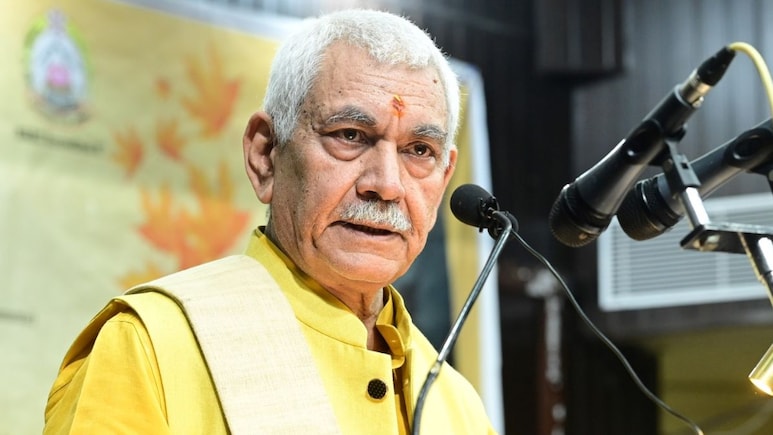
- Kashmir Literature Festival called to erase colonial mindset and reclaim India's true history
- Lieutenant Governor Manoj Sinha urged restoring history and sharing it with all society sections
- Sinha highlighted India's ancient contributions to science, math, and astronomy predating others
The Kashmir Literature Festival began today with a call for erasing every trace of the colonial mindset and reclaiming India's "real history".
The two-day mega festival was inaugurated by Jammu and Kashmir Lieutenant Governor Manoj Sinha, who called for an urgent need to restore history and convey its true form to every section of society so that India's narrative is properly shaped. "Our ancestors, since the Vedic age, recorded facts and transmitted knowledge with great accuracy, but for various reasons modern times saw India lose the habit of writing its own history," said Sinha.
"We failed to communicate our priceless traditions, culture, knowledge, and sciences, and that's why many people claim that certain things came from other places or were introduced by the invaders. These assertions are baseless," he added.
Sinha emphasised the importance of accurately representing India's "real history" and urged writers to correct historical distortions and present the truth to global audiences.
"We must erase every trace of the colonial mindset and ensure that people abroad do not distort our history and present to serve their own narratives. It is the responsibility of writers to correct such errors and take the truth to global readers," said Sinha.
He said that modern India has failed to accurately document and preserve its past, "which has led to narratives that unfairly credit Persia or the Mughals for India's scientific and intellectual achievements".
Sinha underscored India's foundational contributions to mathematics, science, and astronomy, citing Persian and Arab texts from the eighth century that acknowledge these accomplishments.
"We must repeatedly remind the world that when the Vedas were composed some 6,000 years ago, India was the centre of the world's economy, education, culture, and philosophy. For centuries, India was the engine of global civilisation and culture. It laid the foundations for socio-economic advancement across the world through its gift in science, mathematics, astronomy, and medicine," he said.
Sinha said that foreign historians have, sometimes deliberately, omitted India's ancient discoveries and achievements in science, literature, art, and architecture.
"When India stood at the peak of scientific achievement, many countries showed almost no mention of science. The earliest references to science, mathematics, and astronomy in Persia and other places appear only in the eighth century, and even those owe much to India. Europe's first Renaissance in the 12th century drew on India's treasury of knowledge, science, culture, and art. Centuries before any other countries discovered inventions and innovations, India had already established itself as a scientific civilisation," he said.
Track Latest News Live on NDTV.com and get news updates from India and around the world

