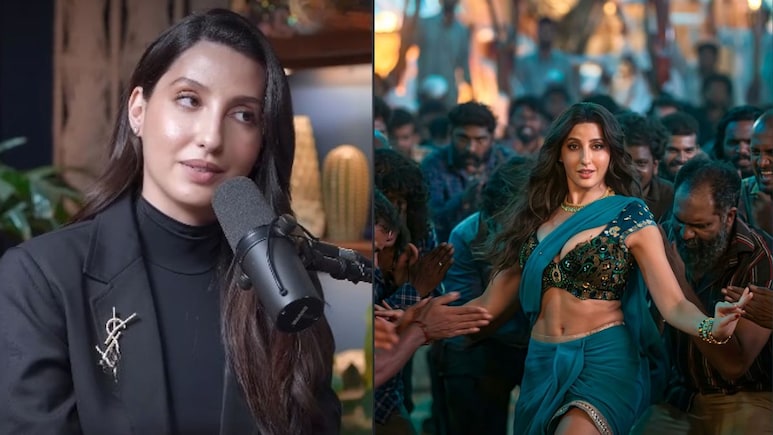
"I think feminism really fu**ed up our society."
On April 10, 2024, Nora Fatehi sat for an interview with the podcaster Ranveer Allahbadia, dressed in a sharply tailored black coat, pinned with a YSL brooch. A look borrowed from what has historically been men's fashion, and one that exists in her wardrobe today because women fought for the right to wear what they want. And yet, in that same breath, she delivered one of her most controversial takes yet.
One of them was her belief that feminism ruined society.
She didn't stop there.
"I don't believe in feminism at all... I think feminism fu**ed up our society completely," she said. She went on to argue that men and women are not equal in "societal things", insisting that men should be "providers and breadwinners" while women should be "nurturers... mothers... taking care of the house, cooking".
She framed feminism as something that had gone "radical", comparing it to religion that becomes dangerous when extreme. According to her, the last "15 to 20 years" of feminism have harmed families, children, and even women's mental health.
And perhaps most tellingly, she added, "If you're bringing to the table money, food, shelter... I need to bring to the table kids, being a mother, taking care of the house."
We've heard this before. Dressed up as "traditional values". Packaged as "biological truth". Sold as "balance".
And now two years later, it looks like Nora and feminism are back in the conversation, but this time, she needed feminism (more on that later).
But let's pause and ask the obvious question.
What Exactly Is Feminism?
Let's fact-check Nora.
At its core, feminism is not a rejection of family, men, or motherhood. It is the belief that women deserve equal rights, equal opportunities, and equal agency over their own lives.
That's it.
The right to vote. The right to education. The right to work. The right to leave abusive marriages. The right to choose motherhood, or not.
None of this dismantles society. In fact, it builds it.
Globally, data consistently shows that when women are educated and employed, economies grow faster, child mortality drops, and families become more financially stable. In India, female literacy and workforce participation have been directly linked to improved health outcomes and household incomes.
So when Nora claims feminism has "ruined" society, what she is really critiquing is not feminism, but a distorted version of it.
Feminism Vs Misandry, And Why People Confuse The Two
A pattern we keep seeing is this: many who call themselves "anti-feminist" are not actually opposing feminism. They are reacting to misandry.
Misandry is the hatred of men. Feminism is the demand for equality.
They are not the same.
But here's the uncomfortable truth. Misandry did not emerge in a vacuum. It is, in many ways, a reaction to centuries of patriarchy. Systems where women were denied property rights, autonomy, safety, and even basic dignity.
When you suppress a group long enough, anger is inevitable. That anger may sometimes take the wrong shape. But to blame feminism for it is like blaming medicine for the existence of disease. This backlash fueled new derogatory terms for outspoken women who live by their own rules: a tactic to slow them down. Labels like 'Feminazi' emerged to mock those who fiercely championed their rights
And Then, Something Changed
For someone so firm in her stance, something shifted.
Fast forward to 2026, and Nora found herself at the centre of a controversy that ironically underlined exactly why feminism exists.
Her song Sarke Chunar Teri Sarke from the film KD: The Devil sparked massive backlash over its sexually suggestive lyrics. Lines interpreted as crude double meanings triggered outrage across social media and industry circles.
All versions of the song were eventually taken down after complaints citing obscenity laws, and the issue escalated to national bodies, including the National Commission for Women.
Nora distanced herself quickly.
She claimed she had shot the song years ago in Kannada, had no knowledge of the Hindi lyrics, and did not approve their use.
"I would hate for anyone to think I endorse this," she said, adding that artists often have little control and that her "image and reputation" were put at risk without consent.
She even thanked the backlash, saying it forced filmmakers to take accountability.
And then came the comments.
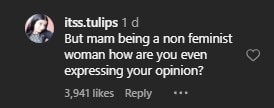
Users mocked her previous stance on feminism. One wrote, "Being a non-feminist woman, how are you even expressing your opinion?" Another sarcastically added, "Patriarchy doesn't allow that."
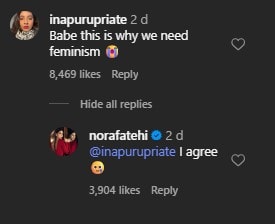
But one comment and Nora's reply stood out: "This is why we need feminism."
Nora replied: yes, I agree.
The Return
Nora's return to need feminism says everything. In that moment, the conversation came full circle.
The same industry dynamics she criticised, the lack of control, the use of her image without consent, the need to hold powerful creators accountable, these are precisely the issues feminism has been fighting against for decades.
The right to agency. The right to consent. The right to not be reduced to an object in someone else's narrative.
What This Shift Really Reflects
This isn't just about one celebrity changing her mind.
It reflects a larger pattern. Many dismiss feminism when it feels abstract. When it challenges comfort. When it comes to traditional roles.
But the moment inequality becomes personal, when your voice is ignored, your consent bypassed, your image used without permission, feminism suddenly makes sense.
And perhaps that's the irony of it all.
Feminism isn't something you "believe in" when it's convenient. It is something that works in the background, giving you choices you didn't even realise you had.
Including the choice to reject it.
And sometimes, the journey back to it.
(These are the personal views of the author)
READ MORE: Nora Fatehi Song In Hindi Banned Over Vulgar Lyrics. It Is The Same In All Other Languages
Track Latest News Live on NDTV.com and get news updates from India and around the world
