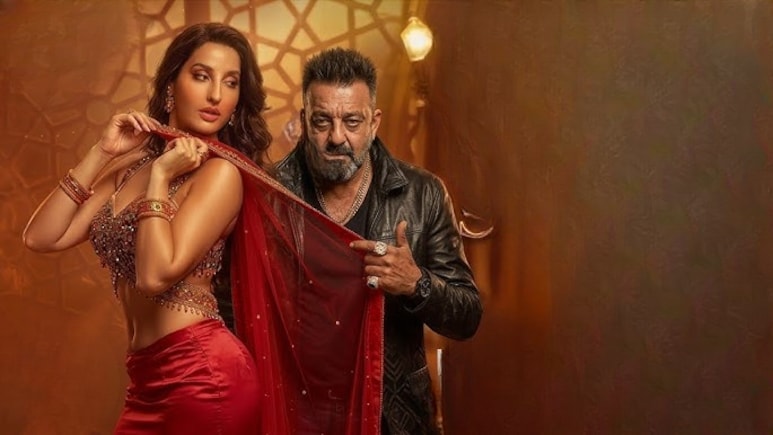
It started like just another big-ticket dance number. But within hours of release, Nora Fatehi's latest track found itself at the centre of a storm that refused to quiet down.
What followed was not just outrage, but a full-blown takedown.
What Exactly Happened
The Hindi version of Sarke Chunar Teri Sarke, featuring Nora Fatehi and Sanjay Dutt from the upcoming film KD: The Devil, has been removed from platforms after massive backlash and a formal complaint to the Central Board of Film Certification.
The song, released by KVN Productions on March 14, was initially part of a multi-language rollout. While the Hindi version has now been taken down, versions in Kannada (the original), Tamil, Telugu and Malayalam continue to stay online, untouched.
The complaint, filed today (March 17) by advocate Vineet Jindal and marked to the Ministry of Information and Broadcasting, alleged that the song's lyrics and visuals were "highly vulgar, sexually suggestive, and obscene", raising concerns about their easy accessibility to minors. Legal provisions under the Bharatiya Nyaya Sanhita, the Protection of Children from Sexual Offences Act, and the Information Technology Act were also cited.
What People Said Online
If the makers expected a typical dance-number reception, X had other plans.
Within minutes of the song dropping, users began calling it out for crossing the line. "Nora Fatehi's new song has crossed all limits of vulgarity!!" read one post.
Sarke sarke's lyrical song is "CHEAP" and "VULGAR"
— MR. X (@Krish_RC_) March 16, 2026
• Lyrics like “ Lift me up, put it inside, don't let even a single drop come out, empty it inside” are among the most vulgar ever heard in an Indian song.
• What kind of message does this send to young audiences ?
• Soon… pic.twitter.com/G1BFKmYUjS
Another questioned the system itself: "Is there even a censor board in India? How are such songs allowed to go mainstream?"
There was also concern about its cultural ripple effect. "One of the most vulgar lyrics ever produced in India. What effect will this have on the youth?" wrote a user, pointing to how quickly such songs become Reel trends and enter everyday spaces.
The criticism wasn't just about choreography. The lyrics, many said, were the real issue.
The result? The Hindi version was pulled down.
The Hindi version of the song was pulled down
But Here's The Thing
(Disclaimer: The following lyrics contain words and phrases that might be disturbing to some. Reader discretion is advised.)
While the Hindi version bore the brunt of the outrage, the story does not quite end there.
All the other versions of the song are still very much alive. And more importantly, the meaning across languages remains almost the same.
We looked at the lyrics across versions and used AI tools to break them down. The phrasing may differ, the words may change, but the core meaning does not. It is consistent across Kannada, Tamil, Telugu and Malayalam.
We are not spelling it out here; you can look at the photos for that, but the takeaway is simple: the issue is not limited to just one language.
Here's a translation of the Kannada (the original) version of the "Jaripey Naatho Pandaga", according to Perplexity:
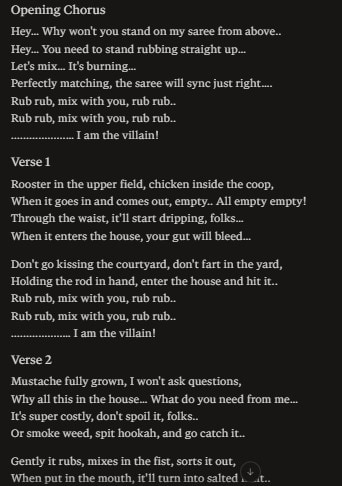
Kannada version, verse 1
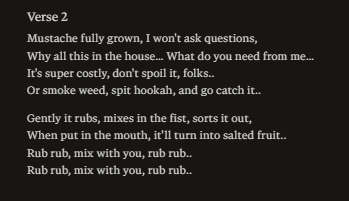
Here's a direct English translation of the Telugu lyrics, according to Perplexity:
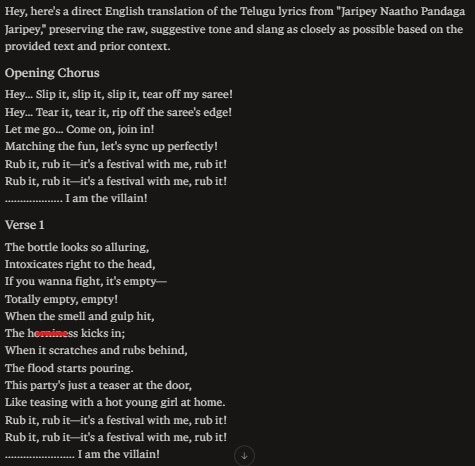
The Telugu version
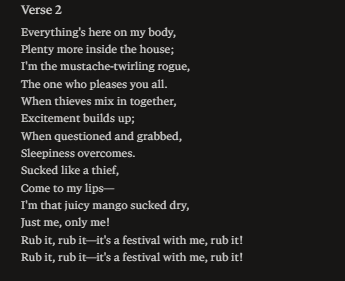
Telugu version, verse 2
Now, let's do the same for the Tamil version:
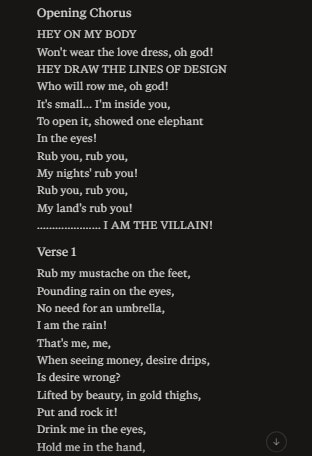
Tamil version, verse 1
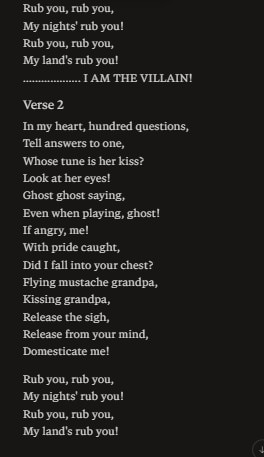
The Tamil version, verse 2
The Malayalam version (translated), according to AI:
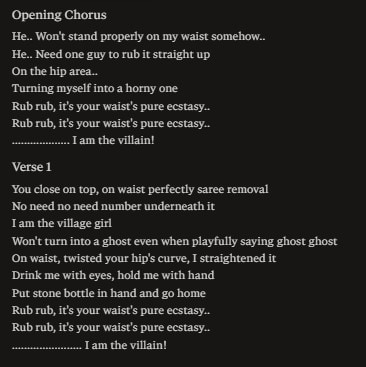
The Malayalam version
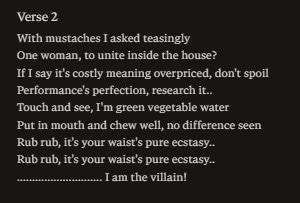
Malayalam version, verse 2
What's In The Name
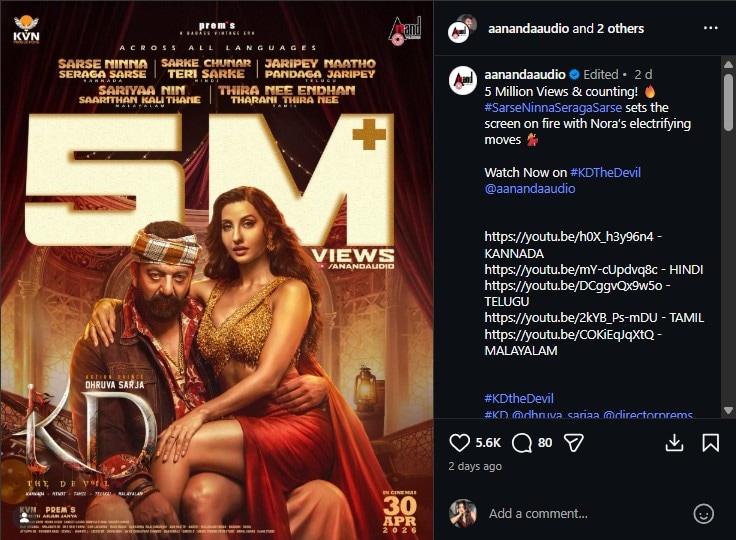
Even as the Hindi version disappears, promotion for the other versions of the song, with different names and languages, has not slowed down.
Anand Audio, an Indian music record label company based in Karnataka, which is behind the song, recently shared on Instagram that one of the regional versions has crossed 10 million views on YouTube.
The film's director (who wrote the song, btw) and composer have also continued to post about the song on their Instagram stories, celebrating its reach.
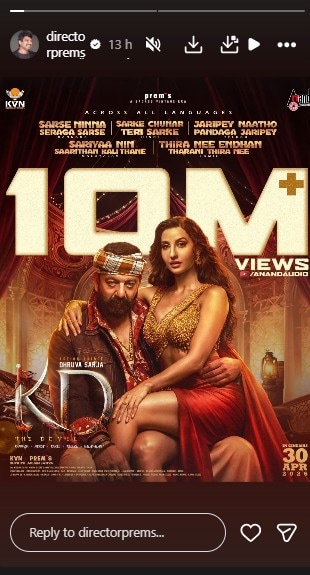
So, while one version is under scrutiny, the larger campaign seems to be moving ahead without pause.
"This Is Not My Creation": The Hindi Lyricist On The Backlash
Lyricist Raqueeb Alam, who has been facing a significant share of the criticism online as the lyricist, addressed the controversy in an interview with Variety. He also took to Instagram to clarify this.
"The song has been written in Kannada by the director, and he told me to do a translation. It is not my creation."
He also admitted his own discomfort with the material.
"I have written five more songs for the movie. I refused to write this, but he told me to just fit in Hindi words, which he would put in the meter of the song. Now, I found out that I have been credited as a lyricist for the Hindi version. I am planning to reach out to them," he said in the interview.
Acknowledging public sentiment, he added, "I know it is a bit excessive."
Moreover, it looks like the director anticipated the controversy. According to an exclusive interview with NDTV, the lyricist said, "I translated it word for word because the film's director, Prem, wasn't agreeing. He told me to translate it into Hindi exactly as it was written in Kannada. I translated it and also said that a song like this wouldn't pass the censors. But Prem said he would see what to do. But the director wanted controversy. He included the translated song in the film as it was, and now the result is in front of you."
So, Wrote The Original Song?
Alam's clarification points to something crucial: the Hindi version is not the original.
The song was first written in Kannada as Sarse Ninna Seraga Sarse, for KD: The Devil. According to the official YouTube credits from the Kannada version and Alam's interview, the lyrics were written by Kiran Kumar (stage name Prem), who is also the director of the film.
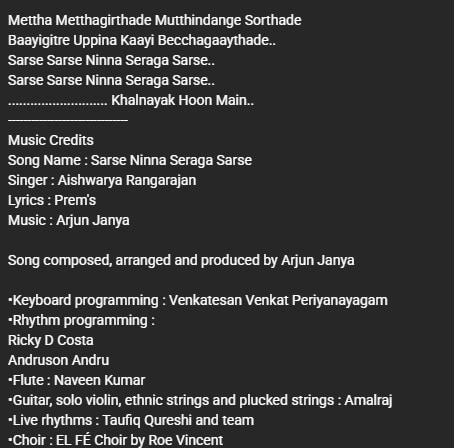
According to YouTube, the lyrics are 'Prem's'
The track is sung by Aishwarya Rangarajan, with music composed and produced by Arjun Janya.
Which essentially means the version that sparked outrage in Hindi is a translated adaptation of an already existing song.
Why The Song Is A Problem
Cinema has never been unfamiliar with double meanings. From cheeky wordplay to outright suggestiveness, there has always been space for adult humour in music.
But there was also a balance.
There were songs for children, family films, and clearly defined spaces for different kinds of content. That balance now feels blurred. With fewer films being made specifically for younger audiences, and the Internet placing everything just a click away, the lines have thinned.
The result is visible. Children today are not just exposed to, but often seen dancing to, the same item numbers that were once considered adult territory, including several of Nora Fatehi's previous hits.
