





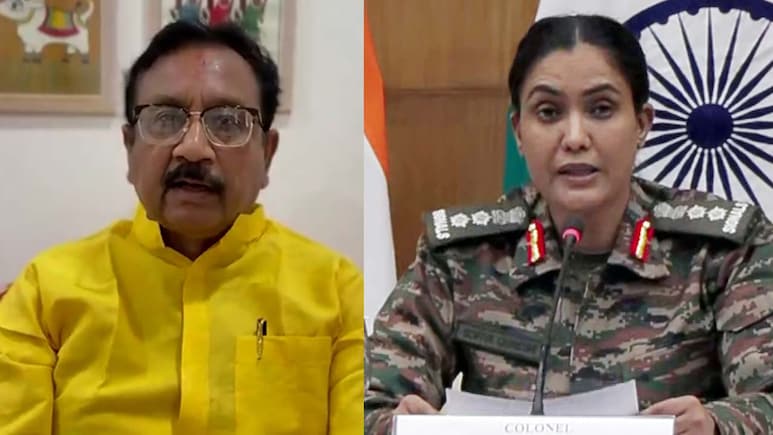
The Madhya Pradesh government is preparing to defend before the Supreme Court its decision not to grant sanction for the prosecution of senior cabinet minister Kunwar Vijay Shah over his controversial remarks concerning Army officer Colonel Sofiya Qureshi.
The state government's response is expected to be filed before the Supreme Court in the coming days after scrutiny by legal experts, the Chief Secretary and the Chief Minister's Office. At the centre of the reply is a five-point defence explaining why the Cabinet believes there are not sufficient grounds to prosecute Shah.
The government's first argument is that no individual came forward to lodge a complaint against Vijay Shah after the controversial statement. It is expected to tell the Supreme Court that despite the political and public controversy surrounding the remarks, there was no private complainant seeking criminal action against the minister.
Read: Madhya Pradesh Governor Backs Move To Deny Probe Sanction Against Minister
The second argument is that Shah did not mention Colonel Sofiya Qureshi by name in his statement. The government also maintains that the minister did not intend to insult Colonel Qureshi or any other individual through his remarks.
The state is also relying heavily on Shah's apologies. According to the government's proposed response, Shah apologised three times and also expressed regret in writing. The Cabinet has taken the position that these repeated apologies should be considered while deciding whether criminal prosecution is warranted.
The government has further described the episode as a human error. Its case is that, given the circumstances, Shah's repeated expressions of regret and the absence of what it considers deliberate intent, there is not a sufficient basis to grant sanction for prosecution.
Another key part of the government's defence is its contention that Shah's statement did not disturb communal harmony. The state is expected to argue that there was neither any actual disruption of communal peace nor any intention on the minister's part to create such a disturbance.
The Cabinet headed by Chief Minister Mohan Yadav had on August 25 decided against granting sanction to prosecute Shah. The recommendation was subsequently sent to Governor Mangubhai Patel, who approved the Cabinet's decision. The government will now place these arguments before the Supreme Court.
But beyond the legal reasoning being prepared for court lies an unavoidable political question. Why is the government so reluctant to act against Vijay Shah?
The answer lies in Shah's unusual political weight within the BJP and in Madhya Pradesh's tribal politics.
Vijay Shah is not an ordinary minister. He has won eight consecutive Assembly elections since 1990 and has remained a fixture in Madhya Pradesh politics for more than three decades. Across eight terms as an MLA, he has served in governments from the Uma Bharti era to the present Mohan Yadav administration.
Over the years, Shah has handled five different portfolios. He has headed the Tribal Welfare Department three times and the Forest Department twice. He has also held charge of School Education, Tourism and Culture, and Food and Civil Supplies.
That longevity in government has been matched by deep political influence on the ground.
Shah is a scion of the Makrai royal family and belongs to the Rajgond clan. He is considered one of the BJP's most prominent tribal faces in Madhya Pradesh, particularly among Gond voters.
That social base is politically crucial. Scheduled Tribes account for around 22 percent of Madhya Pradesh's population. The state has 47 Assembly seats reserved for Scheduled Tribes, while tribal voters influence the outcome in many more constituencies. In all, tribal-dominated seats account for a significant share of the Assembly.
The Gond community is one of the largest tribal groups in the state and accounts for a major share of Madhya Pradesh's tribal population. Shah's standing within this social bloc gives him political importance far beyond his own constituency.
For nearly four decades, he has held sway over Harsud and surrounding areas. His eight consecutive victories have made him one of the BJP's most entrenched regional leaders.
That is why any action against him is politically complicated.
For the ruling party, removing Shah, prosecuting him or publicly distancing itself from him carries the risk of unsettling an influential tribal leader with a long-standing network and a loyal electoral base.
His political survival after earlier controversies also shows how carefully the party has handled him in the past.
In 2013, after controversial remarks concerning women at an event in Jhabua triggered criticism, Shah was removed from the Cabinet. But his exclusion lasted only around four months before he returned to ministerial office.
More than a decade later, another controversy has again put him at the centre of a political and legal storm.
This time, however, the matter is before the Supreme Court.
Shah came under severe criticism after a video surfaced in May 2025 showing him making objectionable remarks in the context of Colonel Sofiya Qureshi, who had gained national prominence during the media briefings on Operation Sindoor.
The Madhya Pradesh High Court took suo motu cognisance of the remarks, sharply criticised Shah and directed police to register an FIR against him on charges including promoting enmity and hatred.
The case subsequently reached the Supreme Court, which sought a status report from the Special Investigation Team constituted by the Madhya Pradesh government.
Shah expressed regret after the controversy. The Supreme Court, however, later pulled him up over the nature of his apology and questioned whether his response was adequate.
Track Latest News Live on NDTV.com and get news updates from India and around the world

