





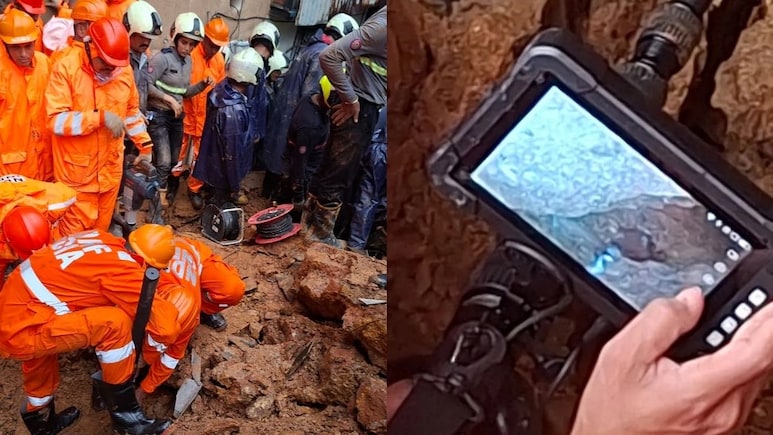
A landslide in Mumbai's Kurla area killed six people on Wednesday, while five others were feared trapped under the debris, officials said.
Rescue teams are using a specialised device known as a victim location camera to check for survivors who may be trapped in gaps beneath the debris. The landslide occurred at Gaushiya Chawl in Ghatkopar's Chirag Nagar.
What is a victim location camera?
A victim location camera is a specialised rescue device used to find people who may be trapped under rubble after a building collapse, earthquake or other structural disaster. It can also be used to search deep borewells and underwater areas.
It has a 5-megapixel camera designed to work in very low light. LED lights built into the camera can illuminate spaces up to about 6 metres.
How does it work?
The main camera is attached to a lightweight, rigid telescopic probe that can extend up to about 5 metres. Rescuers can push the probe through small holes or gaps in the rubble to look inside spaces underneath. If the debris is too deep for the rigid probe, the camera can be attached to a 20-metre cable.
The camera can be moved remotely in different directions. It can rotate up to 360 degrees and move from side to side.
The device is not just a camera. It also has a microphone and speaker. The microphone can pick up sounds made by a trapped person, such as cries, calls for help or other signs of life.
What do rescuers see?
The images from the camera are transmitted to display screens. The main monitor is at least 10 inches, while a secondary monitor is at least 7 inches. A separate 10-inch wireless monitor can also display the camera feed from a distance of around 20-25 metres.
The main monitor is designed to work for around 5-6 hours and the secondary monitor for at least 4-5 hours. An additional external power backup can extend the entire system's operation to around 10 hours.
How does it enter a collapsed building?
If rescuers cannot find a suitable opening in the rubble, a heavy-duty core drilling machine can be used to make a relatively small hole through the debris. The camera probe can then be inserted through this opening to search the void spaces underneath.
The specified system includes a petrol-powered core drill, along with diamond-tipped drilling bits designed to make holes of around 50-55 mm in diameter.
Track Latest News Live on NDTV.com and get news updates from India and around the world

