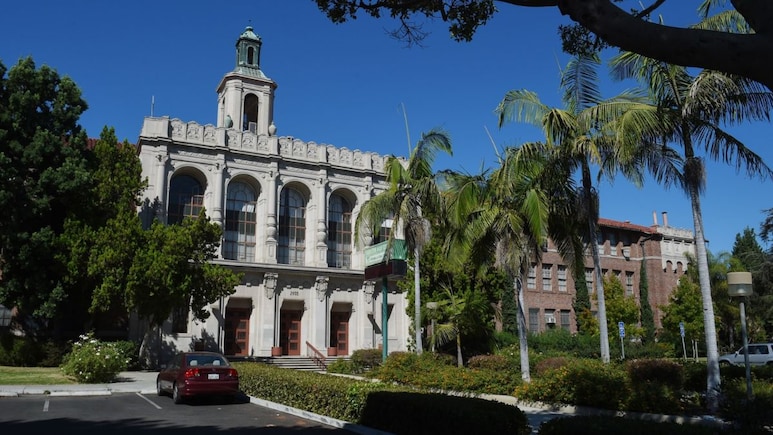
With its verdigris copper bell tower, the 90-year-old Alexander Hamilton High School in West Los Angeles encapsulates many of the Los Angeles Unified School District's distress.
The school has taught everyone from golden-age actress Rita Hayworth and Transformers star Shia LaBeouf to Muhammad Ali's daughter and Mayor Karen Bass. Perhaps its biggest claim to fame is being the school where the original Beverly Hills, 90210 was filmed.
Before the pandemic, Hamilton High enroled almost 3,000 students, but today has only 2,000. Even sought-after performing arts and music magnet programmes have not reversed the trend. One building's basement floods when it rains, while a roughly $400 million modernisation project is behind schedule, according to Jsané Tyler, a community representative at the school.
"This is my 12th year here, so I'm watching the enrolment decline year over year," she said. The magnet programmes are "the only thing that's helped us balance our numbers."
A range of pressures brought the school, and the entire district, to this point. The crisis was laid bare in bond documents for the LAUSD's $222 million debt sale this week: Empty classrooms and shrinking revenue. New labour contracts and swelling costs. Wildfires that destroyed schools. Immigration enforcement which threatens to drive away more students. An FBI investigation that engulfed the district's leadership.
And finally, a threat of outside intervention, as Los Angeles County officials warn the district could run short of cash as soon as November 2027.
The pressures have put LAUSD at the forefront of a financial squeeze afflicting school districts across the US. Falling enrolment and the expiration of pandemic-era aid are forcing systems to cut staff and contemplate school closures, while rising labour and other costs strain budgets.
In Los Angeles, those pressures are compounded by the district's size - and by a series of costly decisions and unexpected shocks. "It's the same things that are happening in a lot of places, but in LA they're magnified," said Marguerite Roza, director of Edunomics Lab, which researches education finance. "It's not just about the district, it's about the city."
'Going Concern'
This demographic pressure is playing out across LAUSD, a 710-square-mile district that cuts across Los Angeles and more than 25 other cities. When classes begin Wednesday after summer break, the district will have about 375,890 students for the 2026-2027 school year, not including independent charter schools, down roughly 13,000 from a year earlier.
Because California school funding is closely tied to student attendance, fewer children ultimately means less revenue. LAUSD has warned that stepped-up immigration enforcement could deepen the decline in Los Angeles, where federal agents have carried out repeated operations and one-in-five children in the county lives with at least one undocumented parent, according to University of Southern California researchers.
Those long-term pressures collided this year with costly new commitments. The school board approved a roughly $21 billion budget in June alongside labor agreements that county education officials had warned were unaffordable. The pay increases are projected to cost about $1.13 billion in the current fiscal year and $1.44 billion the following year, according to the county.
Los Angeles County Superintendent of Schools Debra Duardo subsequently designated LAUSD a "Lack of Going Concern," saying its projections showed it could exhaust its operating cash in November 2027.
The labor agreements followed months of contentious negotiations. Mayor Bass helped lead talks, narrowly averting a strike as unions representing teachers, administrators and support workers threatened a walkout. Then-Superintendent Alberto Carvalho was on paid leave after the FBI searched his home and district headquarters in February. Carvalho, who denied wrongdoing, resigned in June.
Moody's and Fitch have since slashed the district's ratings. County officials also criticised the board for planning to draw $175 million from a retiree health-benefit trust over the objections of district financial staff.
"The board's decision to override its own staff's fiscal advice raises serious concern," Duardo wrote in a July letter.
For now, the county has assigned a fiscal expert to the district. If LAUSD's finances deteriorate further, the county can appoint a fiscal adviser with authority to stay or rescind school-board actions. The district also faces restrictions on issuing debt that has not been approved by voters.
"Our goal is to strengthen our financial plan in a way that protects classrooms, supports the employees who make our schools successful, and keeps students at the center of every decision," Rocío Rivas, the vice-chair of the LAUSD Board of Education, said in a statement.
Bond Sale
For investors in this week's sale, there's some insulation from the turmoil: The bonds will be repaid from dedicated property-tax revenue rather than LAUSD's general fund.
But the district's room to maneuver is shrinking as expenses mount. Three schools were significantly damaged in the 2025 Palisades Fire, and the board approved $600 million for rebuilding.
The district has also authorized $750 million of bonds to fund sexual-misconduct settlements, including claims involving alleged childhood abuse dating back decades.
LAUSD cut central-office jobs, and further reductions and possible school closures are under consideration. The school board is also weighing ways to raise revenue, including pushing California to eliminate tax breaks and impose new taxes.
Yet LAUSD failed to carry out $231 million of spending reductions included in an earlier stabilization plan, according to the county.
Doomsday Predictions
Labor leaders see the interventions as an encroachment that's raising alarm bells. "The labor unions can't help but feel this is an attack on workers," said Gloria Martinez, president of United Teachers Los Angeles, which represents teachers in the district.
At Hamilton High, which is not even part of the real-world Beverly Hills, fiscal warnings have been met with skepticism. Tyler, the community representative, said these "doomsday predictions" occur every two or three years and then end up being wrong.
Schools sometimes receive additional money near the end of the academic year, she said, creating pressure to spend it quickly or risk losing it in the next budget cycle.
"And so then the money tends to not be spent on students the way that it should be," she said.
