





- The Supreme Court reaffirmed bail as the rule and jail the exception under UAPA cases
- The court criticised a verdict denying bail to Umar Khalid and Sharjeel Imam in Delhi riots case
- Smaller benches cannot dilute or disregard larger bench rulings, the court emphasised
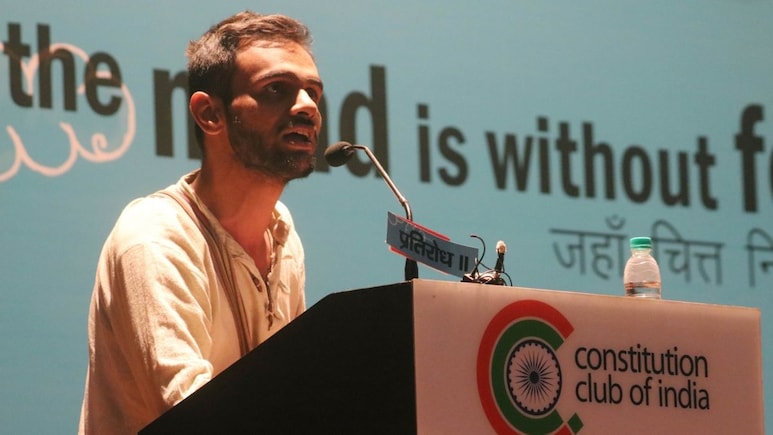
The Supreme Court on Monday strongly reaffirmed that "bail is the rule and jail the exception" even in cases under the stringent Unlawful Activities (Prevention) Act (UAPA), while expressing serious reservations about its recent verdict denying bail to former JNU student leaders Umar Khalid and Sharjeel Imam in the Delhi riots conspiracy case.
A bench of Justices BV Nagarathna and Ujjal Bhuyan said an earlier judgment rejecting bail to Khalid and Imam appeared to dilute the binding precedent laid down by a larger bench in the landmark Union of India vs KA Najeeb case.
"They cannot dilute, circumvent or disregard binding precedent," Justice Bhuyan said, pointing out that two judges who denied bail to Khalid ignored a binding three-judge bench judgment of the Supreme Court which said bail is rule and jail an exception.
Read | 'Bail Should Be Rule If...': Ex-Chief Justice DY Chandrachud On Umar Khalid's Plea
The observations came while the court granted bail to Syed Iftikhar Andrabi, a Jammu and Kashmir resident jailed since June 2020 in a narco-terror case investigated by the National Investigation Agency, or NIA.
The top court specifically referred to the judgment in Gulfisha Fatima vs State, which had rejected bail pleas linked to the Delhi riots conspiracy case, and said it failed to properly follow the principles laid down in the KA Najeeb ruling.
In January this year, a separate two-judge bench of the Supreme Court comprising Justices Aravind Kumar and NV Anjaria had denied bail to Umar Khalid and Sharjeel Imam on grounds of delay in trial proceedings.
Read | "This Is My Life Now": What Umar Khalid Told Partner After He Was Denied Bail
The court on Monday said the interpretation adopted in that judgment gave the impression that the KA Najeeb ruling was only a narrow exception to the stringent bail restrictions under Section 43D(5) of the UAPA.
"It is this hollowing out of the import of the observations in Najeeb that we are concerned with," Justice Bhuyan said while reading the judgment.
As he finished pronouncing the verdict, Justice BV Nagarathana, who was part of the same bench, also commented, "very good judgment, it is reportable".
A reportable judgment of the Supreme Court acts as a precedents or clarify law for other courts to follow.
Read | Umar Khalid, Sharjeel Imam Denied Bail. What Is 2020 Delhi Riots Case
The judges cautioned that the constitutional right to speedy trial under Article 21 cannot be defeated merely because an accused has been charged under anti-terror laws.
"The statutory embargo of Section 43D(5) UAPA must remain a circumscribed restriction that operates subject to the guarantee of Articles 21 and 22 of the Constitution. Therefore, we have no manner of doubt in stating that even under the UAPA, bail is the rule and jail is the exception," the bench held.
The court stressed that the three-judge bench ruling in KA Najeeb remains binding law and cannot be diluted by smaller benches.
"In that spirit, we make it clear that Najeeb is binding law and entitled to the protection of judicial discipline. It cannot be diluted, circumvented, or disregarded by trial courts, High Courts, or even by benches of lower strength of this Court," the judges said.
The bench also flagged what it described as a growing tendency of smaller benches weakening larger bench rulings without expressly disagreeing with them.
"A decision made by a bench of lesser strength is bound by the law declared by a bench of greater strength. Judicial discipline mandates that such binding precedent must either be followed in full, or in case of doubt, be referred to a larger bench," the court observed.
The Supreme Court further held that the existence of a prima facie case cannot justify indefinite incarceration of an undertrial accused under the UAPA.
"A plain reading of Najeeb will show that it was trying to prevent precisely this possibility from arising, when it cautioned that Section 43D(5) must not become the sole metric for denial of bail, causing wholesale breach of the constitutional right to speedy trial," the court said.
The case before the court involved Syed Iftikhar Andrabi, a resident of Handwara in Jammu and Kashmir's Kupwara district, who was arrested by the NIA on June 11, 2020.
The agency alleged Andrabi was part of a cross-border heroin trafficking network that funded terror organisations including Lashkar-e-Taiba and Hizbul Mujahideen.
He is facing charges under the NDPS Act, the UAPA and criminal conspiracy provisions of the Indian Penal Code.
His bail plea had earlier been rejected by both the Special NIA Court and the Jammu and Kashmir High Court, which cited the seriousness of allegations and the early stage of trial.
Granting him relief, the Supreme Court said prolonged incarceration without conclusion of trial cannot be justified under the UAPA solely on the basis of statutory restrictions on bail.
Track Latest News Live on NDTV.com and get news updates from India and around the world

