



India's storied "workhorse" rocket stumbled again on Monday, and with it came a cascade of reactions - some refusing to call it a failure, some meeting the blow with quiet resilience, and others openly wondering whether strategically important missions are being sabotaged.
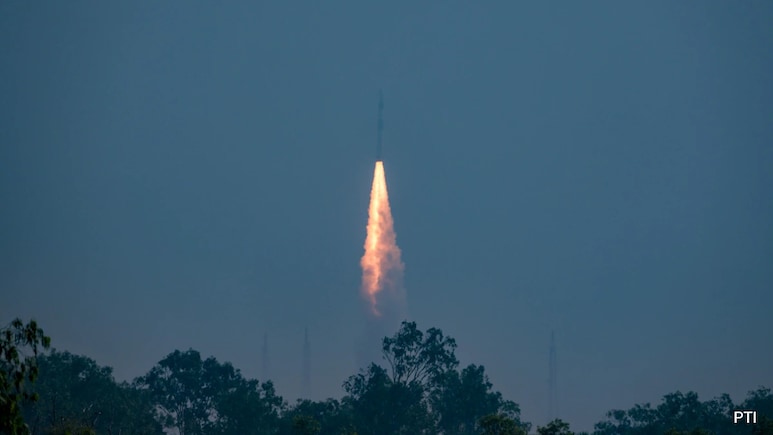
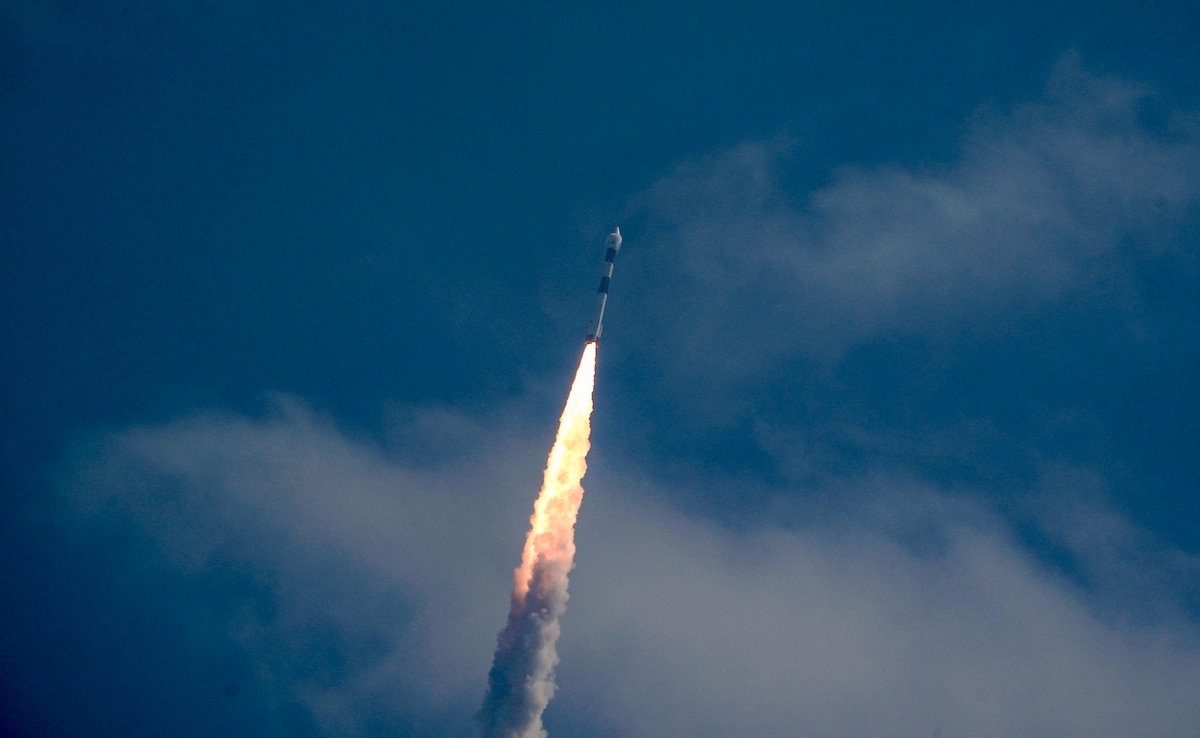
The Polar Satellite Launch Vehicle (PSLV-C62), carrying the EOS-N1 Earth-observation satellite and a cluster of commercial payloads, deviated from its planned path after "disturbances" at the end of the third stage, in the Indian Space Research Organisation's (ISRO) first mission of 2026.
But the overwhelming feeling was ISRO will bounce back stronger, since the Indian space community has no other alternative but to strive for a more resilient higher orbit.
The saving grace remains Launch Vehicle Mark-3 which has a one hundred percent success record, which did launch a few weeks ago from the same rocket port at Sriharikota.
At 10:18 am on Monday, the 44.4-metre, four-stage PSLV lifted off from the Satish Dhawan Space Centre, Sriharikota, with an ambitious manifest that included a strategic hyperspectral surveillance satellite dubbed Anvesha and a Kestrel Initial Technology Demonstrator (KID) capsule slated for re-entry and more.

Less than half an hour after launch, ISRO confirmed the anomaly, setting off a familiar, sobering post-mortem that the space community has now endured two PSLV flights in a row.
"We Shall Come Back At The Earliest": ISRO Chief
ISRO chairman V Narayanan spoke moments after the anomaly, offering a precise accounting of what engineers were seeing in real time:
"The PSLV is a four-stage vehicle with two solid stages and two liquid stages. The performance of the vehicle up to the end of the third stage was expected. Close to the end of the third stage, we are seeing more disturbance in the vehicle, and subsequently, there was a deviation observed in the flight path. We are analysing the data, and we shall come back at the earliest," he said.
Later he admitted the "mission could not proceed in the expected path".
The chairman's remarks match ISRO's public characterization that the disturbance emerged near the end of the third stage (PS3), prompting an immediate review of telemetry and propulsion performance.
Some experts said ISRO should out rightly admitted that the mission had failed rather beating around the bush.
Stoic In Storm: Dhruva Space Keeps Its Chin Up
Among the most affected was Hyderabad-based Dhruva Space, which had "so much riding" on PSLV-C62 through its Polar Access-1 (PA-1) stack, four satellites, five deployers, and ground infrastructure enabling seven missions for states and institutions across India and abroad.
It had its signature on seven of the 16 satellites and was on the verge of making history.
In the wake of the setback, Dhruva Space co-founder and CEO Sanjay Nekkanti issued a note that was strikingly stoic, reflecting the company's full-stack posture and its readiness to re-launch:
"Space is inherently complex, and India's NGEs have been steadily building space infrastructure at scale. Dhruva Space has built its vertically integrated full-stack capability by tapping into ISRO's legacy vendor ecosystem, building in-house infrastructure, and developing Space systems suitable for modular and scalable production. Dhruva Space has supported its customers by establishing critical ground segment infrastructure," he said.
"Across space and launch segments, which involve multiple interdependent systems and processes, Dhruva Space has worked alongside ISRO, INSPACe, NSIL and other partners to enable customers with satellites, launch systems, and launch services. At this stage, our focus is on a measured and timely turnaround. These capabilities enable us and our customers to be ready for upcoming Launch opportunities in under a few weeks. We continue to see strong momentum and maturity in the Indian space programme and we are confident the ecosystem will grow, as envisioned in the Decadal Vision," Nekkanti added.
India's private space entrepreneurs are not disheartened.
Pawan Kumar Chandana, founder of Skyroot Aerospace, Hyderabad which is getting ready to launch its first orbital rocket this year said he was "sad to learn" that the PSLV-C62 mission didn't go as planned.
"Even the most reliable launch vehicles stumble at times. What matters is how quickly we learn and bounce back. ISRO has always come back strong. Wishing the team a swift return to the launch pad," he said.
One needs this resolute resolve to mitigate the actual and emotional risks that comes with rocket launches. Five failures in 64 launches still remains a good track record.
And Then, Plain Suspicion: "Are These Being Sabotaged?"
Not everyone was willing to treat PSLV-C62 as an isolated technical failure. A very senior defence space expert, anguished and speaking with long experience in national security payloads, framed the episode starkly:
"Another failure of a strategic payload launch. Isn't it suspicious that strategic launches are consistently failing? Are we inviting interference by tom-toming strategic endeavours to adversaries? Superb satellites like GISAT, RISAT-1B, NVS-02, and now Anvesha. I am anguished," the expert said.
Professionals across the ecosystem caution against jumping to conclusions without hard evidence; yet the clustering of recent setbacks on missions with defence or navigation implications has undeniably fuelled speculation and anger. Analysts have noted that five ISRO mission failures between 2017 and 2026 disproportionately involve national-security payloads or capabilities, intensifying public scrutiny around reliability and risk posture.
What Exactly Failed, Again, In Third Stage
Monday's anomaly echoes May 2025, when PSLV-C61/EOS-09 (RISAT-1B) failed to reach its 529-km Sun-Synchronous Orbit after a sudden chamber-pressure drop roughly 203 seconds into the third stage-underperformance that forced termination and destroyed the radar satellite. Initial indications at the time pointed to a solid-motor system issue, with later expert commentary exploring possibilities from flex-nozzle malfunction to casing or insulation defects.
For PSLV-C62, early reporting has focused on "disturbances" and deviation near the end of PS3, prompting questions about whether the latest anomaly shares lineage with the prior third-stage failure mode. ISRO has begun detailed analysis; as of this writing.
The Satellites Lost And The Strategic Heartache
The Anvesha (EOS-N1) payload, developed by DRDO and touted as a hyperspectral best, enabling material identification, terrain classification, and surveillance across hundreds of narrow spectral bands, was the mission's primary passenger. The loss stings, not only for defence users but also for the broader ecosystem that had planned to validate orbital AI models and deployment technologies on co-passenger satellites.
Dhruva Space had incorporated a suite of missions into PA-1, including its own THYBOLT-3 and the Northeast-led LACHIT-1, with state universities and international collaborators queued up to operate via Dhruva's Ground-Station-as-a-Service (GSaaS). The broader commercial manifest included experiments like AayulSAT, India's first on-orbit refuelling demonstrator, and the KID capsule for controlled re-entry attached to PS4-each emblematic of a maturing private space sector moving from demos to operational infrastructure.
All now lost with PSLV-C62's trajectory deviation.
A Pattern, If Not A Cause: The Recent Roll-Call Of Strategic Setbacks
GISAT-1 / EOS-03 (Aug 2021): Failure in GSLV-F10 due to insufficient liquid-hydrogen tank pressure at cryogenic ignition; ISRO's later said a vent and relief valve leak as the most likely root cause.
RISAT-1B / EOS-09 (May 2025): PSLV-C61 third-stage anomaly; chamber-pressure drop led to loss of mission minutes after lift-off.
NavIC / NVS-02 (Jan 2025): Satellite successfully deployed to GTO by GSLV-F15, but failed to fire Liquid Apogee Motor due to oxidiser valve malfunction; remains stuck in transfer orbit, unusable for intended navigation services.
Anvesha / EOS-N1 (Jan 2026): Lost with PSLV-C62 following third-stage disturbances and trajectory deviation.
To the lay mind each failure seems due a different reason, but ISRO needs to convince that this bunching is mere coincidence and not a systemic sabotaging of defence related missions. India's semi-functional satellite navigation system has bothered defence experts for some time.
Transparency On Trial: Where Are Failure Analysis Reports?
For decades, ISRO's culture of publishing Failure Analysis Committee (FAC) findings underpinned public trust, offering clear diagnoses and corrective actions. In recent episodes, however, the PSLV-C61 the FAC report has not been made public, and similar opacity shrouds the NVS-02 failure and several other preceding missions. Commentators have flagged this as a break with precedent, one that complicates external accountability and informed debate on whether corrective measures adequately address systemic risks in solid motors, cryogenic subsystems, and satellite propulsion.
Monday's PSLV-C62 failure may intensify calls for ISRO to restore comprehensive public reporting on root causes and design/process fixes, especially as India pitches PSLV for global rideshare markets and pursues high-stakes missions in navigation, surveillance, and human spaceflight preparation. ISRO became what it is because of its robust reviews where even the junior most scientist could question the chairman of ISRO if things were not right. This culture of openness needs to be restored if India's ambitious human space flight program Gaganyaan has to succeed which has much higher stakes with human lives in the loop.
The Mood Music: Ostrich-Like Denial, Stoic Resolve, and Raw Suspicion
The day's mood swung across three registers:
Ostrich-like denial: An unwillingness in some quarters to use the word failure, preferring "anomaly" or "deviation." Semantics matter in aerospace-an unaccomplished mission is a failure, and naming it honestly is the first step toward learning.
Stoic resolve: Dhruva Space and other Next-Gen Enterprises (NGEs) modelled the industry's spine: acknowledge the loss, focus on measured and timely turnaround, and re-manifest payloads at the earliest safe opportunity.
Suspicion and anguish: Veterans of defence space programs asked whether strategic payloads are facing a disproportionate share of setbacks, and whether indiscreet public signalling invites interference. Absence of evidence, such claims must be treated as allegations, yet they capture a genuine fear across the security community.
What Comes Next
Technically, ISRO's immediate priority is to pinpoint the cause of the third stage or PS3 failure mode and publish corrective actions that convincingly break the chain linking two back-to-back third-stage anomalies. Commercially, NSIL and its customers will be weighing schedule confidence and risk posture for rideshare missions that hinge on PSLV's reputation. Strategically, the defence community will track how fast India can replace lost capability in day and night viewing (SAR) imaging and hyperspectral surveillance, while the NavIC program seeks momentum after the NVS-02 setback.
For a spacefaring nation that prides itself on disciplined engineering and frugal excellence, the lesson is not to bury heads in sand but to look squarely at failure, learn faster than competitors, and demonstrate, openly, that fixes are robust.
On Monday, India felt the sting again. On Tuesday, the work must begin to rectify the situation and chin up to face the loss and get ready for other space missions after a thorough investigation. ISRO has invariably bounced back from worst situations and one hopes it does bounce back once again from these back to back failures. The setback only reinforces that space is unforgiving and certainly not meant for the faint hearted. After all it still remains rocket science!
Track Latest News Live on NDTV.com and get news updates from India and around the world

