





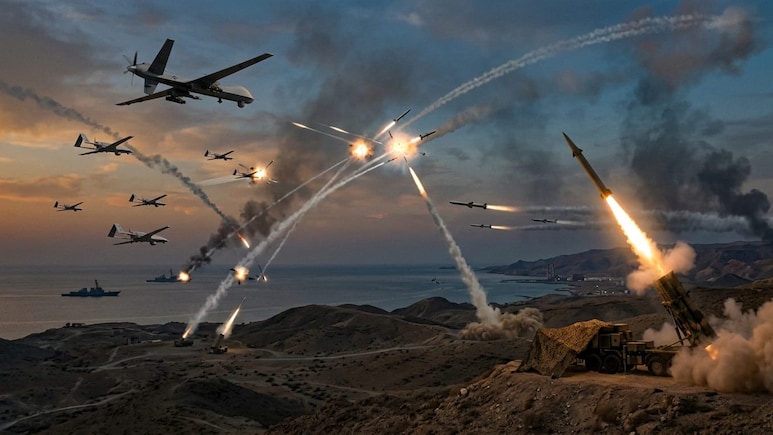
"Our job is to hit the target, not to count the body bags."
Probably, the coldest (and the coolest) line delivered nonchalantly by Indian Air Force Air Marshal AK Bharti in the aftermath of Operation Sindoor signalled a shift. It showed India will now fight with precision, integration, and finality.
While Operation Sindoor (launched exactly a year ago on May 7, 2025) followed a familiar logic -- "you attack us, we obliterate your terror launchpads", its execution caught the world's attention. India delivered strikes with unfamiliar sharpness. However, the initial strikes were calibrated and contained, served with no intentions to widen the conflict.
But Pakistan responded with attempts to target Indian cities and military bases. What followed changed the script -- India changed its targets (and its rules).
In a pre-dawn operation on May 10, 2025, the Indian Air Force struck multiple military installations deep inside Pakistan, including critical air bases at Rafiqui, Murid, Nur Khan, Rahim Yar Khan, Sukkur, Chunian, Pasrur, and Sialkot.
These were not symbolic targets. They were operational nodes. Air-launched precision weapons reportedly:
- Disabled key runways, limiting aircraft operations
- Disrupted command and logistics chains
- Degraded Pakistan's aerial response capability within hours
Satellite imagery later indicated damage to Mushaf air base in Sargodha. Strategic observers have long linked this installation to sensitive underground infrastructure near the Kirana Hills. While Air Marshal Bharti publicly denied any strike on those facilities, the signalling was unmistakable.
A New York Times report quoted a former US official familiar with Pakistan's nuclear programme, noting that such strikes could be interpreted as a warning -- one that touched the most sensitive layers of strategic deterrence.
Facing degraded capabilities, Pakistan moved toward de-escalation. From the outside, Operation Sindoor looked like a short, sharp confrontation. From the inside, it was a demonstration. India had not relied on a single arm of power. It had orchestrated a network:
- Real-time intelligence and surveillance
- Precision air-delivered munitions
- Loitering strike systems
- Integrated command-and-control
Independent analyses -- including those from European military think tanks -- suggested that India achieved air superiority, degraded key Pakistan assets, and imposed costs with controlled escalation.
Symbol of national resolve #OpSindoor
— HQ IDS (@HQ_IDS_India) May 6, 2026
JAI HIND#OpSindoor #indianarmedforces #NationalSecurity @narendramodi @DefenceMinIndia @SethSanjayMP @SpokespersonMoD @MIB_India pic.twitter.com/y67xwYHZCP
As defence experts put it -- this was not "platform warfare", this was "system-of-systems warfare", executed with discipline.
A Year Later: Operation Sindoor Resets Military Doctrine
When Defence Minister Rajnath Singh recently described Operation Sindoor as proof of India's "tech-driven military might," he was not recounting history. He was describing transformation.
Because the most enduring impact of Operation Sindoor has unfolded in the year since -- across procurement, and industry. If Operation Sindoor had a signature, it was the way drones were used -- not as accessories, but as integral components of combat.
Major General RC Padhi (retired) describes the shift as a movement from "capability-building to real operational integration." During the operation, drones and loitering munitions worked alongside radar networks, air defence systems, and command centres -- "handling surveillance, strike support, and even aerial threat neutralisation". What followed was not incremental adoption. It was a structural change.
- Ashni Platoons embedded across infantry battalions
- The Army's evolving "Eagle in the Arm" doctrine
- Drone training becoming standard across units and services
The implication is profound: drones are no longer external tools. They are becoming extensions of the soldier, says Major General Padhi.
Rapidly Expanding Defence Ecosystem: Numbers Tell The Story
| Indicator | Status (Feb 2026) |
| Registered drones | 38,575 |
| Remote pilot certificates | 39,890 |
| Training organisations | 244 |
| GST on drones | 5% |
| Regulatory forms | Reduced from 25 to 5 |
| Approval steps | Reduced from 72 to 4 |
These changes have lowered entry barriers and accelerated participation -- from startups to MSMEs -- aligning innovation with operational demand.
Speed Is The New Strategy: The Startup Moment
For India's private defence ecosystem, Operation Sindoor was not just validation. It was ignition.
Amardeep Singh, Founder of defence start-up Armory, frames it with clarity: the question is no longer whether India can build indigenous systems, but whether it can build them fast enough.
The state has responded in kind:
- Emergency Procurement: 6 fast-tracked acquisitions
- FY27 defence budget rose 15.2% to Rs 7.85 lakh crore
- Over Rs 1.11 lakh crore earmarked for domestic procurement
- Counter-drone systems placed at the centre of priorities
The anti-drone market alone is expected to grow 5-10 times over the next few years. But the deeper shift is cultural.
Startups like Armory are no longer waiting for procurement cycles. They are working alongside the armed forces -- testing, refining, deploying. The loop between innovation and battlefield use is tightening.
'Atmanirbhar Bharat': A Layered Ecosystem
Nagendran Kandasamy of Zulu Defence Systems describes the post-Sindoor transformation as a shift toward a "cohesive, layered ecosystem." This ecosystem now includes:
- Autonomous strike platforms
- Swarm-enabled drone networks
- AI-driven decision layers
- Integrated counter-drone systems
Zulu Defence's 333 per cent year-on-year growth reflects the scale of this shift. Increasingly, modern warfare is not about individual platforms. It is about how systems communicate, adapt, and act together, adds Kandasamy.
Similarly, another homegrown defence company Krishna Defence & Allied Industries Limited (KDAIL) witnessed its revenue (from operations) increase 83.10 per cent year-on-year. "Our focus continues to remain on mission-critical components, precision engineering, and manufacturing depth," Ankur Shah, Managing Director at KDAIL.
Perhaps the most consequential outcome of Operation Sindoor was the validation of Indian-built systems under live conditions. Among them: the ALS-50 loitering munition developed by Tata Advanced Systems.
| Feature | Capability |
| Type | Autonomous loitering munition |
| Launch | Vertical Take-Off and Landing (VTOL) |
| Targeting | Vision/image-based guidance |
| Range | Up to 50 km |
| Flexibility | Abort and recovery mid-mission |
A spokesperson from Tata Advanced Systems Limited (TASL) noted that as a completely indigenous system, the ALS-50 delivered "enhanced operational flexibility, real-time target acquisition and precision in engaging targets" during Operation Sindoor. Its ability to loiter, identify, and strike with accuracy in live conditions, they added, sets a new benchmark for mission-ready systems.
Similarly, deep-tech UAV firm BonV Aero is building with an aim to help the Army its "forward position" needs. Its UAV platforms are built to operate in high-altitude sectors and contested airspaces, and is deployable within hours. "We stand ready to support the armed forces' demands as and when the call comes," says Satyabrata Satapathy, co-founder & CEO, BonV Aero.
Operation Sindoor also involved a "Suppression of Enemy Air Defenses" (SEAD) campaign, using indigenous systems like the Akash air defence system, Akashteer control network, and BrahMos missiles. India is no longer just developing defence technology -- it is proving it where it matters most.
India's New War Playbook
The cumulative effect of the past year is visible in how India's defence ecosystem now functions:
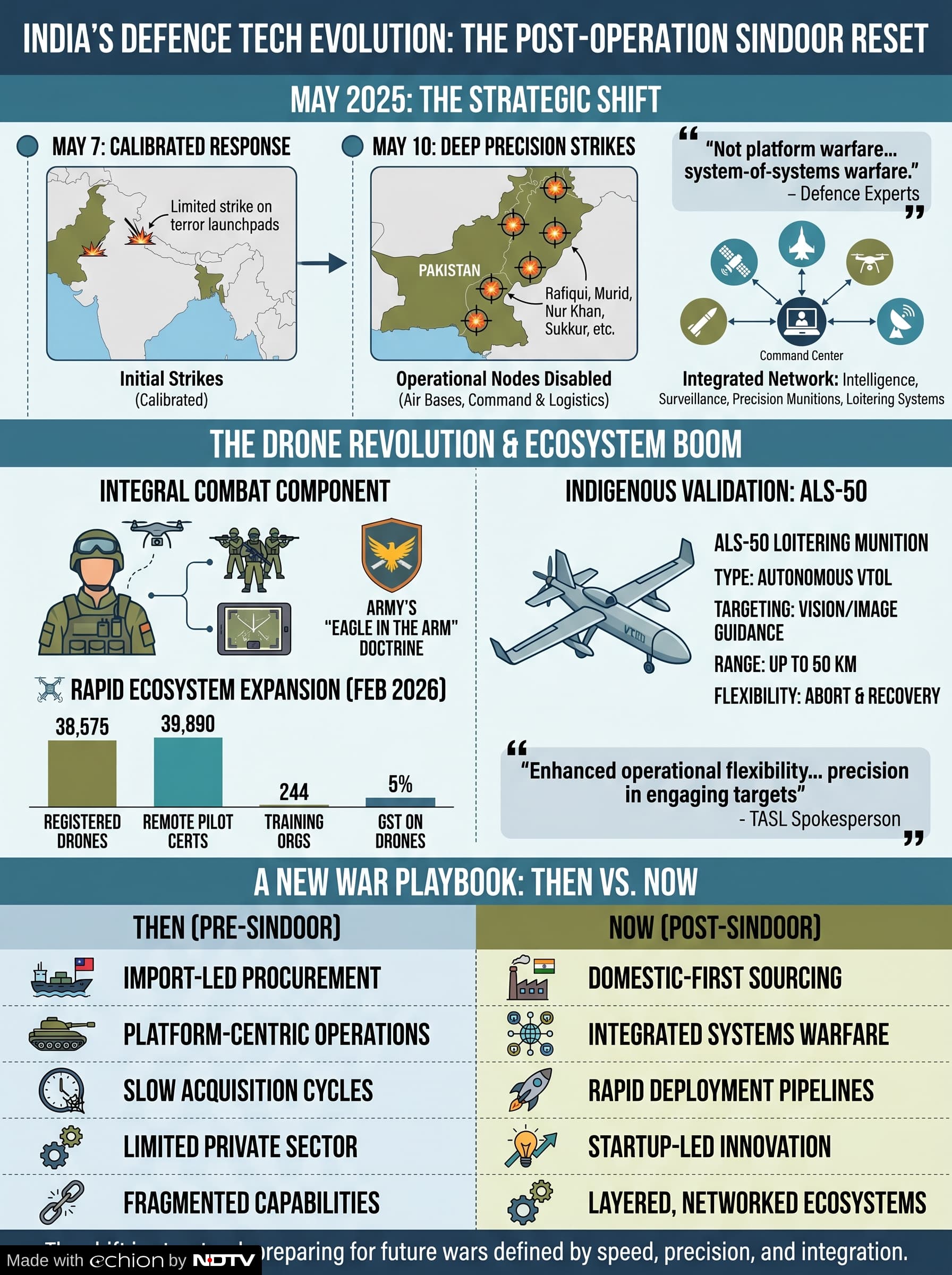
Operation Sindoor will be remembered for its precision strikes, its controlled escalation, and its swift conclusion. But its real significance lies deeper. It showed that India is no longer preparing for the wars it studied in the past. It is shaping itself for the wars it expects in the future -- where speed, precision, and integration will decide outcomes. And in this shift, Operation Sindoor stands not just as a response -- but as a rewrite.
Track Latest News Live on NDTV.com and get news updates from India and around the world

