





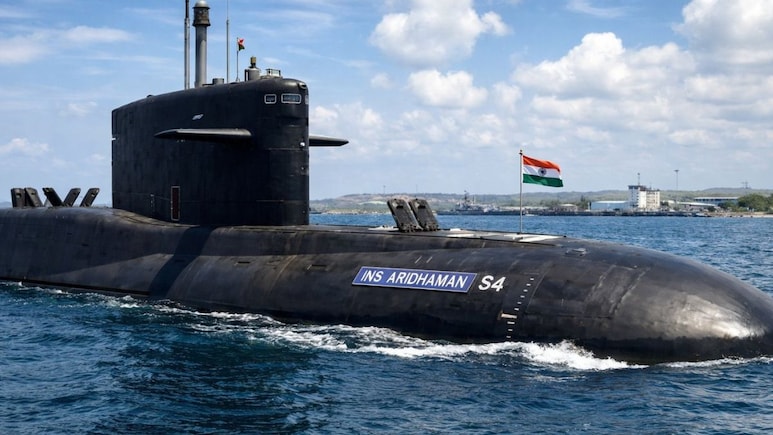
- INS Aridhaman, the third indigenous nuclear submarine, was inducted into the Indian Navy
- It weighs 7,000 tons and is 90 per cent constructed with indigenous technology
- Aridhaman carries double the missile strike capability of its predecessors
The third indigenous nuclear-powered submarine INS Aridhaman, which means 'destroyer of enemies', was inducted into the Indian Navy on Friday. Given the immense complexities involved in its construction, the nuclear submarine is a considered a military and technical feat.
Part of the Arihant class, the 7,000-ton submarine has been constructed to an extent of 90 per cent using indigenous technology and is capable of conducting a nuclear strike. It is equipped with a nuclear reactor that provides it with a continuous supply of energy, eliminating the need to surface to refuel. It can reach underwater speeds of 45 kilometers per hour.
Weighing 1,000 tonnes more than its predecessors Arihant and Arighat, Aridhaman carries double the missile strike capability and an extended operational range. While Arihant and Arighat have four vertical launch tubes, Aridhaman has eigh such tubes. Aridhaman is fitted with nuclear warheads that can surge from the ocean's depths and strike targets in the skies or land.
Aridhaman is also capable of carrying 24 'Sagarika K-15' ballistic missiles, which possess a strike range of 750 to 1,500 kilometers. It is equipped with eight long-range K-4 ballistic missiles, which have a range of 3,500 kilometers. In the future, it will also be equipped with the K-5 missile, which will have a range of approximately 6,000 kilometers.
INS Arihant was the first vessel under the Submersible Ship Ballistic Missile Nuclear (SSBN) project that was followed by INS Arighat. INS Arihant is India's first home-made nuclear submarine. It was launched in July 2009 and was quietly commissioned in 2016. The Navy commissioned its second indigenous SSBN, INS Arighaat, in August 2024.
India is among a select group of countries having nuclear-powered submarines. The countries that have such assets are: the US, Russia, the UK, France and China.
Along with INS Aridhaman, Union Defence Minister Rajnath Singh was also present for the induction of INS Taragiri at Visakhapatnam.
As the fourth potent platform of the Project 17A class, Taragiri is not merely a ship, it is a 6,670-tonne embodiment of the 'Make in India' spirit and the sophisticated engineering capabilities of our indigenous shipyards.
⚓️ Legacy. Power. Purpose.
— IN (@IndiannavyMedia) April 1, 2026
From steel to sea, #Taragiri stands ready.#IndianNavy is set to commission #INSTaragiri.
🗓️ 03 April 2026
📍 Visakhapatnam
A testament to strength, precision & #Aatmanirbharta.#RiseAbove @indiannavy @IN_HQENC @IN_WNC @IN_HQSNC pic.twitter.com/DhRO1pzLT7
Built by Mazagon Dock Shipbuilders Limited (MDL), Mumbai, this Frigate represents a generational leap over earlier designs, offering a sleeker form and a significantly reduced Radar Cross-Section that allows it to operate with lethal stealth. With indigenous content exceeding 75 per cent, the ship highlights the maturity of a domestic industrial ecosystem that now spans over 200 Micro, Small and Medium Enterprises (MSMEs).
Driven by a Combined Diesel or Gas (CODOG) propulsion plant, Taragiri is designed for 'High-Speed - High Endurance' versatility and multi-dimensional maritime operations. The ship's weapon suite is world-class, featuring supersonic Surface-to-Surface Missiles, Medium Range Surface-to-Air Missiles, and a specialised Anti-Submarine Warfare suite. These systems are seamlessly integrated through a state-of-the-art Combat Management System, ensuring that the crew can respond to threats with split-second precision.
Beyond its role as a premier hunter of the seas, Taragiri is built for the complexities of modern diplomacy and humanitarian crises. Its flexible mission profile makes it ideal for everything from high-intensity combat to Humanitarian Assistance and Disaster Relief (HADR).
Track Latest News Live on NDTV.com and get news updates from India and around the world

