





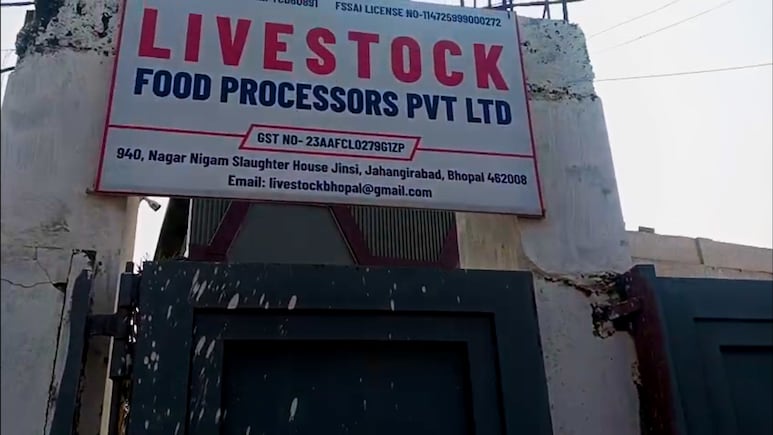
The sealed slaughterhouse in Bhopal's Jinsi area has prompted many more unsettling questions than alleged cow slaughter alone. At the heart of the controversy now is the alleged illegal settlement of Rohingya refugees, forged identities and their use as labour in a powerful slaughterhouse network, raising serious concerns about national security, governance and systemic protection in the capital of Madhya Pradesh.
The spotlight is firmly on Aslam Qureshi alias Chamda, the operator of the Jinsi slaughterhouse. Fresh complaints allege that around 250 Rohingya refugees were illegally settled near the Mecca Mosque in Jinsi, employed in slaughtering and allied activities, and provided with fake documents prepared locally in Bhopal. Residents claim this shadow network also pushed local workers out of their livelihoods.
A complaint detailing these allegations was submitted last year at the Zone-1 DCP office in Bhopal. The police conducted an inquiry and gave Aslam a clean chit. What has now shocked investigators and rights bodies alike is that this clean chit was reportedly based largely on Aslam's own statements, not on independent verification or ground-level investigation.
When the Bhopal police submitted their report to the National Human Rights Commission, it was rejected outright. The Commission pointed out glaring contradictions. While police termed the allegations "baseless", Aslam himself admitted that labourers were brought from border states such as West Bengal, Assam and Bihar and housed on his private property.
The NHRC also noted that the investigating officer failed to verify the authenticity of identity cards produced by these labourers. In one of its sharpest observations, the Commission accused the police of diverting attention from the core issue by citing the absence of the complainant's address.
Politics Intensifies
Political reactions have been sharp and polarised. BJP leaders have demanded the harshest action, including invoking the National Security Act, while promising action against officers accused of negligence.
BJP MLA Rameshwar Sharma said, "Whoever Aslam Chamda is, his skin will be peeled off, his property will be confiscated and action under the NSA will be taken. No guilty person will be spared. An investigation is also underway to determine which country's people were working there (at the slaughterhouse). Action will be taken against the officers who were negligent earlier as well."
The Congress, on the other hand, has questioned how such large-scale illegal activity could allegedly continue under what it calls a "triple-engine government", accusing the administration of selective blindness despite repeated claims of protecting cows and Sanatan values.
Former law minister PC Sharma said, "In the so-called triple-engine government of the BJP, which talks about Hindutva and Sanatan Dharma, cows were openly slaughtered. People were caught red-handed, yet no action was taken. We demanded that the cow be declared the national animal, but that has not been done. The Madhya Pradesh government must take strict action in this matter."
Tightening Grip
Aslam Qureshi's rise itself tells a story of influence. Beginning in the late 1980s by buying buffalo hides from villages across Sehore, Vidisha, Raisen and Ashta, his fortunes changed when he secured contracts to lift dead cattle. Over time, his grip over municipal systems reportedly became so strong that no competitor dared bid against him for slaughterhouse tenders. Even members of the Qureshi community had protested when the slaughterhouse was handed over to him.
Following Aslam's arrest, attention has now turned to officials of the Bhopal Municipal Corporation. Tender documents bear the signatures of senior officers, including the then additional commissioner, superintending engineer and executive engineer. Yet, despite their clear role in the approval process, no interrogation has been initiated so far, raising questions about accountability.
Cabinet Minister Vishwas Sarang called for the death penalty.
"Whoever is guilty and involved in cow slaughter should be given the death penalty. It is a matter of investigation how one individual became so powerful. Who is involved, where and how must be probed thoroughly. There can be no crime bigger than killing the cow and, after a complete investigation, such people should be awarded the death penalty."
The scale of the alleged operation became evident on the night of December 17, when police seized 26 tonnes of meat from a truck near the police headquarters. Interrogation revealed that the meat was allegedly destined for Gulf countries, while bones were reportedly routed to China. Investigators claim Aslam's network extended across the Bihar, Bengaluru, Hyderabad, Maharashtra and overseas markets.
Documents accessed during the investigation by NDTV reveal that the Jinsi slaughterhouse, projected as a modern facility under a Public-Private Partnership model, was handed over in November 2025 with strict conditions. These included pollution control norms, food safety compliance, scientific waste disposal and round-the-clock CCTV surveillance. On paper, it was a model project. On the ground, questions now outnumber answers.
Just weeks after the handover, on December 17, 2025, tonnes of frozen meat was dispatched from Bhopal, officially declared as buffalo meat. The paperwork describes all the animals as buffaloes over 15 years of age, cleared through ante-mortem and post-mortem examinations, and certified fit for human consumption by municipal authorities. The logistics trail is meticulous 1,325 cartons, 26,500 kilograms, refrigerated trucks, cold storage facilities in Mumbai and Navi Mumbai, matching vehicle numbers, seals and e-way bills.
Yet investigators now say forensic checks suggest the meat was beef, not buffalo. This revelation has triggered a fresh set of questions. Were the CCTV cameras functional from day one? Do the recordings of slaughter days exist, and who monitored them? Where did the animals shown as "buffaloes" actually come from, and how was their age verified? Was there any independent audit of procurement records? And, crucially, how much did the municipal corporation know about this commercial chain - who processed the meat, who sold it, and who profited?
Food safety has also emerged as a serious concern. While official documents mention an internal municipal investigation, independent laboratory test reports of the seized consignment have not been made public so far.
Track Latest News Live on NDTV.com and get news updates from India and around the world

