





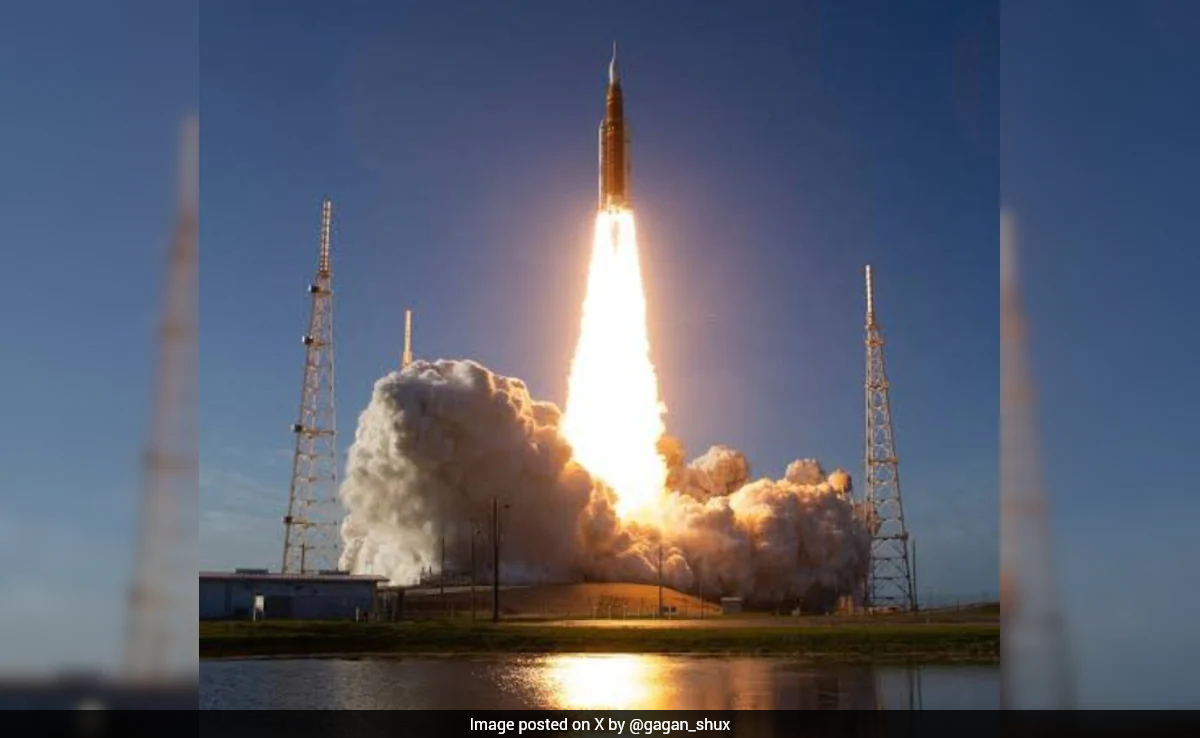
As NASA sent humans back to the Moon under the Artemis 2 mission, from the legendary launch site of the Kennedy Space Center (KSC) in Florida, the sea facing site is again at the centre of global attention. The Space Launch System rocket propelled the Artemis-2 mission from the Launch Pad 39 B, from where it lifted off today.
Neil Armstrong began humanity's first journey to the Moon from Kennedy Space Center's Launch Pad 39 A, which is just a few kilometres away from where the Artemis-2 lifted off. For India, that legendary concrete and steel structure carries a rare and deeply personal connection. Group Captain Shubhanshu Shukla, who is the only Indian to have flown to space from the USA, lifted off from Pad 39A. NDTV spoke to him exclusively as Artemis 2 readied for historic launch.
For Shukla, now an astronaut of the Axiom 4 Mission and a designated Gaganyatri of ISRO, Kennedy Space Center is not merely a launch facility. It is a place where the past, present and future of human spaceflight intersect. Recalling his own experience, he says the significance of such a place does not always register immediately during training. "During your training for going to space, you are extremely busy with technical work," Shukla told NDTV. "Most of the time, the significance of what is happening around you doesn't really sink in."
But Pad 39A, he says, is different. "There are a few moments which stand out. You don't have to force it. It is just so much in your face that you cannot miss it. Visiting Kennedy Space Center and especially Pad 39A was one such moment."
Standing before the launch pad for the first time, Shukla felt the weight of history. Apollo missions, Space Shuttle launches and now Artemis-2, all trace their lineage back to the same KSC site. "The place is resplendent with the history of spaceflight," he said. "It has not sent just rockets to space. In a sense, it has sent humanity to space, and even to our nearest neighbour, the Moon."
Today humanity is on its way back to the Moon, said Jared Issacman, Administrator of NASA, after the successful lift off this morning.
That sense of continuity is what makes KSC unique. "If you look at it, it is just an infrastructure designed to send rockets to space," Shukla reflected. "But it holds a lot of emotional value, not just for astronauts or people working on the programme, but for the entire world."
Shukla's own flight from Pad 39A came aboard SpaceX's Falcon 9 rocket, a mission that placed him among a very small group of humans to have launched from that historic site, and the only Indian ever to do so. For him, the moment of lift off remains etched in memory, not just for its symbolism, but for its sheer physical intensity.
"It is extremely powerful," he said, describing the seconds after ignition. A fighter pilot by profession, Shukla was no stranger to afterburners and high performance aircraft. Yet the rocket launch defied his expectations. "Engaging afterburner and taking off was not new for me. I have done it many times. But the scale of how it happens in a rocket is very different."
What surprised him most was how rapidly everything unfolded.
"My imagination didn't match reality. It is too powerful and it is too quick. When you are sitting inside, the numbers are changing so rapidly. The force, the vibration, your entire body feels that. That was the first jolt for me when the lift off happened."
The crew of four flying on Artemis 2 flew on NASA's Space Launch System, a rocket far larger than Falcon 9, Shukla believes the experience for the crew is both familiar and profoundly different. While the scale of the vehicle is vastly larger, human limits define what astronauts can physically endure.
"The trajectory is limited by human performance," he explained. "So the G forces will be similar. But the sound, the vibration and the overall perception will be very different."
Beyond the mechanics of launch, Shukla views Artemis 2 as a milestone not for one nation, but for humanity itself. After decades, humans are once again on their way far beyond low Earth orbit. "I think every citizen of this planet should sit down and think about what is happening," he said. "After decades, humans are again going back to the Moon."
Distance, he notes, changes perspective.
From the International Space Station at around 400 kilometres above Earth, astronauts can still see the blue planet clearly. Artemis 2 takes humans nearly 384,000 kilometres away. "They are on their own," Shukla said. "Going around the Moon and coming back. This is not easy." There is no lunar landing on this mission.
That distance also dissolves borders. "Once you leave the boundary of your planet, in a sense you lose all boundaries," he told NDTV. "You don't introduce yourself as being from India or the US. You introduce yourself as being from Earth."
NASA's longer term plans, including building a sustained human presence near the Moon's South Pole, reinforce that vision. Shukla sees these ambitions as a declaration of intent by humanity. "We are defining some really audacious goals for ourselves as a race," he said. "Going to the Moon, setting up a base, imagining people living there, these are extremely challenging tasks. But it all starts with step one, of saying that yes, we are doing this."
For India, the timing is significant. The country has already announced its intention to land an Indian astronaut on the Moon by 2040, and Shukla believes Artemis will energise that journey. "The next 10 to 20 years are going to be phenomenal in terms of space exploration," he said. "We are also on a path of human spaceflight. That in itself is monumental for us as a country."
Shukla's own path reflects India's growing footprint in human spaceflight. He flew to space as part of the Axiom 4 mission in 2025, a commercial human spaceflight undertaken with international collaboration. The mission placed him in low Earth orbit and marked a rare India-US human spaceflight linkage. Today, as an ISRO Gaganyatri, he is deeply involved in preparations for India's first indigenous human space missions under Gaganyaan.
As Artemis 2 lifted off from KSC, the same ground that once propelled Shukla skyward and decades earlier carried Neil Armstrong toward the Moon, history feels cyclical. For India, the connection is no longer symbolic alone. An Indian has already launched from that launch port. Another generation now looks toward it, imagining a future where India, too, sends humans beyond Earth.
Track Latest News Live on NDTV.com and get news updates from India and around the world

