


India's anaemia numbers may be lower than previously estimated, but the country's fight against the condition is far from over. The latest national findings from the Indian Council of Medical Research's (ICMR) Survey for Assessment of Markers of Population Health, Activity, Diet and Anthropometry (SAMPADA) 2023-2025 indicate a lower prevalence of anaemia across several population groups compared with earlier national surveys. However, nearly 56% of women of reproductive age and 46% of adolescent girls continue to be affected.
More importantly, the findings raise questions about how India diagnoses and treats anaemia. For years, iron supplementation has been a central component of the country's response, but iron deficiency accounts for only about half of anaemia cases among women, adolescent girls and children, according to SAMPADA.
This distinction is clinically important. Treating every case of low haemoglobin as iron deficiency without investigating its underlying cause can delay appropriate treatment. Doctors say India needs to shift from simply correcting haemoglobin levels to identifying why they are low, ensuring appropriate treatment and tracking patients until recovery.
"We keep treating the number, not the woman," says Dr Uma Vaidyanathan, Director, Obstetrics and Gynaecology, Fortis Hospital, Shalimar Bagh. "As per the survey, fewer anaemic women is progress. Half still anaemic is failure!"
What Does The New ICMR SAMPADA Survey Reveal About Anaemia In India?
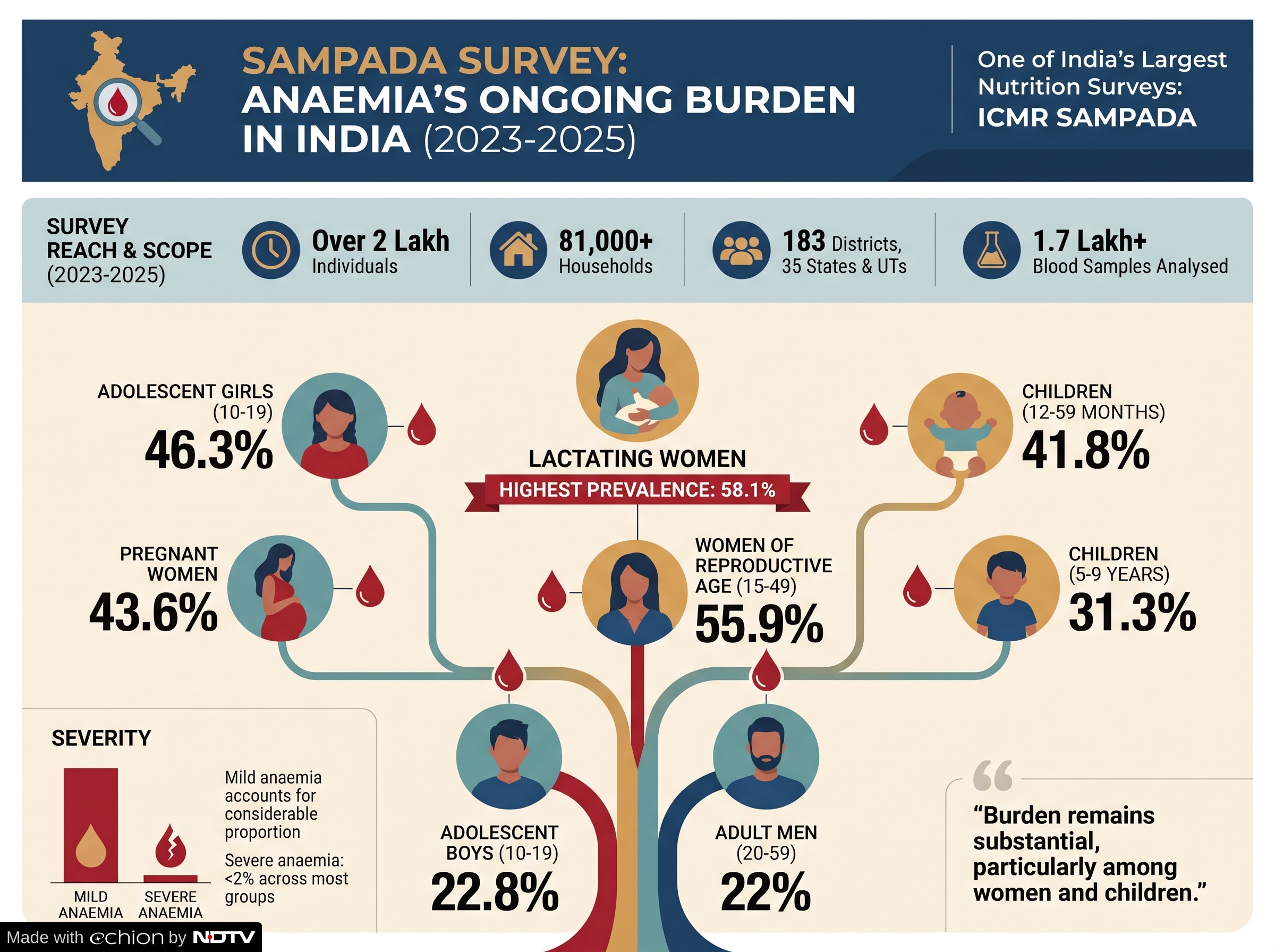
Conducted between 2023 and 2025, SAMPADA is one of India's largest nutrition surveys, covering more than 2 lakh individuals across over 81,000 households in 183 districts and 35 states and Union Territories. Researchers analysed more than 1.7 lakh blood samples to assess haemoglobin levels across different age groups and physiological categories.
The survey reported the following anaemia prevalence:
- Women of reproductive age (15-49 years): 55.9%
- Adolescent girls (10-19 years): 46.3%
- Adolescent boys (10-19 years): 22.8%
- Children aged 12-59 months: 41.8%
- Children aged 5-9 years: 31.3%
- Pregnant women: 43.6%
- Lactating women: 58.1%
- Adult men (20-59 years): 22%
While these figures are lower than several estimates from previous national surveys, the burden remains substantial, particularly among women and children. SAMPADA also found that severe anaemia affected less than 2% of individuals across most population groups, with mild anaemia accounting for a considerable proportion of cases.
One important methodological difference is that SAMPADA used venous blood samples and automated laboratory analysers for haemoglobin estimation. Earlier National Family Health Survey (NFHS) rounds used capillary blood collected through finger pricks and portable testing devices.
Consequently, the differences between the surveys should not automatically be interpreted as a direct measure of improvement. Differences in sampling, testing methods and population age groups can influence prevalence estimates.
Why Treating Every Anaemia Case With Iron May Not Be Enough
One of the most significant findings from SAMPADA is that iron deficiency accounts for approximately half of anaemia cases among women, adolescent girls and children. This means that a substantial proportion of people with low haemoglobin may have other underlying causes.
Iron deficiency and anaemia together affected 26.7% of women of reproductive age, 26.9% of adolescent girls and 16.4% of children aged 12-59 months. The findings underline why identifying the cause of anaemia is as important as detecting low haemoglobin.
Dr Vaidyanathan believes India's approach needs to become more individualised. Explaining the problem with a treatment approach that focuses predominantly on haemoglobin correction, Dr Vaidyanathan said: "A woman with low haemoglobin gets iron as per tests. If it doesn't rise, she gets prescribed more iron! Nobody asks if it is actually iron deficiency, B12 deficiency, a haemoglobinopathy such as thalassaemia or sickle cell anaemia, ongoing blood loss or poor compliance?"
Apart from iron deficiency, anaemia can result from inherited blood disorders such as thalassaemia and sickle cell disease, chronic infections, inflammation, kidney disease and ongoing blood loss. Vitamin B12 and folate deficiencies can also cause specific forms of anaemia.
SAMPADA found vitamin B12 deficiency in 57.4% of women of reproductive age and 65.4% of adolescent girls. However, its prevalence was broadly similar among anaemic and non-anaemic individuals, suggesting that it does not explain a substantial proportion of the overall anaemia burden at the population level.
This distinction is important: detecting a nutritional deficiency does not necessarily establish that it is responsible for a person's low haemoglobin. Appropriate investigations are needed to determine the cause.
READ | Anaemia Prevalence Lower Than Earlier Estimates, Severe Cases Below 2 Per Cent: ICMR Survey
India's Anaemia Mukt Bharat Programme: Why Testing And Follow-Up Matter
India's Anaemia Mukt Bharat programme has traditionally focused on iron and folic acid supplementation, deworming, screening, treatment and dietary awareness. However, the revised Anaemia Mukt Bharat Abhiyaan operational guidelines, released in June 2026, introduce a more comprehensive approach.
The revised framework adopts the T4 strategy: Test, Treat, Talk and Track. It emphasises haemoglobin testing, treatment according to the diagnosed category of anaemia, dietary counselling and systematic follow-up.
The guidelines also seek to distinguish nutritional anaemia from non-nutritional causes and strengthen digital tracking of beneficiaries.
Dr Vaidyanathan believes these changes are important but says implementation remains a concern. "The June 2026 AMB guidelines emphasise Test, Treat, Talk and Track. Yet testing and follow-up remain our weakest links," she said.
This is particularly relevant for women of reproductive age, pregnant women and adolescents, who may experience repeated episodes of anaemia because of nutritional inadequacies, menstrual blood loss, pregnancy-related iron requirements or underlying medical conditions.
A patient who does not respond to iron treatment needs further evaluation rather than repeated supplementation without investigating the cause. Depending on the clinical presentation, doctors may recommend additional blood investigations, assessment of iron stores, vitamin levels or testing for inherited blood disorders.
READ | Osteoporosis, Anaemia, Heart Disease: Why Indian Women Need To Take Their Health Seriously
What Needs To Change In India's Fight Against Anaemia?
The SAMPADA findings offer an opportunity to rethink anaemia prevention and treatment. Iron supplementation remains essential for people with confirmed iron deficiency, but it cannot be the only intervention.
India needs better access to diagnostic testing, more consistent follow-up, improved dietary diversity and targeted screening for underlying conditions. Healthcare workers must also be equipped to recognise patients who do not respond to conventional treatment.
For women, this means addressing menstrual and pregnancy-related blood loss, nutritional deficiencies and inherited disorders rather than treating low haemoglobin as an isolated laboratory finding.
Disclaimer: This content including advice provides generic information only. It is in no way a substitute for a qualified medical opinion. Always consult a specialist or your own doctor for more information. NDTV does not claim responsibility for this information.