

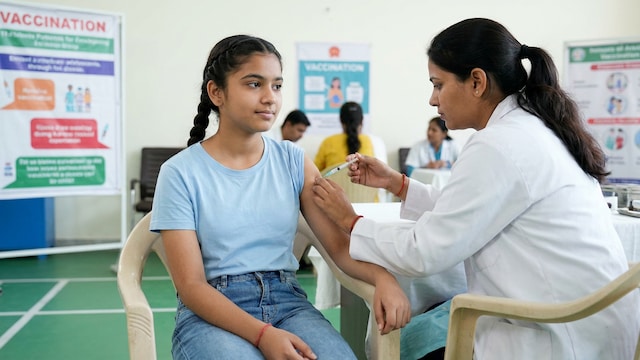
Five states have reported 100 per cent coverage of their identified target under India's Human Papillomavirus (HPV) vaccination campaign, while Maharashtra has vaccinated just 9 per cent of its target and Mumbai only 2 per cent, according to the October 14, 2026 U-WIN report.
India's HPV vaccination campaign has covered nearly 80 per cent of its identified target nationally, but stark differences across states underscore the challenges of cervical cancer prevention.
NDTV spoke to oncologists across domains who said, vaccination must go hand in hand with screening, early diagnosis and access to treatment.
The national coverage stands at 79.51 per cent, with 91.82 lakh girls vaccinated against an identified target of around 1.15 crore, the report shows. Gujarat, Uttar Pradesh, Andhra Pradesh, Madhya Pradesh and Mizoram have recorded 100 per cent coverage.
Maharashtra ranks 32nd among 36 states and Union Territories. Within the state, Pune has recorded 4 per cent vaccination band Thane 8 per cent, while Wardha has reported 25 per cent, according to the October 14 U-WIN data.
The figures highlight uneven progress in a campaign aimed at protecting girls against Human Papillomavirus (HPV), the infection responsible for virtually all cervical cancers.
But vaccination is only one part of the cervical cancer prevention strategy. Screening to detect high-risk HPV infections and precancerous lesions, followed by timely treatment, remains critical to reducing the disease burden.
Vaccination alone cannot eliminate cervical cancer
India's cervical cancer prevention efforts are increasingly centred on HPV vaccination, but the wider elimination strategy also requires screening women, identifying precancerous lesions and ensuring they receive treatment.
The World Health Organization's cervical cancer elimination framework includes targets for vaccination, screening and treatment. Its screening target envisages 70 per cent of women being screened with a high-performance test by the age of 35 and again by 45.
The issue was discussed at the National Consultative Workshop on the Implementation Framework for Cervical Cancer Elimination in India, where state health officials and experts deliberated on screening practices, implementation barriers and ways to improve uptake.
The workshop presentation by Dr Abhishek Shankar, Radiation Oncologist at AIIMS Delhi, raised questions about whether states are prepared to transition from Visual Inspection with Acetic Acid (VIA) to HPV DNA-based screening.
Dr Shankar's presentation highlighted that improving screening coverage requires more than making tests available. Women need to be reached, screened, informed of their results and linked to treatment where necessary.
The presentation identifies barriers that have historically impeded screening uptake, including lack of awareness, stigma, limited access to healthcare facilities, shortages of trained personnel, financial constraints, inconsistent implementation and inadequate follow-up.
The challenge, therefore, is not only to make screening available, but to ensure women are reached, screened, informed of their results and linked to treatment where necessary.
HPV DNA testing could change the screening approach
The workshop also discussed the role of HPV DNA-based screening in India's cervical cancer elimination strategy.
Dr Shankar spoke of centralised screening solutions and the importance of testing for 14 high-risk HPV genotypes argues for greater use of molecular testing to detect HPV infections before they progress to cervical disease.
HPV DNA testing identifies high-risk infections, while genotyping can help distinguish HPV 16 and 18 from other high-risk types and guide subsequent clinical management.
Dr Shankar cited a comparison in which HPV testing had a pooled sensitivity of 89.9 per cent for detecting CIN2+, compared with 62.5 per cent for conventional Pap cytology and 72.9 per cent for liquid-based cytology.
The higher sensitivity of HPV DNA testing could help identify women at risk earlier, although a positive HPV result does not necessarily mean a woman has precancerous lesions or cancer. Further clinical evaluation and management depend on the screening pathway.
Dr Shankar's presentation emphasised the importance of identifying high-risk HPV infections before they progress to disease, while ensuring that screening results are linked to appropriate clinical evaluation and treatment.
Can self-sampling and centralised laboratories improve access?
The workshop presentations also discussed self-sampling as a possible way to address barriers to cervical cancer screening, including discomfort with pelvic examinations, cultural reluctance and geographical access.
A proposed hub-and-spoke model would allow samples to be collected at community-level facilities and transported to central laboratories equipped for molecular testing. Results would then be returned to screening facilities, where women requiring further evaluation could be referred to appropriate centres.
Such a model could potentially expand access to testing without requiring molecular diagnostic infrastructure at every primary healthcare facility. Its effectiveness, however, would depend on sample transport, laboratory capacity, turnaround time, communication of results and the availability of treatment and referral services.
Doctors also noted, a screening initiative in Amethi as an example of how a hub-and-spoke model could be implemented, with samples collected at Health and Wellness Centres and transported to a central laboratory for testing.
A screening programme that identifies women at risk but cannot ensure follow-up would remain incomplete.
The road to elimination
India's cervical cancer elimination effort involves more than preventing HPV infections through vaccination. It also requires screening women who may already be at risk, detecting precancerous changes, treating them early and ensuring that access to services does not depend on where a woman lives.
The October 14, 2026 U-WIN report indicates progress in vaccination, but the differences across states raise questions about how uniformly the campaign is reaching its target population.
The discussions at the National Consultative Workshop on the Implementation Framework for Cervical Cancer Elimination in India point to another challenge: building a system that combines vaccination, screening, awareness, reliable diagnostics and treatment pathways.
Disclaimer: This content including advice provides generic information only. It is in no way a substitute for a qualified medical opinion. Always consult a specialist or your own doctor for more information. NDTV does not claim responsibility for this information.