

)
For busy professionals, finding time to exercise can feel almost impossible. Long working hours, meetings, commuting and household responsibilities can leave little room for a traditional gym session. However, a lack of time does not necessarily mean you have to give up on physical activity. Even a short workout can help you break up long periods of sitting and add more movement to your day. A seven-minute workout can be especially useful for people who struggle to fit exercise into their schedule.
For people who spend much of their day at a desk, a short movement break can also help counter some of the effects of prolonged sitting. The biggest advantage of a seven-minute workout is that it removes one of the most common barriers to exercise: time. You do not need a gym, expensive equipment or a large space. A short session can be done at home, in a hotel room or even during a break from work, depending on the exercises you choose.
What Is A 7-Minute Workout?
A seven-minute workout is a short exercise session that combines several movements performed for brief periods. The exercises can target different parts of the body and may include cardio, bodyweight strength exercises and movements that improve mobility.
The routine below requires no special equipment. You can perform each exercise for 30 seconds, followed by 15 seconds of rest or transition time. Complete all the exercises once for a quick seven-minute session.
1. Jumping Jacks
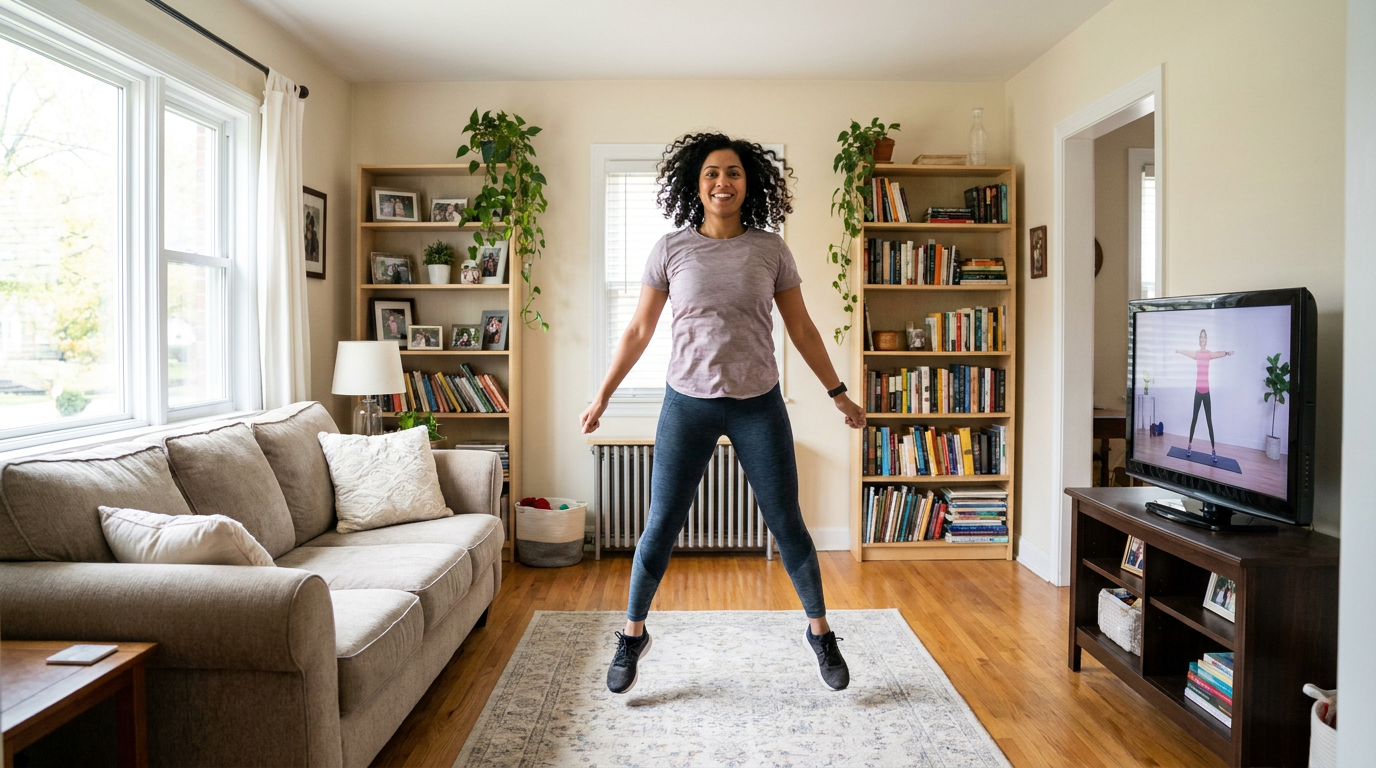
Jumping jacks are a simple way to raise your heart rate. Stand upright with your feet together and arms by your sides. Jump your feet out while raising your arms overhead. Return to the starting position and repeat. If jumping is uncomfortable, step one foot out at a time instead.
2. Bodyweight Squats
Squats work the thighs, hips and glutes while also engaging your core. Stand with your feet around shoulder-width apart. Push your hips backwards and bend your knees as though you are sitting in a chair. Keep your chest lifted and then return to standing. Do not rush the movement.
3. Push-Ups
Push-ups primarily work the chest, shoulders and arms while engaging the core. Place your hands slightly wider than your shoulders and keep your body in a straight line. Lower your chest towards the floor and push yourself back up. Beginners can perform push-ups with their knees on the floor or against a wall.
4. High Knees
High knees give you a quick cardiovascular challenge. Stand upright and lift one knee towards your chest, followed by the other. Move your arms naturally as you alternate. You can increase the pace if you're comfortable. For a lower-impact version, march in place rather than running.
5. Reverse Lunges
Reverse lunges strengthen the legs and challenge balance. From a standing position, step one foot backwards and lower your body until both knees are comfortably bent. Push through the front foot to return to standing, then switch sides.
6. Plank
Plank is a simple exercise for strengthening the core. Place your forearms on the floor and extend your legs behind you. Keep your body in a straight line from your shoulders to your heels. Tighten your abdominal muscles and hold the position.
7. Glute Bridges
Glute bridges target the glutes and also involve the muscles around the hips and core. Lie on your back with your knees bent and feet flat on the floor. Push through your feet to lift your hips towards the ceiling. Pause briefly before lowering them slowly. Avoid over-arching your lower back.
How To Fit Your Workout Into Your Workday
The best time for a seven-minute workout is the time you can follow consistently. You can exercise before work, during a lunch break or after finishing your workday. Another option is to use it as a movement break after several hours of sitting. If seven minutes feels manageable, you can gradually repeat the circuit two or three times. However, longer is not always better. The important thing is to build a routine that fits your schedule and fitness level.
Disclaimer: This content including advice provides generic information only. It is in no way a substitute for a qualified medical opinion. Always consult a specialist or your own doctor for more information. NDTV does not claim responsibility for this information.