

)
Autism Spectrum Disorder (ASD) is widely recognised as a neurodevelopmental condition affecting communication, behaviour, and social interaction. Globally, autism has long been reported to be more common in boys than girls, with estimates suggesting a male-to-female ratio of 3-4:1. However, emerging research indicates that this gap may not reflect true prevalence but rather a significant underdiagnosis of autism in girls.
In India, where awareness around autism is still developing, particularly outside urban centres, this disparity becomes even more pronounced. Experts say that diagnostic frameworks and screening tools have historically been based on male presentations of autism, making it harder to identify the condition in girls who may exhibit different, less obvious symptoms.
According to research published in the Indian Journal of Medical Research (IJMR), early diagnosis and intervention are critical for improving outcomes in children with autism. Yet, many girls remain undiagnosed or misdiagnosed until adolescence or adulthood, often after struggling with mental health challenges or social difficulties for years. Understanding how autism presents differently in girls, and why it is often missed, is essential for timely intervention, better support systems, and improved quality of life.
Why Autism Is Often Missed In Girls
Autism in girls frequently goes undetected due to differences in how symptoms present. According to a study published in Indian Pediatrics in 2024, "Early signs of autism are often picked up by parents between 6-18 months of age and typical symptoms are evident by 2-3 years." However, traditional diagnostic criteria tend to focus on more overt behaviours commonly seen in boys.
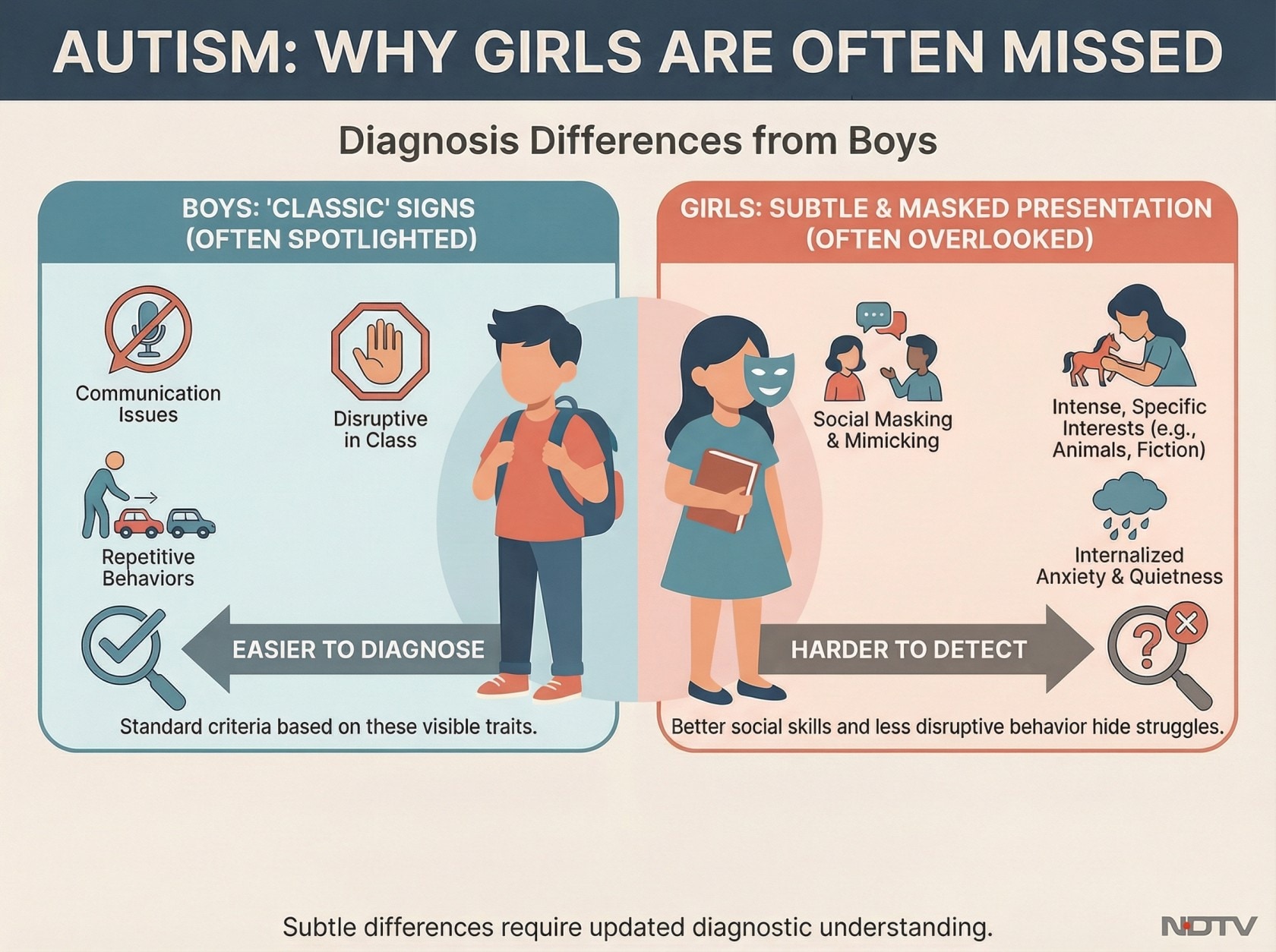
Dr. Sankalp Mohan, Senior Consultant-Neurology at Fortis Hospital Manesar, explains: "Diagnostic frameworks, largely derived from Western male-centric data, tend to capture more overt symptoms such as poor eye contact and repetitive behaviours, which are more commonly recognised in boys."
This creates a gap where girls, who may not exhibit these classic signs as prominently, are overlooked during early screening.
The Role Of "Masking" And Social Conditioning
One of the most significant reasons autism is underdiagnosed in girls is the tendency to "mask" symptoms. Dr. Mohan notes that "many girls exhibit 'masking' or 'camouflaging' behaviours, consciously imitating peers, forcing eye contact, or rehearsing social interactions."
In the Indian sociocultural context, this becomes even more complex. "Girls are often encouraged to be compliant, quiet, and socially adaptive, so these behaviours may be misinterpreted as normal or even desirable," he adds. As a result, underlying social communication difficulties may remain hidden for years.
Also Read: Maternal Perinatal Depression Increases Risk Of Autism In Toddlers, Finds Study
Subtle Signs That Often Go Unnoticed
Another factor contributing to delayed diagnosis is the nature of restricted interests and social challenges in girls. "In boys, restricted interests may appear unusual or intense, prompting evaluation," Dr. Mohan explains. "In girls, these interests may align with socially accepted themes such as stories or animals but are pursued with disproportionate intensity."
Because these interests appear typical, they are rarely flagged as a concern. Additionally, social difficulties in girls often manifest differently:
- Trouble maintaining friendships
- Emotional sensitivity
- Social exhaustion or fatigue
"These children are often labelled as 'shy' or 'introverted,' rather than being evaluated for autism," Dr. Mohan says.
Misdiagnosis And Mental Health Overlap
In many cases, girls with autism are first diagnosed with other conditions rather than ASD itself. Dr. Mohan notes: "Girls with autism are more likely to present with anxiety, depression, somatic complaints, or academic decline. Autism may not be considered initially." This overlap of symptoms can lead to misdiagnosis or delayed identification.
Systemic And Cultural Challenges In India
India faces unique challenges when it comes to autism diagnosis, particularly for girls. "Access to trained specialists and standardized diagnostic tools remains limited in many parts of India," Dr. Mohan explains. "Gender-sensitive diagnostic approaches are still not widely adopted."
Additional barriers include:
- Limited awareness in schools
- Lack of structured screening programs
- Social stigma around neurodevelopmental disorders
Teachers, who are often the first to notice developmental concerns, may miss subtle symptoms in girls. "Educational settings play a critical role, but subtle social difficulties in girls are easily overlooked," he adds.
The "Female Protective Effect"
From a biological perspective, researchers are exploring why fewer girls are diagnosed with autism. Dr. Mohan says: "The concept of a 'female protective effect' suggests that girls may require a higher threshold of genetic or environmental risk to manifest autism."
This means that when autism is diagnosed in girls, it may present later or with more complex symptoms.
Also Read: Supreme Court Bars Stem Cell Therapy For Autism: Why The Ruling Matters
Why Early Diagnosis Matters
Delayed diagnosis can have long-term consequences for girls with autism. "Many girls grow up without understanding their difficulties, leading to low self-esteem, social isolation, and increased vulnerability to mental health disorders," Dr. Mohan warns.
Early identification allows for:
- Targeted behavioural interventions
- Improved communication and social skills
- Better academic and emotional support
Autism in girls is often overlooked, not because it is rare, but because it presents differently. From masking behaviours to societal expectations and diagnostic limitations, multiple factors contribute to delayed identification, especially in India. Recognising these differences is the first step toward bridging the gap. Greater awareness, gender-sensitive diagnostic approaches, and early intervention can ensure that girls with autism receive the support they need to thrive.
Disclaimer: This content including advice provides generic information only. It is in no way a substitute for a qualified medical opinion. Always consult a specialist or your own doctor for more information. NDTV does not claim responsibility for this information.