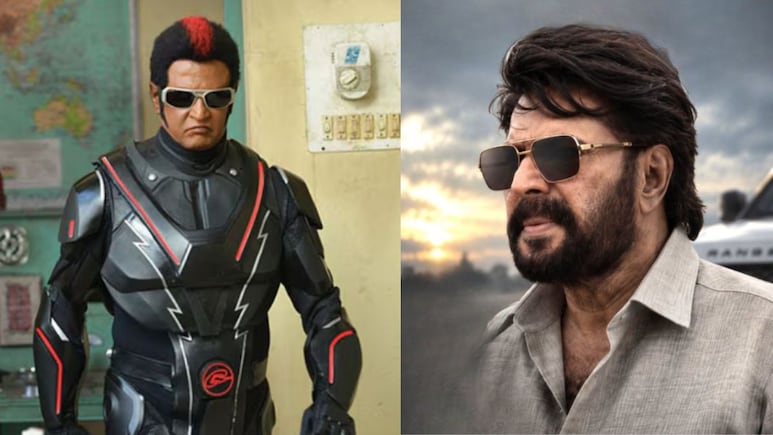
Before he became the superstar that he is today, fans queued up in theatres to watch him play the villain. Films like Apoorva Raagangal, Moondru Mudichu, 16 Vayathinile and Addu Puli Attam initially established Rajinikanth as the striking antagonist in Tamil cinema before he turned hero with Bairavi (1978). There's been no looking back for Superstar Rajinikanth since. But breaking the conventions of his hero image, the superstar in fact played a negative character in his film, Enthiran, facing off against himself as the protagonist.
In director Shankar's Enthiran, Rajinikanth essays the dual roles of Dr Vaseegaran and Chitti, the robot that eventually becomes a menacing antagonist. While Rajinikanth may have never taken on the role of antagonist otherwise, today, the relationship between stardom and villainy has come a full circle as stars in south cinema, like Mammootty, Shiva Rajkumar, Kamal Haasan, Fahadh Faasil and Nagarjuna, are actively embracing villain roles opposite equally established heroes in other industries.
<
In director Rajkumar Periasamy's new film OM: Chapter 1: Udhiram - The Blood Wood, Malayalam superstar Mammootty, affectionately called Mammukka, will be seen as Burma Karthikeyan, also known as Siya, a powerful figure who controls a red sandalwood smuggling network. He will be seen taking on the protagonist, Dhanush, who essays the role of an undercover police officer in the film. Interestingly, Mammukka's character is said to be more grey-shaded than black and that is perhaps what makes the new age villain roles more appealing to stars.
During recent promotional events for the film, Mammootty spoke candidly about initially turning down the project due to health reasons. He even joked, "I still don't understand whether I am the villain or the hero in this film!" For an actor who has spent more than four decades playing the leading man, the distinction between hero and villain seems to have become increasingly irrelevant. What matters, perhaps, is the opportunity to play an interesting character, who is morally ambivalent.
However, this isn't the first time that Mammootty has essayed a negative or morally ambiguous role. In Malayalam cinema, where the Padma Bhushan awardee has successfully defied the conventional hero image, he has played some of the striking roles as the flawed anti-hero in south cinema. Even at the peak of his stardom, he has experimented with such roles. Films like Vidheyan, Paleri Manikyam: Oru Pathirakolapathakathinte Katha, Munnariyippu Puzhu and Abraham Ozler show how the 75-year-old star doesn't allow boundaries to define his craft and is willing to push boundaries to give the audience the unexpected at every turn.
Interestingly, the Malayalam star has turned down numerous offers to play antagonist in other film industries. Producer Allu Arvind revealed in 2019 that he had asked Mammukka to play a negative role in a film starring Pawan Kalyan and the Brahmayugam star declined. However, he eventually said yes to playing a character with grey shades in Akhil Akkineni's Telugu film Agent (2023) and now with Dhanush's Tamil film OM, he has taken on a full-fledged anti-hero role in many ways.
In a promotional video for his film Kalamkaval, the Patriot actor had stated, "Doing negative roles is not about courage; it is about desire. I do not want to ignore the actor within me. What I like most is being an actor. Everything else came later. I have no objection to being called a star, but my preference is to be recognised as an actor." And it's this willingness to explore the motivations, contradictions and complexities of a character with grey shades that makes such roles increasingly attractive to stars who want to push creative boundaries and audience perceptions.
Keeping in line with this trend, Kannada star Shiva Rajkumar aka Shivanna has been confirmed as the antagonist in Ajith Kumar's new film, Dare Devil, to be directed by Adhik Ravichandran. The actor who has spent several decades playing the hero in Kannada cinema is being courted by Tamil filmmakers for his ability to bring a different kind of star power to the antagonist's role, just like Mammukka.
Ajith Kumar's manager, Suresh Chandra, made an interesting point about casting him in the Tamil star's home production when he told Cinema Express, "Shivanna has been cast in an unconventional villain role. He does not play the usual unidimensional bad guy. His role is multi-dimensional and powerful. "Ajith sir is a huge fan of Shivanna. He feels that Shivanna carries this powerful presence and that Dare Devil needs to utilise that presence."
What is clear is that filmmakers are now no longer writing the villain as a one-dimensional character who exists merely to engage the hero in a few fights before meeting their inevitable downfall in the climax. The antagonists being crafted today are more layered, have greater depth and possess a distinct identity of their own. They command as much screen presence - and sometimes even screen time - as the hero, and in some instances, end up becoming the film's biggest talking point. And every star who steps into such roles has the creative freedom to present them with their unique stamp.
And one shouldn't forget the audience in this changing narrative. Viewers too no longer want to see a simple good versus evil template - they want to see an antagonist who brings novelty, is morally ambiguous and also has an emotional arc. When a hero whom they celebrate, steps into the shoes of a grey character, they are curious to see a different side of the star. Thus, it's not surprising to see the casting of established stars across languages. With exposure to world content thanks to OTT platforms, the Indian audience has developed an appetite for unconventional characters and filmmakers are exploring exciting new collaborations as a result.
South cinema is not redefining the good versus evil template today but stars are also looking to redefine what it means to be a hero and what it means to be a villain. At a promotional event for Kalki 2898 AD in 2024, Kamal Haasan spoke about his desire to play a villain. Referring to the creative freedom he gets, the Thug Life star said, "I always wanted to play a bad man because the bad man gets to do all the good things." Similarly in an interview with PTI, actor Vijay Sethupathi said, "I enjoy villain roles. In real life, I can't kill anybody, I get a chance to do it (in films). I can express that wholeheartedly. On screen, you can express and play with emotions, it's fun."
When Malayalam star Fahadh Faasil essayed the role of antagonist SP Bhanwar Singh Shekhawat in the Pushpa franchise and was lauded for it, he spoke about why such roles appealed to him. Talking about his character in Pushpa 2 at an Aavesham promotional event, he said, "The role isn't about how cruel I will be, it's far more interesting, it's not the usual kind of cruelness; it's a different track."
Ultimately, the changing face and nature of the antagonist reflects how South cinema is rethinking the very idea of heroism. When antagonists are given as much importance and as strong character arcs as the protagonists, stars have the opportunity to move beyond their established screen personas and explore a different facet of their acting abilities. The line between the hero and villain is becoming increasingly blurred but equally compelling and integral to cinema's constantly evolving narratives.
Also Read | Nitesh Tiwari's Ramayana: Did Ravana Just Get A Socialist Makeover?
