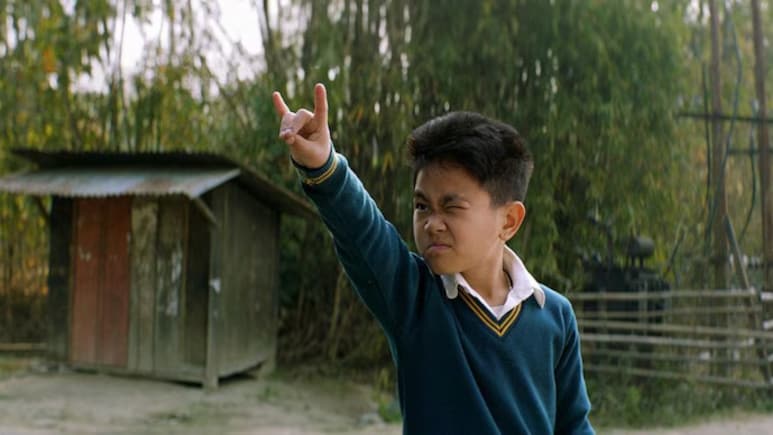
Marked by a keen eye for detail, a gentle rhythm and controlled buoyancy, Boong, Manipuri writer-director Lakshmipriya Devi's remarkably accomplished debut feature, probes a climate of discord and disquiet in the garb of a story of a boy, his mother and her absent husband.
The deceptively simple but marvellously evocative and wonderfully well-crafted film views life in a strife-torn region through the prism of a fractured family that hopes against hope of becoming whole again.
Boong, produced by Excel Entertainment, is a tale of love, loss, longing, and a tenacious spirit rooted in a child's innocence and innate ebullience in the face of adversity.
The film just won a BAFTA Award in the "children's and family film" category. But it breaks the confines of the genre with intent.
The narrative, centred on a lively, wide-eyed schoolboy unsullied by the doubts and despondency around him, opens out into what is a vivid and illuminating portrait of a place and a time where surface serenity conceals a brewing unrest.
Boong plays out in a part of India that has seen that steady widening of ethnic fissures, aggravated by a leadership vacuum and delusional politics. The situation has left the people at their tether's end and groping for elusive answers.
It is, indeed, a film about a search for reconciliation and peace. It seeks to make sense of socio-political and familial turmoil from the standpoint of Brojendra, alias Boong (Kugun Kipgen), a lively schoolboy who defies distances and barriers.
The boy, with his best friend Raju (Angom Sanamatum) in tow, goes in search of his missing father, hoping to give his mother Mandakini (Bala Hijam) a surprise gift, a gift that has the potential of bringing her life back on track.
Mandakini, who sells handloom sarees from a shop in the bazaar, has not heard from her husband Joykumar (Hamom Sadananda) since he left Imphal for the border town of Moreh in search of work.
The man, a wood smith whose tools now lie idle and bear witness to his inexplicable absence, has gone completely incommunicado. Phone calls to him go unanswered, triggering understandable fears and motivated rumours that he might no longer be alive.
Mandakini is, however, loath to believe the worst. Her son, too, hasn't stopped waiting for his father, his confidence and optimism bolstered by public acts of assertion by his mother.
Boong's deep connection with his missing father is most directly reflected in how he uses a sling shot, a skill that he imbibed from Joykumar.
A Madonna album lying around the house is a reminder of the man's fondness for the American pop singer-songwriter. Boong's father was the president of the Imphal East Madonna Fan Club.
Later in the film, after Boong sets out with his best friend to look for Joykumar, the Madonna factor returns centre stage, if only briefly and tangentially. Her 'presence' opens a door for him when a popular performer does a show in Myanmar, across the border from Moreh, to help the boy find his father.
In Moreh, Boong and Raju encounter migrants, armed security men in uniform and a thriving underground performance arena kept alive by a transgender subculture. They represent the many directions in which the state is being pulled. But since they are beyond Boong's comprehension, they matter little to him.
What does though are the racial slurs that Raju, a boy who never saw his mother, faces. The only son of a Marwari trader Sudhir Agarwal (Vikram Kochhar), he is branded a "meyang" (outsider). But no matter what, he and Boong are an inseparable duo.
The prankster in Boong comes to the fore when he is asked to lead the school prayers. He breaks into "Like a Virgin". The transgression is
among other deliberate acts that he indulges in in the hope of being expelled.
He has his sights set on getting into an English medium school. Once he makes it there, the social and class divides become more apparent than ever before but for him and Raju, like for the adults around them, life goes on even as tensions keep bubbling forth to the surface.
The tone of the film changes perceptibly when the boys decide to do the unthinkable. They sneak into a van headed to Moreh with the body of a female classmate's deceased grandfather. Armed with a photograph of Joykumar, the duo goes to great lengths and even crosses the heavily militarised Manipur-Myanmar border to locate the man.
Boong's steely childlike resolve drive him into a quest that is fraught with risk and uncertainty. Gugun Kipgen's performance, marked by infectious joie de vivre, provides the film a solid core. As Raju, Angom Sanamatum is terrific.
Lakshmipriya Devi's screenplay never strays away from its principal concern - the boy's determination to skirt around the hurdles in his way. He is, in the end, faced with a choice that can only compel him to think like an adult.
The script imparts a larger context to the tale by framing Boong's adventure against the backdrop of the realities of a state that was to be wracked by ethnic conflict soon after the film was wrapped.
Its commentary on the world of adult also encapsulates the predicament of a woman who refuses to let the existence of her husband be erased by circumstances and people that stand to benefit from his disappearance, including his own elder brother and sister-in-law.
The underlying family and village dynamic reflects a wider, more ominous phenomenon that is alluded to through the passing reference to an insurgent outfit fighting for a Manipur that is free to determine its destiny.
But Boong is eventually about hope and acceptance, about the need to look for flashes of light in the darkest of times and find a way to move on. Not to be missed for it articulates truths that matter.
-
Gugun Kipgen, Bala Hijam Ningthoujam, Angom Sanamatum, Vikram Kochhar
