






Fuel prices have skyrocketed in several nations, including developed economies, around the world amid the ongoing Iran war. In many nations, governments urged citizens to use public transports or walk to office for fuel rationing.
In contrast, Indian consumers have (so far) been immune to fuel shortages or price hikes. While the price of premium fuel was raised by oil marketing companies (OMCs), regular fuel has remained largely untouched. Follow Live Updates
This is particularly significant as India is an energy-dependent nation, and produces a very small percentage of oil that it consumes. Additionally, global crude costs have jumped because of the Iran war and supply risks.
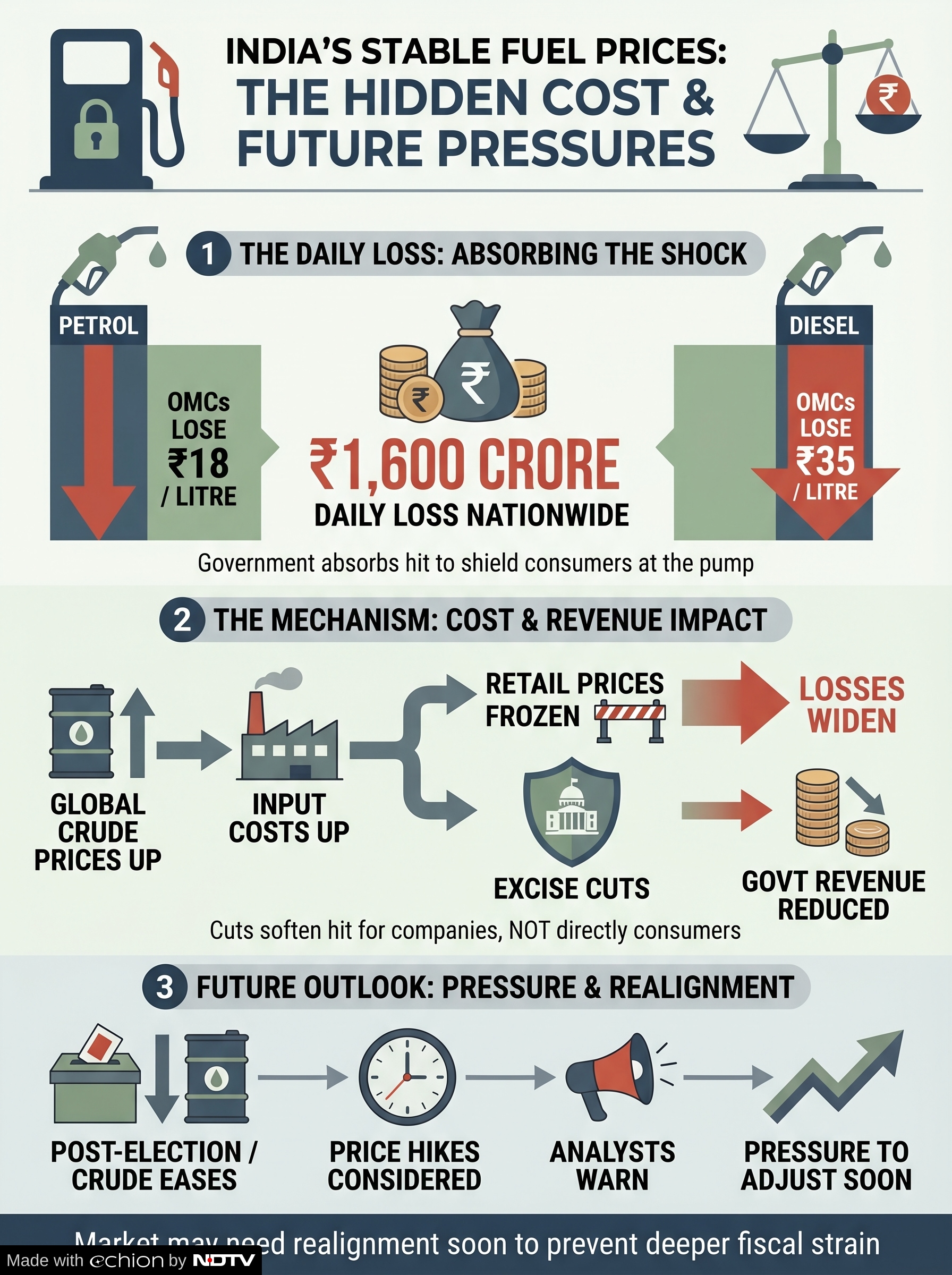
Thus, in order to shield consumers from price rise, state-run OMCs are incurring a heavy loss every day. Here's what the data says:-
| Metric | Value | Notes |
| Petrol loss per litre | Rs 18 | OMCs sell below cost |
| Diesel loss per litre | Rs 35 | Loss widened with crude surge |
| Daily total loss | Rs 1,600 crore | Across all three PSU fuel retailers |
| Last retail price freeze | Since April 2022 | No change for 3 years |
| Global crude (recent peaks) | $120+/barrel | Raises input cost for OMCs |
Key players bearing the hit:
- Indian Oil Corporation (IOC)
- Bharat Petroleum Corporation Ltd (BPCL)
- Hindustan Petroleum Corporation Ltd (HPCL)
These three state-run firms control most petrol/diesel sales.
If domestic fuel prices were aligned with global cost changes, petrol would be Rs 113/litre (approximately) and diesel Rs 123/litre (approximately) now. Instead, OMCs sell at much lower rates, incurring massive deficits.
| Scenario | Petrol price | Diesel price |
| India pump price now | Rs 94-105 | Rs 87-90 |
| Actual cost-based price | Rs 113 | Rs 123 |
| Gap per litre | Rs 18 | Rs 35 |
It is important to mention here that the Indian government is also take a hit to keep consumers protected. Following the Iran war, the government announced a cut on excise duties on petrol and diesel. This cut hits the government revenue directly. However, this doesn't help the OMCs much as most of the cushioning goes into softening losses.
According to industry analysts, these losses are set to drag quarterly results of the OMCs down. The daily estimated loss is pegged at Rs 1,600 crore.
Add image caption here
"The current scenario demonstrates a disconnect between the global price of crude oil and the price of oil products sold to consumers in India. Their crude is now selling for near $85-90 a barrel, an increase of 10-15 per cent in the last few weeks. However, the price of fuel in India is unchanged. As a result, oil companies in India are losing an estimated 1,600 crore rupees a day. If this continues, the losses for the companies will reach Rs 45,000-50,000 crore a month," said Siddharth Maurya, Managing Director, Vibhavangal Anukulkara.
He added, "Suppressing the price of fuel will likely help keep the inflation rate in India steady however it creates inefficiencies in the fuel pricing system. From a policy perspective, the current situation is clearly unsustainable. Increasing the price of diesel and petrol by Rs 1 would be a positive step in the right direction to relieve some losses on the oil marketing companies, and would likely have a minimal impact on inflation. The current situation is clearly preventing the companies from investing in refining and energy initiatives which are vital for the energy transition."
Crude Oil Price Outlook
According to Prathamesh Mallya, DVP Research, Commodities, AngelOne, oil prices have been very volatile in the recent past with Brent crude falling over 13 per cent and WTI dropping more than 14 per cent as of April 15, following the announcement of a two-week ceasefire in the Middle East.
"Oil prices have corrected on account of following factors. The two-week ceasefire, which includes the partial reopening of the Strait of Hormuz, has provided temporary relief to the market. Markets are also responding to potential further negotiations in Pakistan to prevent a repeat of the blockade. We expect the volatility to continue in the coming trading session on account of the geo-political tensions in Middle East. Oil Prices might move higher towards $100 in the next fortnight till the time the negotiations between US-Iran-Israel continues," he added.
Track Latest News Live on NDTV.com and get news updates from India and around the world

