






You pay your health insurance premium every year. Then comes the medical emergency. A hospital stay. A surgery. A sudden illness.
And just when you think your insurance policy will do its job, the real battle begins: getting the claim approved.
For years, this has been one of the biggest pain points for Indian policyholders. Delayed approvals. Endless paperwork. Partial settlements. And in some cases, outright rejections.
Now, the Insurance Regulatory and Development Authority of India (IRDAI) is trying to change that.
A series of reforms introduced by the regulator aims to make claims faster, more transparent and less stressful. But will they be enough to fix a system that has frustrated millions?
The Problem Is Bigger Than Most People Realise
The numbers tell a troubling story.
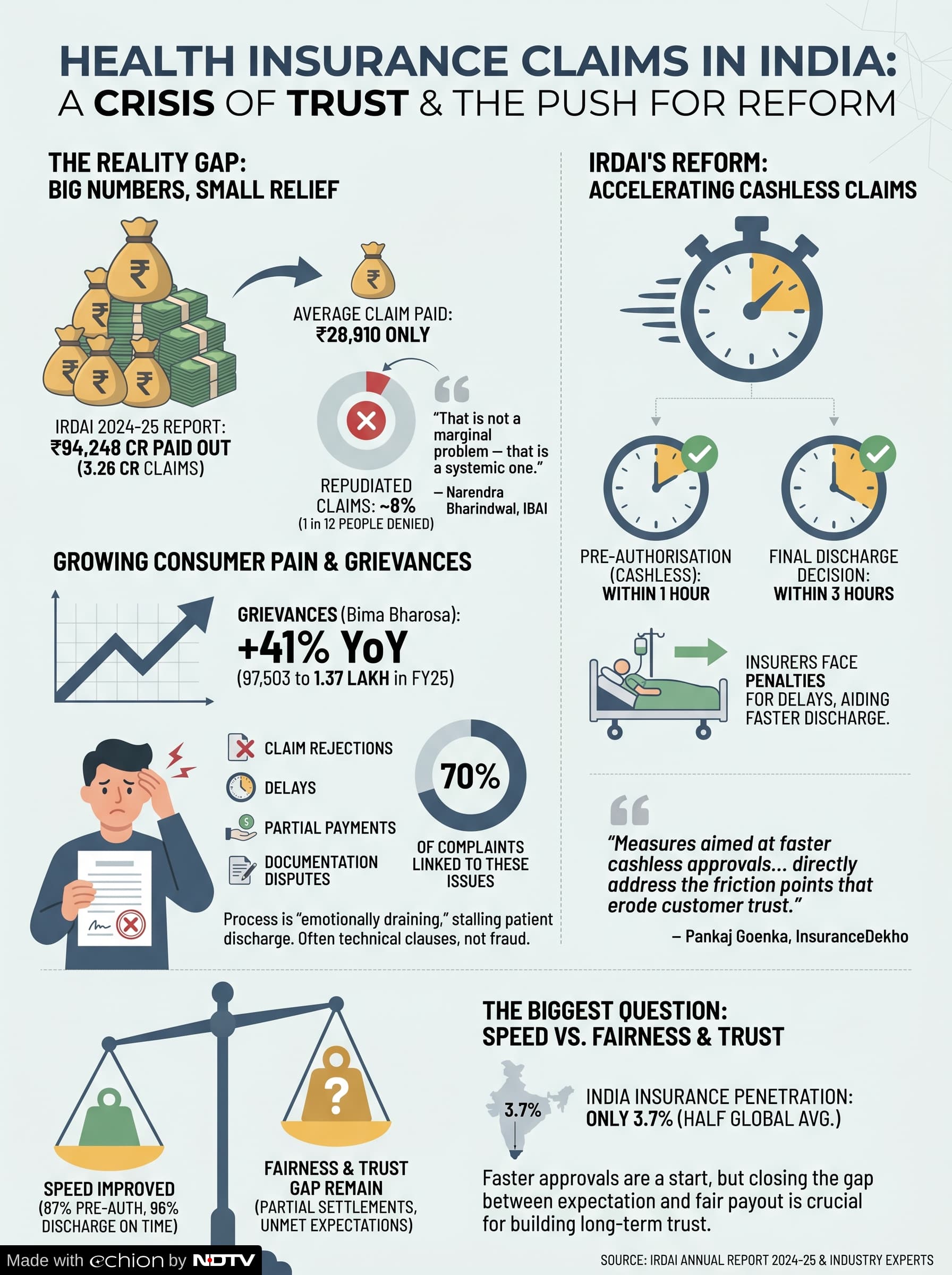
According to IRDAI's Annual Report 2024-25, insurers processed 3.26 crore health insurance claims and paid out Rs 94,248 crore during the year.
But beneath those headline figures lies a worrying reality.
Narendra Bharindwal, President of the Insurance Brokers Association of India (IBAI), points out that the average health claim paid stood at just Rs 28,910, even as medical inflation continues to push hospital bills much higher.
More concerningly, around 8 per cent of health insurance claims were repudiated. In simple terms, nearly one in every 12 people who filed a health insurance claim did not receive a payout.
Consumer dissatisfaction is also rising.
Grievances registered on Bima Bharosa jumped 41 per cent year-on-year to 1.37 lakh in FY25 from 97,503 in FY24. Bharindwal notes that nearly 70 per cent of complaints in the health and general insurance segment were linked to claim rejections, delays, partial payments or documentation disputes.
"That is not a marginal problem - that is a systemic one," he says.
Why Claims Become A Nightmare
Anyone who has dealt with a health insurance claim knows the experience can be emotionally draining. The stress often arrives at the worst possible moment-when a patient is ready to leave the hospital.
Arun Ramamurthy, co-founder of Staywell.health, says policyholders frequently face uncertainty around pre-authorisations, reimbursement reviews and documentation requirements.
The frustration is not always about money.
Patients and their families are often left waiting for updates, responding to repeated requests for documents, or trying to understand why a medically necessary treatment is being questioned.
Many disputes arise because of technical policy clauses, waiting periods, exclusions, room-rent limits or incomplete disclosures rather than outright fraud, Ramamurthy explains.
The result is confusion, anxiety and a growing trust deficit.
What Has IRDAI Changed?
IRDAI's latest reforms are designed to tackle exactly these issues. One of the most significant changes relates to cashless claims.
Under the new framework, insurers must process cashless pre-authorisation requests within one hour. Once a hospital sends the final discharge request, insurers must communicate their decision within three hours.
If they fail to do so, they may have to bear additional hospitalisation expenses incurred because of the delay. This could be a game changer for families stuck in hospital rooms simply because paperwork is moving slowly.
Ramamurthy says the reform directly addresses a common problem where patients are medically fit for discharge but remain admitted while waiting for claim clearance.
The regulator has also tightened transparency requirements. If an insurer rejects a claim, it must clearly explain the reason and point to the specific policy clause supporting the decision.
For policyholders, this means fewer vague explanations and greater clarity about why a claim was denied.
Early Signs Look Promising
The initial results suggest insurers are responding.
According to Bharindwal, nearly 87 per cent of pre-authorisation requests and more than 96 per cent of discharge authorisations are now being processed within the prescribed timelines.
This marks a significant improvement from the delays many customers experienced in the past. The reforms have also been welcomed by industry participants.
Pankaj Goenka, Chief Business Officer at InsuranceDekho, says the measures address some of the biggest friction points in the customer journey.
"Measures aimed at faster cashless approvals, standardised documentation requirements, and tighter turnaround timelines directly address the friction points that erode customer trust the most," he says.
Goenka believes the changes could make it easier for advisors and insurance partners to recommend health insurance products because customers will have greater confidence in the claims process.
But The Biggest Question Remains
While faster approvals are important, experts say speed alone does not solve everything. A claim approved quickly is not necessarily a claim settled fairly.
Bharindwal argues that the deeper issue lies in the gap between what customers expect and what they ultimately receive. Partial settlements due to sub-limits, exclusions, non-medical expenses or policy conditions continue to frustrate policyholders.
People pay premiums expecting protection. When a large part of a hospital bill remains unpaid, trust suffers.
This becomes even more important at a time when insurance penetration in India remains just 3.7 per cent, roughly half the global average.
Every delayed, disputed or partially paid claim can discourage potential customers from buying insurance altogether.
Nevertheless, there is broad agreement that IRDAI has taken a major step in the right direction. The regulator's reforms aim to make insurers more accountable, reduce uncertainty and bring greater transparency to the claims process.
But implementation will determine whether these changes truly transform customer experience. Ramamurthy cautions that while the reforms will reduce friction, they cannot eliminate every dispute. Policy wording, disclosure issues and coverage limitations will continue to create challenges.
Goenka echoes a similar view, saying the focus must now shift to consistent execution across the insurance ecosystem.
For Bharindwal, the ultimate test is simple. Insurers should be judged not just by how quickly they process claims, but by how fairly they settle them. Because when a medical emergency strikes, policyholders are not looking for paperwork.
They are looking for protection. And that is exactly what health insurance is supposed to provide.
Track Latest News Live on NDTV.com and get news updates from India and around the world

