






Turning 30 brings a familiar financial choice. You can sign a 20-year home loan and become a homeowner. Alternatively, you can rent and put the same money into the market. Most people assume buying is the sensible option. The numbers tell a different story.
Urban property prices in India have grown faster than median household incomes for several years. In prime cities, home loan EMIs now consume 40 to 65 per cent of household income. Safe financial rules suggest keeping this between 30 and 35 percent. At the same time, rental yields sit at just 2 to 3 per cent. Renting a flat costs a fraction of the total debt, maintenance, and taxes needed to buy it.
Price-to-rent ratios in major cities regularly sit between 35 and 50 times annual rent. When this ratio crosses 25 to 30 times, investing capital into diversified funds produces better long-term results.
The Real-World Comparison
Harsha Vardhana, Founder and Group CEO, Atom Financial Services, cites a comparison. Consider two 30-year-olds in the same city with the same income.
The first sister buys a flat costing Rs 1.2 crore. She pays a 20 per cent down payment of Rs 24 lakhs. She takes a loan for the remaining Rs 96 lakhs at 8.75 per cent interest for 20 years. Her monthly EMI is roughly Rs 84,800. Adding maintenance and taxes brings her total monthly cost to Rs 90,000.
The second sister rents a similar flat for Rs 28,000 per month. She invests her Rs 24 lakhs into a diversified equity portfolio. Every month, she invests her monthly savings of Rs 62,000 into a systematic investment plan (SIP).
Twenty years later, at age 50, the homeowner owns a flat worth about Rs 4.23 crore, assuming property appreciates at 6.5 percent annually. The investor sister holds a portfolio worth about Rs 7.60 crore, assuming a 12 percent annual return in equity investments. The investor ends up ahead by roughly Rs 3.37 crore.
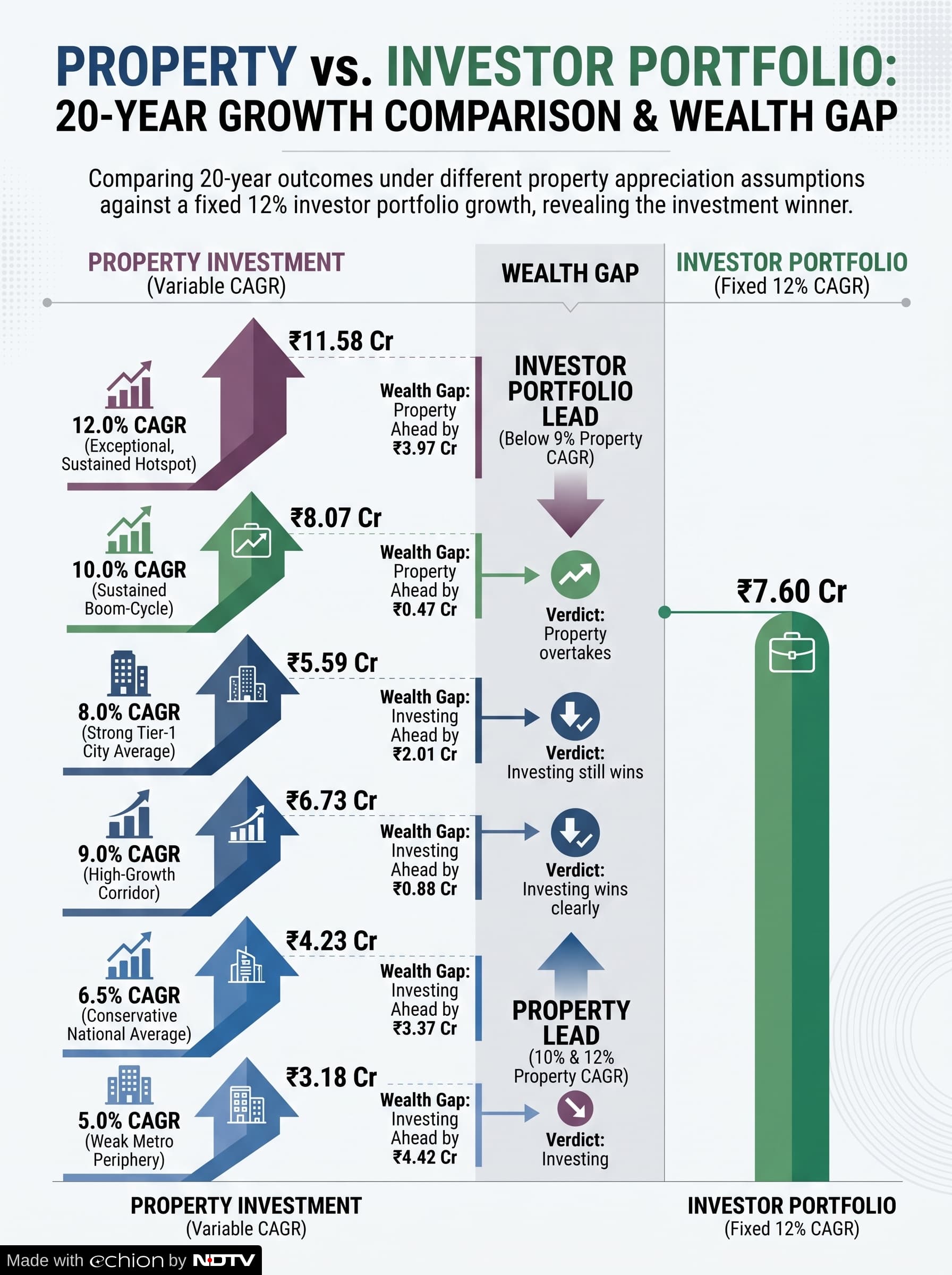
INVESTMENT GROWTH OVER 20 YEARS (IN CRORES)
- Investor (Equity SIP): Rs. 7.60 Crore
- Homeowner (Property): Rs. 4.23 Crore
- Wealth Gap: Rs. 3.37 Crore
This wealth gap compounds quickly over time:
- Year 5: The investor is ahead by Rs. 12 lakhs.
- Year 10: The gap grows to over Rs. 50 lakhs.
- Year 15: The difference crosses Rs. 1.4 crore.
- Year 20: The final stretch adds almost Rs. 2 crore more due to compounding.
Three Reasons Why Investing Beats Buying
According to Harsha Vardhana:
- Interest Costs Drain Wealth: On a Rs 96 lakh loan over 20 years, total interest costs roughly Rs. 1.07 crore. You pay more in interest than the original loan amount. In the early years, most of each EMI pays off interest, not principal.
- Opportunity Cost of Down Payments: A Rs 24 lakh down payment invested at age 30 compounds for two decades. Locking that money into stamp duty, registration, and equity removes it from the market during your highest-earning decade.
- EMIs Limit Life Flexibility: Paying Rs 85,000 monthly locks you into a fixed obligation. This leaves less room to take career risks, start a business, or relocate. Renters can make bolder moves in their thirties.
What The Data Shows
Data supports this pattern even in strong real estate markets. A CSEP study covering Indian housing from 1991 to 2021 found residential real estate appreciated at 9.3 percent annually. Other long-run studies put realistic Indian property growth at 5 to 9 percent annually.
RBI's House Price Index shows how uneven real estate growth can be:
| Period | Annual Home Price Appreciation |
| 2010 - 2015 | 16.0% |
| 2015 - 2020 | 5.5% |
Renting and investing stay ahead as long as property appreciates below roughly 9.5 to 10 percent annually. "The instinct to buy a home the moment you can afford the down payment is deeply ingrained, but it is worth pausing on what that down payment actually gives up," said Vardhana.
He added, "When we ran the 20-year numbers on a typical 30-year-old buying a 1.2 crore flat versus renting and investing the difference, investing came out nearly Rs 3.5 crore ahead. Almost half of every early EMI payment goes toward interest. Over 20 years, the interest bill on a Rs 96 lakh loan adds up to more than Rs 1 crore. Very few buyers calculate that cost before signing."
"We stress tested this against stronger property markets like Hyderabad and Bengaluru. Even then, investing stays ahead unless property appreciation holds above roughly 10 percent every year for two straight decades. Very few micro markets sustain that over long periods."
Practical Steps To Take
Buying a home at 30 still makes sense for families prioritising housing stability or for individuals who struggle to invest regularly without the forced structure of an EMI. In smaller cities with lower price-to-rent ratios, the gap between buying and renting is also much smaller.
If you are evaluating this choice, Vardhana gives these guidelines:
- Build a Cash Buffer First: Secure liquid savings equal to 3 to 5 times your annual expenses before committing to a home loan.
- Cap Your Housing Expenses: Keep total housing costs-including EMI, taxes, and maintenance-under 35 percent of your net income.
- Consider a Staged Approach: Invest aggressively through your thirties. Buy a home between ages 38 and 42 using a much larger down payment. This cuts years off the loan and saves significant interest.
Buying a house at 30 feels like a necessary milestone. Investing through your thirties and buying later often builds far greater wealth.
Track Latest News Live on NDTV.com and get news updates from India and around the world

