






Stock Market News: For years, bonds have carried a reputation problem.
They are often seen as products meant for retirees, conservative investors, or wealthy individuals with large portfolios. Stocks get the spotlight. Mutual funds dominate conversations. Fixed deposits remain a household favourite. Bonds, meanwhile, rarely make it to the center of the discussion.
But that perception is changing.
Also Read | Layoffs Are Rising In Tech, But These Skills Are Helping People Unlock Better Pay
As market volatility keeps investors on edge and interest rates continue to influence financial decisions, more Indians are looking beyond traditional investment options. Bonds are quietly emerging as an important tool for balancing risk and building more resilient portfolios.
According to Saurabh Jain, Co-Founder and CEO of Stable Money, much of the hesitation around bonds stems not from the asset class itself, but from long-standing misconceptions that no longer reflect the reality of today's market.
"The bond market has become significantly more accessible for retail investors over the past few years," says Jain. "Yet many people continue to make decisions based on outdated assumptions."
Here are five common myths about bonds that investors should leave behind.
Myth 1: Bonds Are Only for the Wealthy
Perhaps the biggest misconception is that bond investing is reserved for high-net-worth individuals and institutions.
That may have been true a few years ago. But the landscape looks very different today.
Saurabh Jain points out that regulatory changes have dramatically lowered the barriers to entry. One of the most significant developments was SEBI's decision to reduce the minimum investment size for corporate bonds from Rs 1 lakh to Rs 10,000.
This move opened the door for a much larger pool of retail investors.
Add to that the rise of digital investment platforms, and bonds are no longer an exclusive club. Investors can now explore a range of fixed-income opportunities without committing large amounts of capital.
"The accessibility of bonds has improved substantially," Jain says. "Retail investors today have far more opportunities to participate than they did even a few years ago."
Myth 2: Bonds Are Only for People Who Want Regular Income
Many investors associate bonds exclusively with monthly or periodic income.
That's only part of the story.
While bonds can generate predictable cash flows, financial experts say their value extends much further. They can play an important role in portfolio construction by helping reduce overall volatility and balancing exposure to riskier assets such as equities.

1-year bond yield Photo Credit: Trading Economics
Saurabh Jain believes investors often underestimate this aspect. "Bonds are not just income-generating instruments," he explains. "They can also serve as an important diversification tool, helping investors maintain stability during periods of market uncertainty."
In other words, bonds are not simply about earning interest. They are also about managing risk. When equity markets become turbulent, a well-allocated debt component can help cushion the impact on an investor's overall portfolio.
Myth 3: Bonds Are Completely Risk-Free
The word "fixed income" often creates a false sense of certainty. Many investors assume that all bonds are inherently safe and guarantee returns.
That assumption can be costly.
While bonds are generally less volatile than equities, they are not immune to risk. The financial strength of the issuer matters. Interest-rate movements matter. Market conditions matter.
Saurabh Jain says investors should carefully assess the quality of the issuer before investing.
"Not all bonds carry the same level of risk," he notes. "Investors should evaluate credit quality and understand the structure of the bond rather than assuming every bond offers guaranteed safety."

5-year bond yield Photo Credit: Trading Economics
A government bond and a lower-rated corporate bond may both fall under the bond category, but the risks involved can be very different.
Understanding those differences is essential.
Myth 4: Higher Yields Always Mean Better Investments
A bond offering an unusually high return can look attractive at first glance. But experienced investors know that yield tells only part of the story.
In fixed-income investing, higher returns often come with higher risks. A company offering elevated yields may be compensating investors for greater uncertainty.
According to Saurabh Jain, focusing only on returns can lead investors into avoidable mistakes.
"Investors should prioritise risk-adjusted returns instead of chasing the highest yield available," he says. "Reliability and consistency are equally important in fixed-income investing."
The lesson is simple: a bond that promises more may also be asking investors to take on significantly more risk. The smartest choice is not always the one with the biggest number attached to it.
Myth 5: Fixed Deposits and Bonds Are Basically the Same
This is one of the most common misunderstandings among Indian investors. Both fixed deposits and bonds belong to the fixed-income universe, but they serve different purposes.
Fixed deposits are primarily savings instruments offered by banks. They are often used for capital protection, emergency funds, and short-term financial goals. Deposits are also insured up to Rs 5 lakh under DICGC guidelines.
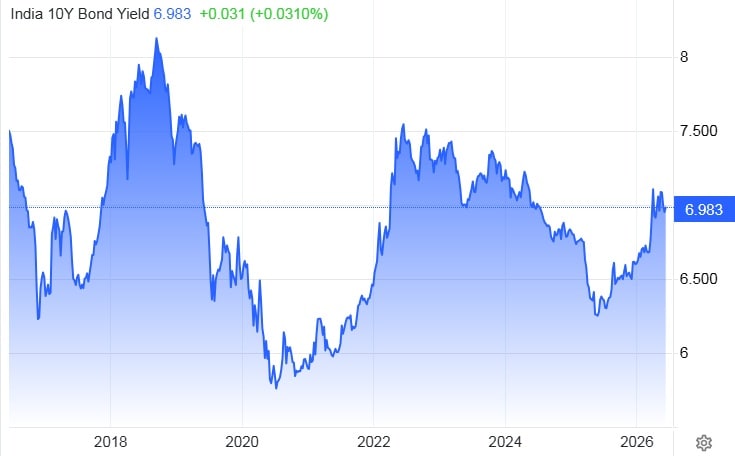
10-year bond yield Photo Credit: Trading Economics
Bonds work differently. They are debt instruments issued by governments or companies and do not carry the same insurance protection. Their risk and return profile depends on factors such as issuer quality, tenure, and credit rating.
Saurabh Jain believes investors should view the two products as complementary rather than interchangeable. "Fixed deposits and bonds can both have a place within a financial plan," he says. "The key is understanding the role each one plays in achieving specific investment objectives."
While fixed deposits can provide stability and liquidity, bonds can help diversify the debt portion of a portfolio and potentially improve long-term outcomes.
Bonds Moving From Sidelines To Mainstream
As Indian investors become more financially aware, bonds are gradually moving from the sidelines into mainstream portfolio discussions.
The challenge is that many decisions are still influenced by myths that no longer hold true.
Saurabh Jain of Stable Money believes that understanding the realities of bond investing is becoming increasingly important for investors seeking balance, diversification, and stability in uncertain markets.
Bonds may never generate the excitement that stocks do. But they don't need to. Sometimes, the investments that attract the least attention play the biggest role in building long-term financial resilience.
Track Latest News Live on NDTV.com and get news updates from India and around the world

