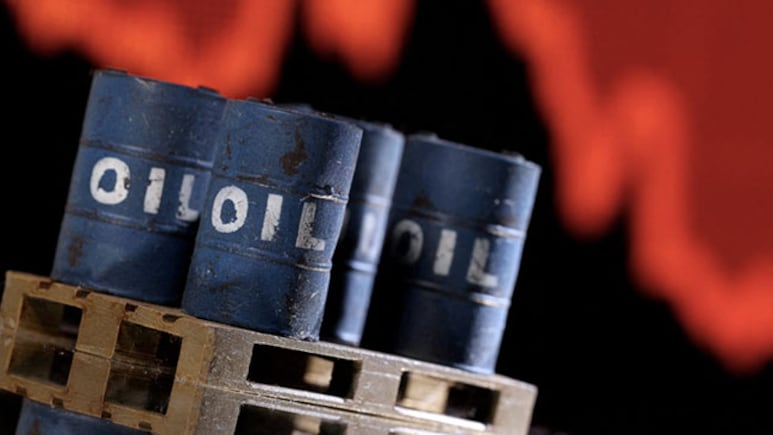
One country sits at the center of a war it never asked for, watching oil prices climb to levels that should make it rich but instead keep its officials up at night.
Saudi Arabia, the Gulf's largest oil producer, is running worst-case models that show Brent crude surging past 180 dollars a barrel if the Iran conflict and its chokehold on energy supplies drag into late April, according to a Wall Street Journal report citing several Saudi oil officials.
Rather than celebrate, Riyadh is alarmed. Prices that high could destroy long-term demand, trigger a global recession and brand the kingdom a wartime profiteer.
"Saudi Arabia generally does not like too rapid increases in oil, because that then creates long term market instability," Umer Karim, analyst of Saudi foreign policy at the King Faisal Center for Research and Islamic Studies, was quoted as saying in the Journal report.
The ideal, he added, is modest price gains with stable market share. Saudi Aramco, the national oil company that handles production, sales and pricing, has not commented on the report yet. LIVE UPDATES
The math is already brutal. Since fighting erupted on February 28, prices have jumped sharply, with Brent futures touching around 119 dollars a barrel this week after Iran struck Qatar's Ras Laffan energy hub, Saudi facilities at Yanbu and continued attacking ships in the Strait of Hormuz, the narrow passage carrying about 20 percent of the world's oil. Gulf benchmarks tied to Oman crude, which Middle East producers use to price physical tanker cargoes, have blown past 166 dollars in recent trade.
Some Saudi customers are balking at using that benchmark given its wild swings, but Aramco insists it reflects true supply conditions, the officials told the Journal.
Saudi light crude is already selling to Asian buyers at around 125 dollars a barrel via its Red Sea port. As stored barrels run dry next week, officials expect prices in these Saudi scenarios to close in on 138 to 140 dollars, then climb toward 150 by mid-April before stepping toward 165 and even 180. Wood Mackenzie analysts have warned 200 dollars is plausible in 2026. Rebecca Babin, senior energy trader at CIBC Private Wealth, put it bluntly: give her a June timeline and she would call 180 dollars.
American consumers are already bleeding. US gasoline has hit about 3.88 dollars a gallon, up from roughly 2.93 a month ago, according to AAA. Diesel has surged to around 5.10 dollars, squeezing every company that moves goods by truck. Philip Blancato, chief executive at Ladenburg Asset Management, called higher fuel costs "a tax on consumers and businesses, forcing households to spend more on energy and less elsewhere." Federal Reserve Chair Jerome Powell has acknowledged the oil shock would pressure spending, employment and inflation simultaneously.
How worried should India be?
For India, the alarm is existential. New Delhi imports close to 89 percent of its crude, a share set to touch 90 percent by FY26, meaning global price spikes transmit almost directly into the economy. According to SBI estimates and rule of thumb modelling, every 10 dollar rise in oil widens the current account deficit by roughly 30 to 40 basis points. A sustained move toward 150 to 180 dollars could push the deficit above 3 percent of GDP, hammer the rupee and add over a full percentage point to consumer inflation. GDP growth could take a hit of up to one percentage point, forcing the RBI into an ugly choice: tighten policy to contain prices or hold rates and watch inflation spiral.
India has levers. In 2022, the Centre absorbed around one lakh crore rupees in excise cuts to shield consumers. Its pivot to discounted Russian barrels has helped diversify supply. But in a 180 a dollar world, discounts could shrink fast.
Track Latest News Live on NDTV.com and get news updates from India and around the world


