





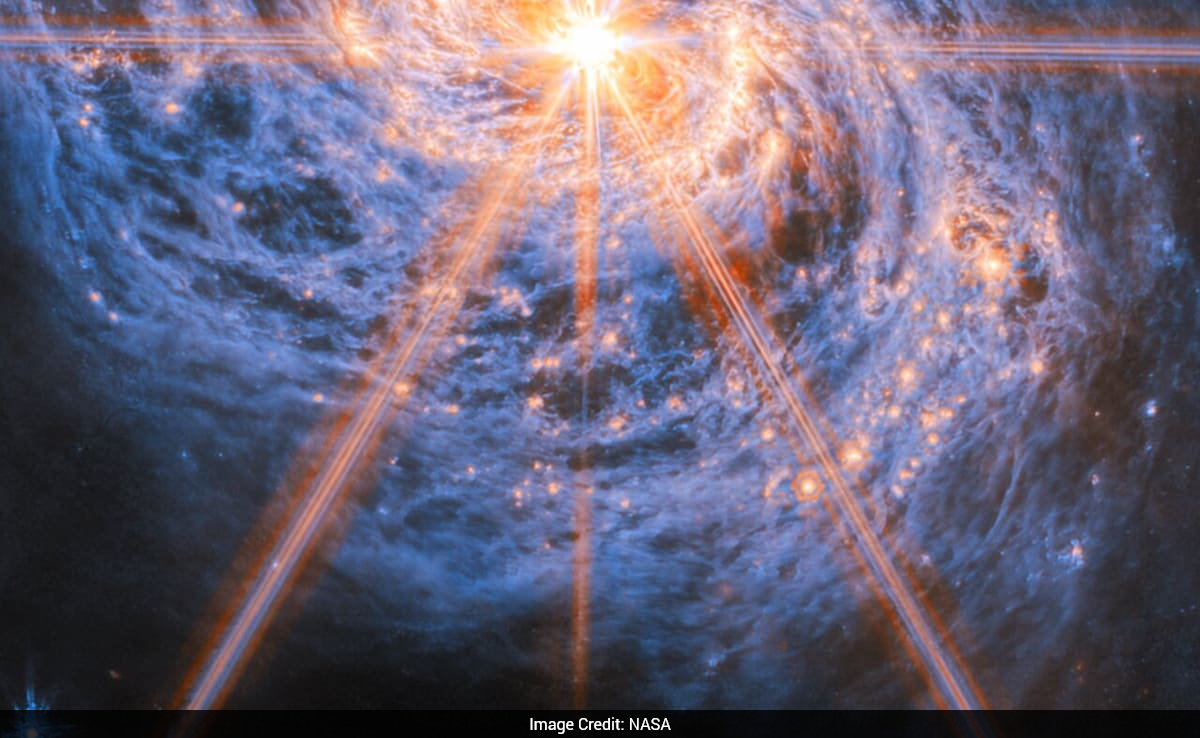
NASA's James Webb Space Telescope has captured a striking new image of Messier 77, offering astronomers a closer look at one of the most studied galaxies in space. Also known as M77, the barred spiral galaxy is located around 45 million light-years away in the constellation Cetus. It highlights the galaxy's spiral arms, glowing dust and bright central core using Webb's Mid-Infrared Instrument (MIRI), reported NASA.
At the centre of M77 is an active galactic nucleus (AGN), a compact region filled with hot gas that shines brighter than the rest of the galaxy combined. Scientists said the AGN is powered by the galaxy's central supermassive black hole, which is eight million times more massive than the Sun. Gas near the centre is pulled into a fast orbit around the black hole, where it crashes together, heats up and releases huge amounts of radiation.
The image also shows bright orange lines extending from the galaxy's centre. However, these are not part of the galaxy itself. The lines are diffraction spikes created because the intense light from the AGN bends slightly around the edges of Webb's mirror panels and one of the telescope's support structures. Scientists said this six-plus-two-pointed pattern appears in Webb images when a light source is extremely bright and concentrated.
M77 is also known as a strong star-forming galaxy. The near-infrared image reveals a bar structure across the galaxy's central region, which is not visible in normal light images. Around this bar is a bright “starburst ring” formed by the inner ends of the galaxy's spiral arms.
The starburst ring stretches more than 6,000 light-years across and contains intense star-forming activity. In the image, this activity appears as densely packed orange bubbles spread around the ring. Because M77 is relatively close to Earth, astronomers consider it one of the best examples for studying starburst regions.
The galaxy's disc is filled with gas and dust that help create future stars. Webb's MIRI instrument captures the glow of interstellar dust in blue shades, showing swirling smoky filaments and empty cavities between them. Bright orange bubbles created by newly formed star clusters are also visible along the spiral arms.
Beyond the telescope's main view, the spiral arms connect to a faint outer ring of hydrogen gas where more star formation is taking place. Thin filaments of hydrogen gas stretch from this ring into intergalactic space, forming the outermost layer around the galaxy. Due to the tentacle-like appearance of these filaments, M77 is also known as the Squid Galaxy.
Track Latest News Live on NDTV.com and get news updates from India and around the world

