





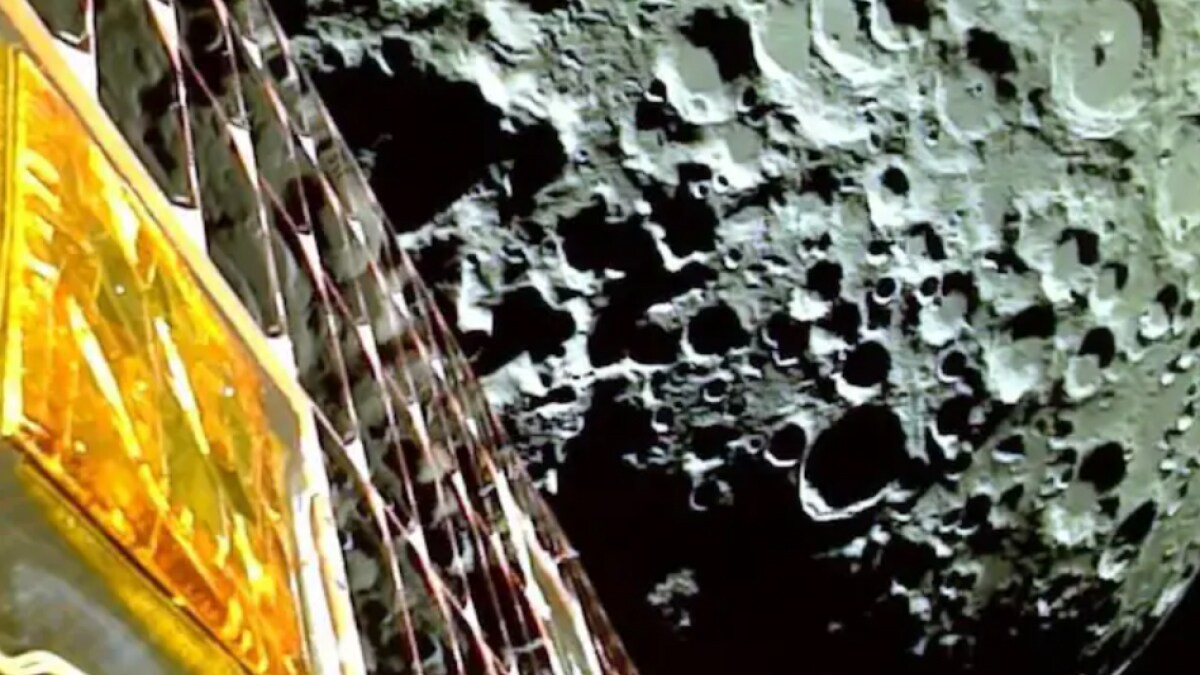
A small "hop" by Chandrayaan-3's Vikram lander has given Indian scientists a rare, close-up look at the lunar soil and its behaviour. The manoeuvre, carried out just before the lander entered sleep mode, is now yielding new data on the Moon's south pole regolith.
The study, led by K Durga Prasad and published in The Astrophysical Journal, noted that in the final phase of the mission, ISRO commanded Vikram to fire its engines. The lander lifted about 40 cm off the lunar surface and touched down 30-40 cm away from its original spot.
"During this manoeuvre, which was executed at the end of the mission, the lander utilised residual propellant to briefly ascend and relocate to a nearby location," the researchers wrote. "After a safe landing at the new location, the lander payloads were redeployed and resumed scientific observations until the lander was set to sleep mode."
Also read | Hubble Space Telescope Tracks 25 Years Of Expansion In Crab Nebula
The researchers revealed that Chandra's Surface Thermophysical Experiment (ChaSTE), a payload on the lander, measured the surface, sub-surface temperatures and thermal conductivity of the top 10 cm of the regolith.
They further stated that these observations provide new insights into the local-scale thermophysical environment of high-latitude and polar regions amid growing interest in polar exploration.
"This layered structure suggests that even shallow depths on the Moon can show significant variation in physical properties," the researchers noted.
Also read | Ex-SpaceX Engineer Bets On Solar Power To Revolutionise Space Travel
ChaSTE and other instruments revealed that the top 6.5 cm of soil has two distinct layers. The upper layer has higher bulk thermal conductivity, while the lower layer is slightly less conductive. The hop also gave direct evidence of variations in thermo-physical and geotechnical properties right around the landing site.
Scientists could see how lunar dust and rocks react when exposed to engine heat and thrust.
The experiment was one of a kind, and the data will help design future landers, sample collectors, and habitats that need to interact with the same lunar soil.
Track Latest News Live on NDTV.com and get news updates from India and around the world

