





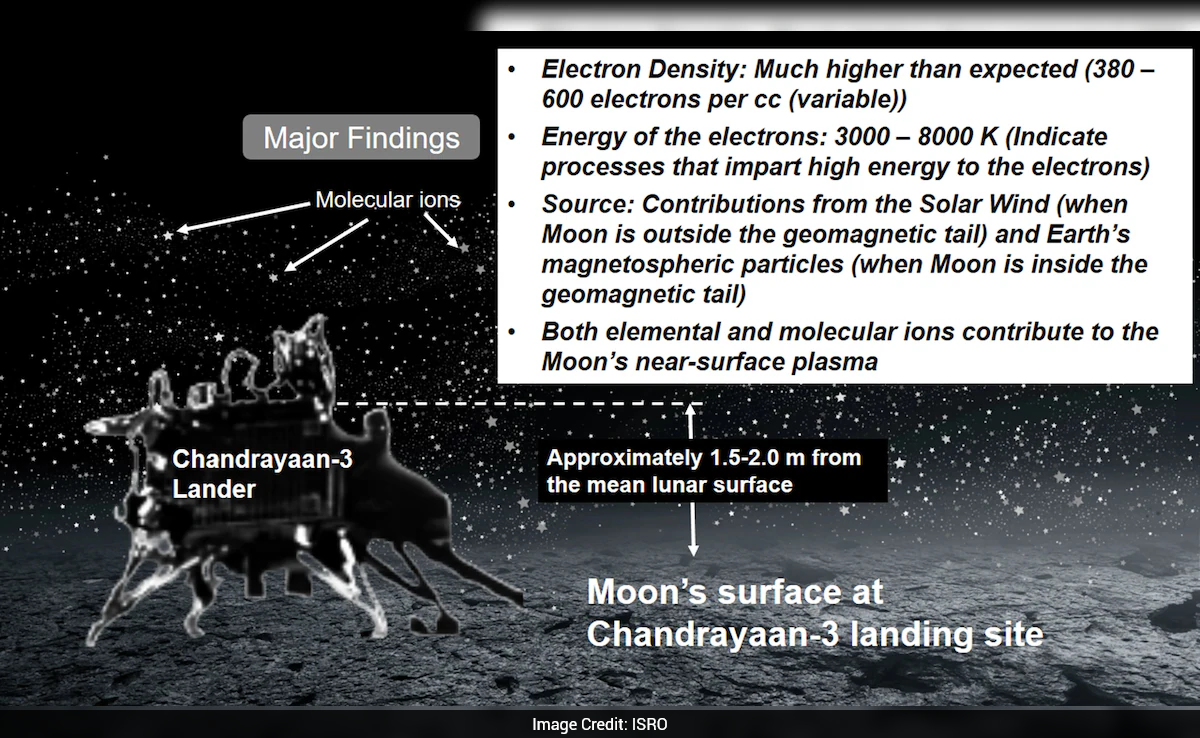
Chandrayaan-3 has uncovered a "far more active" and dynamic electrical environment near the Moon's south pole than previously understood, new analysis of data from the lander has revealed.
The results, obtained by the Radio Anatomy of the Moon Bound Hypersensitive ionosphere and Atmosphere - Langmuir Probe (RAMBHA-LP) instrument onboard the Vikram lander of Chandrayaan-3, mark the first-ever direct measurements of lunar plasma so close to the surface in the southern high latitudes, according to the Indian Space Research Organisation (ISRO).
The probe detected electron densities between 380 and 600 particles per cubic cm near the landing site of Chandrayaan-3 (Shiv Shakti point). These electron densities are far higher than earlier satellite-based estimates.
In physics, plasma is often called the fourth state of matter, consisting of a mixture of charged particles, including ions and free electrons. Despite being electrically neutral overall, plasma is highly conductive and responds strongly to electromagnetic fields. The Moon's thin plasma environment, or lunar ionosphere, is governed by several major processes," ISRO said in a statement.
"Solar wind, which is a continuous stream of charged particles (primarily electrons, hydrogen and helium ions) ejected from the Sun's upper atmosphere, constantly impinges on the Moon's surface. This, along with the photoelectric effect, is the primary mechanism for creating the plasma."
"The lunar plasma is further influenced by the deposition of charged particles originating from the Earth's magnetosphere (specifically the magnetotail) when the Moon passes through that region (typically 3-5 days during a period of 28 days), resulting in a constantly changing and dynamic electrical environment near the surface," the organisation explained.
The electrons were also found to be highly energetic, with temperatures ranging from 3,000 to 8,000 Kelvin.
Researchers say the plasma environment constantly shifts due to solar wind during lunar daytime and charged particles from Earth's magnetotail when the Moon passes through it.
ISRO said that the study "uncovered that the lunar plasma is not static but is constantly modulated by two distinct factors, depending on the Moon's orbital position around the Earth."
"When the Moon is facing the Sun (lunar daytime) and outside the Earth's magnetic field, changes in the near-surface plasma are driven by particles from the Solar Wind interacting with the sparse neutral gas (exosphere) on the Moon. When the Moon passes through the geomagnetic tail, the plasma changes are caused by charged particles streaming from the tapered region of Earth's long magnetic tail (towards the opposite side of the Sun), known as the geomagnetic tail," it said, adding that the findings offer a vital "ground truth" for future lunar missions.
The RAMBHA-LP experiment was developed by the Space Physics Laboratory at the Vikram Sarabhai Space Centre in Thiruvananthapuram.
Track Latest News Live on NDTV.com and get news updates from India and around the world

