




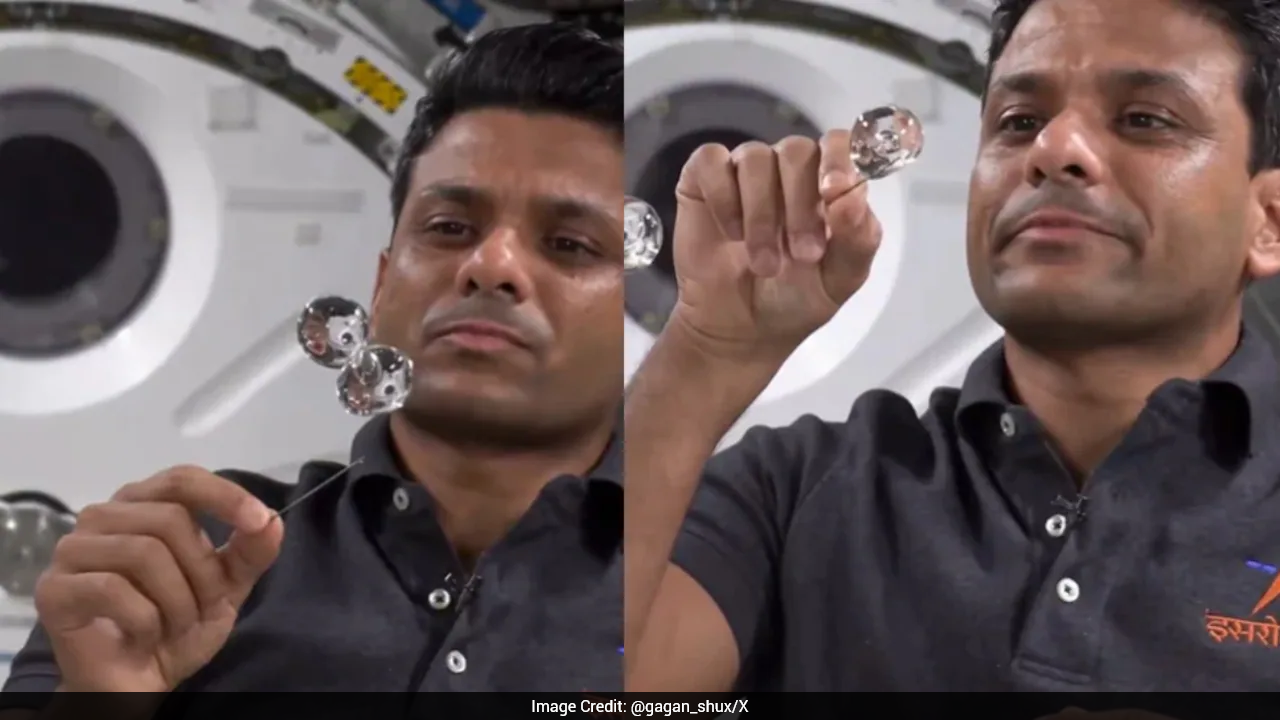
Astronaut Shubhanshu Shukla recently shared a video showing two floating water droplets merging into a larger droplet in space, offering a fascinating look at how liquids behave in microgravity. Through the simple experiment, he also explained the science behind the phenomenon and how it helps researchers better understand fluid dynamics in space.
Sharing the video, Shukla described how he brought two floating blobs of water together and watched them combine into one. He said that while the activity looked simple, it offered an interesting lesson in physics.
Explaining the science behind the experiment, Shukla said that surface tension plays a much bigger role in shaping how liquids behave in microgravity. This happens because the effects of gravity, such as buoyancy and settling, become negligible in these conditions.
Watch Video Here:
Playing with water in space is fun. But sometimes, the fun comes with a rather interesting physics lesson! What you see here are two floating blobs of water that I bring together. The moment they touch, they merge into a single blob. Simple enough to watch, but quite fascinating from a scientific perspective. So, what is happening? In microgravity, surface tension plays a much more prominent role in shaping liquid behaviour because gravity-driven effects such as buoyancy and settling become negligible. Water naturally tends to minimise its surface area, and when the two blobs touch, surface tension drives them to coalesce into one larger droplet. Notice how the energy released in this process doesn't simply disappear. It gets converted into motion and oscillations of the newly formed droplet. These gradually die down as the energy is dissipated through viscous forces within the liquid. Interestingly, scientists can study the rate of coalescence and the subsequent motion to understand fluid properties such as viscosity and surface tension. This is particularly useful in designing spacecraft propellant management systems, where understanding how liquids move, settle and behave inside tanks in microgravity is critical. There have actually been experiments aboard the ISS that used droplet coalescence to measure the viscosity of liquids! Who said playing with water was just child's play? Sometimes, it is science in disguise! #shux #space #shubhanshushukla #india #axiom4
— Shubhanshu Shukla (@gagan_shux) November 16, 2026
He wrote, "Water naturally tends to minimise its surface area, and when the two blobs touch, surface tension drives them to coalesce into one larger droplet."
Water naturally tries to reduce its surface area. Therefore, when two floating droplets come into contact, surface tension causes them to join together and form one larger droplet. This process is known as coalescence.
Shukla also explained what happens to the energy released when the two droplets merge. Instead of disappearing, the energy turns into movement and oscillations, causing the newly formed droplet to move and change shape. These movements gradually slow down as the energy is lost through viscous forces within the liquid.
Shukla wrote, "Interestingly, scientists can study the rate of coalescence and the subsequent motion to understand fluid properties such as viscosity and surface tension. This is particularly useful in designing spacecraft propellant management systems, where understanding how liquids move, settle and behave inside tanks in microgravity is critical."
"There have actually been experiments aboard the ISS that used droplet coalescence to measure the viscosity of liquids," he added.
He said that playing with water is not always just child's play, as such simple activities can also offer valuable scientific lessons.
Track Latest News Live on NDTV.com and get news updates from India and around the world

