




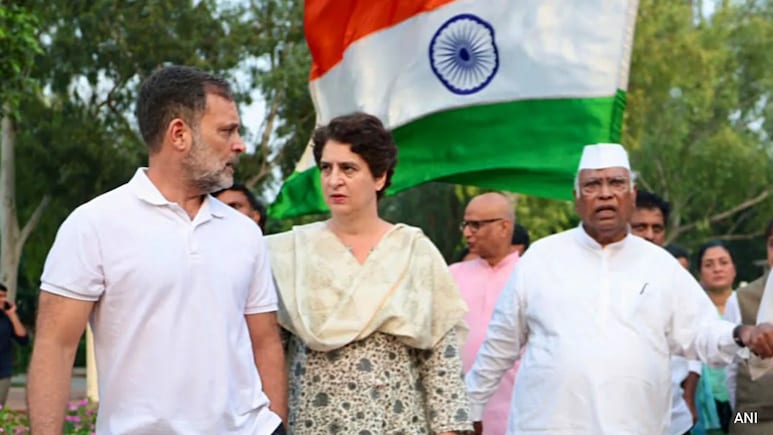
In a democracy, political parties have the right to protest, mobilise public opinion and hold governments accountable. But democracy also demands that political leaders remain sensitive to the everyday struggles of the very citizens whose interests they claim to represent. It is this equilibrium between political confrontation and public responsibility that lies at the heart of the controversy surrounding the Congress-led INDIA bloc's November 1 rally at Delhi's Ramlila Maidan.
The CTI (Chamber of Trade and Industry) and local market associations, representing over 20 major wholesale and retail markets such as Chandni Chowk, Sadar Bazaar and Khari Baoli, have appealed to Congress leader and Leader of Opposition Rahul Gandhi to postpone the rally until after November 10, when the festive period culminating in Bhai Dooj will have passed. The reason is simple: the national capital's traders are preparing for one of the busiest shopping periods of the year, with Dhanteras falling on November 6 and Diwali on November 8.
However, Rahul Gandhi is adamant about proceeding with the November 1 rally, ‘Vote Bachao, Desh Bachao', despite the traders' concerns.
When festive shoppers, traders and ordinary citizens fear disruption from political protests, should a party fighting to protect democracy be unwilling to accommodate their concerns? Further, have the ECI's (Election Commission of India) recent SIR (Special Intensive Revision) measures and rollbacks given fresh fuel to Opposition protests?
Brunt on festive economy
According to local market associations and the CTI, Delhi's Dhanteras-Diwali period business worth approximately Rs 10,000-25,000 crore could be at risk due to the proposed rally. The organisation has also alleged that earlier rallies, marches and road closures disrupted commercial activity in central Delhi.
These figures are estimates made by the traders' body, not independently established losses that can automatically be attributed to the proposed demonstration. However, the underlying concern deserves serious consideration. When major wholesale and retail markets, transport routes and railway stations are potentially affected by crowd management and traffic diversions, the consequences can extend well beyond the immediate vicinity of a political gathering.
For a small trader, a rally can mean fewer customers, delayed deliveries and a day of uncertainty at precisely the moment when sales matter most.
The markets around Ramlila Maidan, including Chandni Chowk, Sadar Bazaar, Chawri Bazaar and Bhagirath Palace, serve thousands of businesses and customers. Festive shopping is not merely a matter of consumer choice; it sustains livelihoods across a network of wholesalers, shopkeepers, transport operators, delivery workers and small suppliers.
Unlike large corporations, many small businesses have limited capacity to absorb a sudden loss of revenue. Their earnings during the festive period can help them meet rent, wages, supplier payments and household expenses. A disruption that appears temporary to a political organiser can therefore have a disproportionate impact on those operating on thin margins.
There is also the inconvenience faced by ordinary citizens. Families planning their festive purchases, people travelling into Delhi from neighbouring towns, employees commuting to work and customers visiting crowded commercial districts could all be affected by road restrictions and congestion.
These concerns of ordinary citizens cannot outweigh the right of political parties to protest. However, Opposition parties cannot treat them as irrelevant simply because their rally has an important political objective.
The issue is not whether the Congress should abandon its protest. It is whether postponing a rally by a few days would materially undermine its political message while reducing the risk of disruption to thousands of livelihoods.
A democratic party must surely be capable of distinguishing between a cause that demands persistence and a date that can be reconsidered.
Politics before people?
Rahul Gandhi has responded directly to the business community, expressing solidarity with traders while linking the disruption they describe to his allegations of electoral wrongdoing.
His argument reflects the Opposition's position that alleged electoral irregularities are not an ordinary political disagreement but a threat to democratic accountability.
This position of the Opposition deserves to be understood rather than dismissed, particularly when continuing political protests have yielded positive results for the Opposition, with the ECI announcing a slew of measures on September 26.
Among the measures were doorstep collection of documents from voters facing discrepancies, relaxed hearing procedures, extended deadlines in Delhi and Maharashtra, and a review of its ECINET software. The ECI also maintained that its decisions had been unanimous.
The ECI's statement was intended to address mounting concerns over the SIR of electoral rolls. Instead, it has become another flashpoint in the confrontation between the poll panel and the Opposition, with the Congress-led INDIA bloc pressing ahead with its campaign against CEC Gyanesh Kumar.
The Opposition dismissed the announcement as inadequate, arguing that it failed to address deeper questions about transparency, institutional functioning and alleged voter exclusions. Therefore, at its September 30 meeting, INDIA bloc leaders agreed on a coordinated campaign, including demonstrations and rallies, keeping the demand for the CEC's removal firmly on the agenda.
The November 1 protest therefore reflects a dispute that extends beyond procedural changes to the larger question of public trust in electoral institutions. Yet street mobilisation alone cannot settle questions of institutional accountability. The Opposition must substantiate its allegations, while the ECI must demonstrate that its safeguards work transparently and effectively.
Ultimately, the November 1 rally is about more than a clash between political mobilisation and festive shopping. It is about the responsibilities that accompany the right to protest.
Political leaders who seek to represent the public must recognise that citizens are not merely an audience for political campaigns. They are workers, traders, commuters, students, farmers and families whose daily lives continue while political battles unfold.
The Congress and the INDIA bloc do not have to choose between defending electoral integrity and respecting the economic interests of Delhi's trading community.
They can do both.
Disclaimer: These are the personal opinions of the author

