






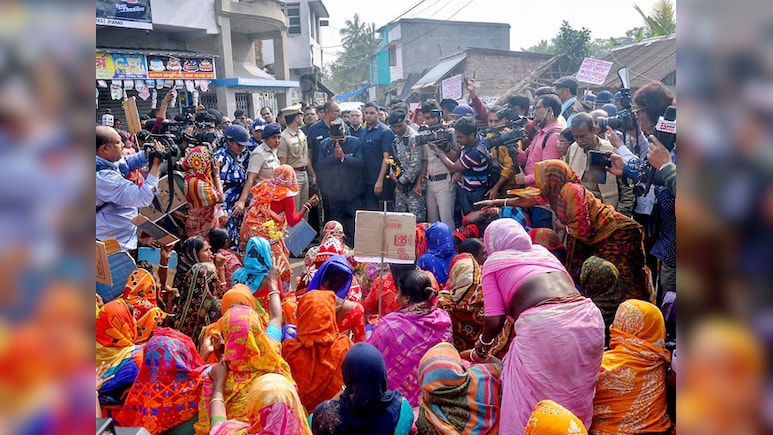
Sandeshkhali, a remote stretch in the Sundarbans region of North 24 Parganas, lies far from Kolkata, not only geographically but also culturally. It is a region marked by poverty, weak infrastructure, and chronic underdevelopment. Yet, in recent years, particularly during the last election cycle, Sandeshkhali has emerged as a politically sensitive flashpoint in West Bengal.
The controversy began with allegations against a local Trinamool Congress strongman, Sheikh Shahjahan, accused of running illegal operations and perpetrating serious atrocities against women. Reports of the degrading treatment of poor local women triggered widespread outrage. Following sustained protests, Shahjahan was arrested and remains in custody. Among those who led the resistance was Rekha Patra, who emerged as a prominent face of the movement against the ruling party government.
Despite the intensity of the protests, however, the issue failed to significantly alter the electoral outcome. The Trinamool Congress retained control of the area.
While Sandeshkhali represented a rural flashpoint, a separate controversy in urban Kolkata drew national attention. The alleged rape case in the RG Kar area became a major political issue. Although the accused was arrested, the BJP continued to campaign on the claim that justice remained incomplete and that the real culprits had not been fully brought to account. The case sparked protests, candlelight marches, and broader civil society mobilisation.
In the 2026 election campaign, the BJP is attempting to stitch these two episodes together - from rural Sandeshkhali to urban Kolkata - into a single political narrative. The strategy is clear: to revive both controversies as emblematic of a larger question of governance and women's safety in West Bengal. The unanswered question is whether this effort will translate into electoral gains.
The BJP has returned to Sandeshkhali with renewed vigour. Rekha Patra has shifted her political activity to Hingalganj, an adjacent constituency, signalling an attempt to expand the issue's geographic resonance. The party hopes that allegations of atrocities in Sandeshkhali will influence voters beyond the immediate locality.
This strategy draws on the deeper structural realities of the region. Sandeshkhali remains vulnerable to flooding, suffers from poor connectivity, and lacks adequate healthcare and educational facilities. Its economy is largely agrarian, with betel leaf cultivation playing a central role, and poverty continues to shape everyday life. These conditions provide fertile ground for political mobilisation.
At the same time, the region's history offers a longer lens. The undivided 24 Parganas has long witnessed cycles of agrarian distress and local tensions. Colonial-era records describe administrators mediating communal disputes, while writers such as Bankim Chandra Chattopadhyay chronicled the hardships of Bengal's peasantry. Contemporary unrest, therefore, is not an aberration but part of a deeper historical continuum.
Yet history alone does not win elections. In the previous contest, Sandeshkhali did not produce a decisive political shift. This time, however, the BJP appears determined to refine its campaign. Alongside Sandeshkhali, the focus has sharpened on the R.G. Kar case.
The hospital falls within the Kashipur-Belgachia Assembly constituency, where Trinamool leader Atin Ghosh-seen as relatively popular and non-controversial-is contesting. But the political resonance of the case extends far beyond constituency boundaries. The victim's mother has also publicly expressed her desire to enter electoral politics, even appealing to the BJP for support in her pursuit of justice. This has reportedly caused friction within the CPI(M), whose leaders had been among the most vocal supporters of the family during the protests. Whether the BJP will offer her a nomination remains uncertain.
Irrespective of that decision, the party is actively campaigning on both issues. Women have taken the lead in this effort, supported by high-profile visits from leaders such as Smriti Irani at the national level, and Rupa Ganguly and Agnimitra Paul within the state. Prime Minister Narendra Modi already commands significant support among women voters across India, and the BJP hopes to deepen that base in West Bengal. The Kashipur-Belgachia constituency is not the sole focus of the R.G. Kar issue. The BJP is attempting to turn it into a statewide political issue.
The critical question, however, persists. These issues failed to deliver electoral dividends in the previous election. Why should this time be different? According to BJP leader Rahul Singha, people remain concerned about these issues. Other leaders argue that public sentiment has shifted - that latent dissatisfaction now runs deeper, and that earlier organisational weaknesses have been addressed. They point to improved campaign infrastructure and a more coordinated outreach effort. Whether this confidence is justified remains to be seen.
For now, the BJP's strategy rests on converting memory into momentum - reviving past outrage and recasting it as a present political choice.
(The author is Consulting Editor, NDTV)
Disclaimer: These are the personal opinions of the author

