






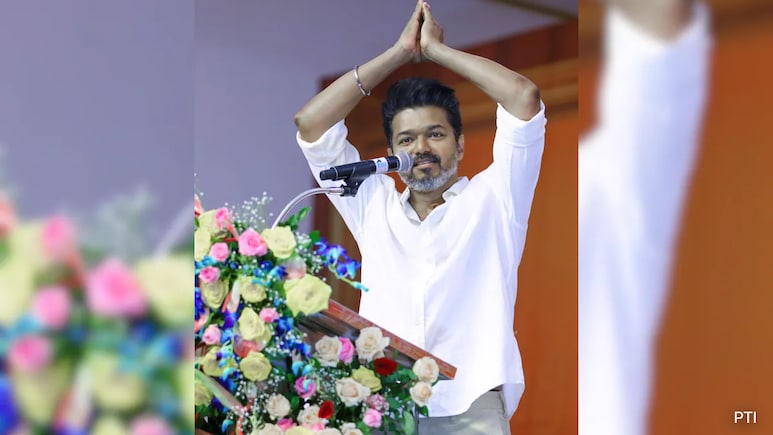
In politics, timing is everything. And in Tamil Nadu, timing without alliances is often nothing. By insisting that he will neither join an alliance nor play second fiddle - but only lead one - Vijay may well have missed the political bus even before his electoral journey truly began.
The arithmetic is unforgiving.
With the 2026 elections approaching, it is increasingly clear that no major party is willing to come under the banner of his Tamilaga Vettri Kazhagam (TVK). The only theoretical pathway - poaching allies from the ruling Dravida Munnetra Kazhagam which has won 3 consecutive elections - was always a long shot. That window now appears firmly shut.
What makes this more striking is the scale of the opportunity that slipped away. Vijay entered politics at the peak of his cinematic career, commanding a rare, almost unmatched following among youth and women.
Not since MG Ramachandran, who won 3 successive elections, has a star carried such momentum into the political arena. That alone should have made him the nucleus of a formidable alliance.
Instead, hesitation - and perhaps overconfidence - seems to have defined his early political moves. Rather than actively reaching out and stitching together a coalition, Vijay appeared to wait, expecting others to gravitate towards him.
In Tamil Nadu's deeply networked alliance culture, that was a misreading of political reality. Ironically, he had the right pitch. TVK's promise of a "share in power" was a direct appeal to smaller parties long frustrated by the dominance of the two Dravidian majors- the Dravida Munnetra Kazhagam and the All India Anna Dravida Munnetra Kazhagam - both of which have consistently resisted coalition-style governance.
This was Vijay's opening.
Consider the Viduthalai Chiruthaigal Katchi. A vocal advocate of power-sharing, it could have been the first domino. But alliances are built on trust and initiative. For VCK, a long-time DMK ally, the risk of "blinking first" was too high. Vijay needed to make that move easier - he didn't.
The Indian National Congress too briefly hovered around the idea of a new alignment. A Congress-TVK tie-up could have been transformative - giving TVK structure and Congress relevance in a state where it has long ceded ground. Instead, Congress used the possibility of a new alliance as leverage, extracting a better deal from the DMK and moving on.
Even the opposition All India Anna Dravida Munnetra Kazhagam, led by Edappadi K Palaniswami, briefly signalled interest. The optics - TVK flags at AIADMK events - hinted at a potential convergence. A tie-up could have echoed the successful AIADMK-Vijayakanth's DMDK experiment that once reshaped the opposition space. But that moment passed, as AIADMK recalibrated and revived ties with the BJP.
Perhaps the most telling gap was the failure to engage with DMDK. With Premalatha Vijayakanth now aligning with the DMK, even that door has closed.
The result is stark. A party that could have been the fulcrum of a new political formation risks becoming a holding space for the politically displaced. The groundswell of support Vijay generated remains real - but in electoral politics, sentiment without structure rarely translates into seats.
As nomination deadlines approach, Vijay's political instincts face their first real stress test.
But the larger question lingers: in a state where alliances are everything, has Vijay already missed his moment? Or is the support for TVK exponentially growing, set to defy alliance arithmetic?
(The author leads NDTV's Chennai Bureau)
Disclaimer: These are the personal opinions of the author

