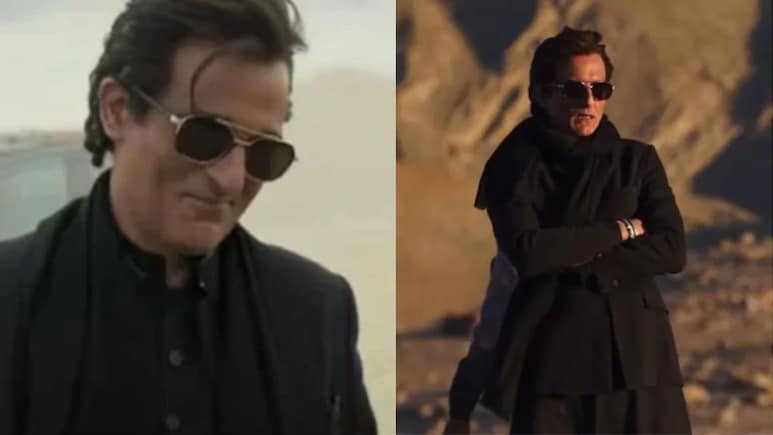
Ever since the release of Dhurandhar, Akshaye Khanna's character Rehman Dakait has been trending across social media. Fan pages are sharing edits of his scenes, and many users are calling him intense, protective, and even “ideal man".
In the film, Rehman Dakait is shown as a ruthless villain who kills people and goes to any extent to retain power. He is violent and dangerous. Yet, certain moments in his personal life have struck a chord online.
-

-
 Andrew Ng On AI At Scale: Building The Intelligence Economy | NDTV World Summit 2026
 -
 NDTV World Summit 2026: Behind The Scenes As Ayush And Vedika Preview Two-Day Mega Event
 -
 Who Is Rajiv Mehta? Lilavati Hospital Trustee To Speak At NDTV World Summit 2026
 -
 Ex-CIA Director To Decode 'War In Times Of AI' At NDTV World Summit
 -
 From Call Centre To Billion-Dollar Disruptor: Nikhil Kamath At NDTV World Summit
 -
 'Every 5 Years, You'll See A New India': Swami Sarvapriyananda Ahead Of NDTV World Summit
 -
 Alain Ebobisse, Africa50 CEO, To Attend NDTV World Summit 2026. All About Him
 -
 Kriti Sanon At NDTV World Summit: A Look At Her Career And Business Ventures
 -
 Ex-CIA Director To Decode 'War In Times Of AI' At NDTV World Summit
 -
 Who Is Vikram Rai, CEO, South Asia GE Aerospace, Set To Attend The NDTV World Summit 2026
After the murder of their son, his wife – played by Saumya Tandon – slaps him in grief. Instead of reacting in anger, he hugs her. In another scene, when bullets rain down on their car, he surrenders to protect his family. These scenes have been widely shared, with many viewers highlighting his calmness and protective instinct as signs of emotional depth.
Sociologist Explains Why Women Are Obsessed With Dhurandhar's Akshaye Khanna
Amid this growing admiration, Prerna, a public sociologist and cultural studies professor, posted a video on Instagram offering a different perspective. “If you are currently obsessed with Akshaye Khanna and Dhurandhar, you are not having a crush. You are having a trauma response,” she says in the clip.
According to the public sociologist, the audience is “collectively hallucinating tehzeeb on a literal psychopath.” She describes the character as “a geographic ghost,” adding, “He is a Balochi warlord, vibing to a Bahraini rap song, performing a Lucknowi adab. He does not exist. It is a complete flattening of identity.”
Prerna links the online reaction to what she calls “internal orientalism.” She argues that viewers are “so starved for the safe male intimacy of the 2000s, the soft intellectual Sid from Dil Chahta Hai, that we will accept a killer just because he wears a Pathani suit.”
FYI: In the 2001 film, Sid, also played by Akshaye Khanna, is shown as quiet, sensitive, and thoughtful. Unlike his carefree friends, he is an artist who values emotional honesty. He falls for an older woman and treats her with respect and gentleness. Over the years, the character has come to represent a softer, more emotionally available male lead from that era of Hindi cinema.
In Prerna's view, audiences had “two choices – Admit that the gentleman era of Bollywood is dead or invent a gentleman out of a villain.” She adds, “We chose the latter.”
She also points out the contrast between the character's actions and the online reaction. “He kills his own mother, and we are making thirsty edits,” she says. “So we don't want the man. We just want the manners back.”
In the end, the public sociologist's request is basic and almost funny in its honesty: “Please just give us a normal person who reads poetry.”
Also Read | Story Behind Akshaye Khanna's Sher-E-Baloch Look In Viral Dhurandhar Song, Costume Designer Reveals Details
Track Latest News Live on NDTV.com and get news updates from India and around the world
