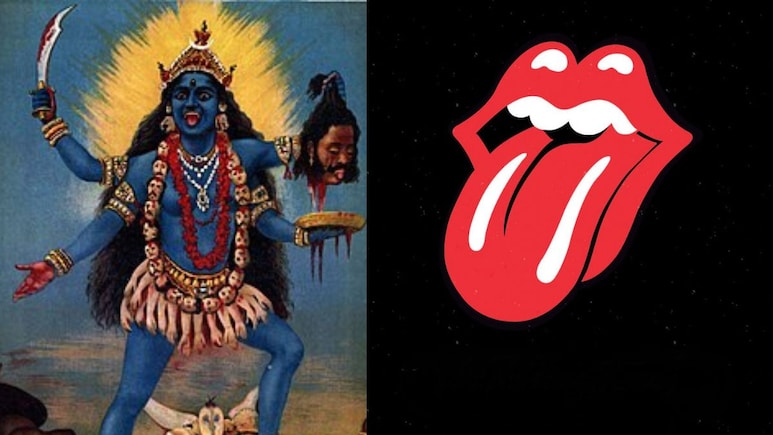
It is difficult to think of a band logo more instantly recognisable than the bright red lips and defiantly extended tongue of the The Rolling Stones.
Over five decades, it has appeared on album sleeves, tour posters, aircraft liveries and an endless stream of merchandise. Often called the most famous logo in popular music, its origins lie in a surprising cultural reference: the fierce Hindu goddess Kali.
So how did a sacred image travelled across continents, passed through the hands of an art student in London, and became one of the most powerful branding tools in rock history? Let's find out.
A Band In Search Of An 'Identity'
In 1970, the Rolling Stones were preparing for their European tour but were dissatisfied with poster designs proposed by their record label, Decca Records.
They wanted something sharper, something that captured their anti-authoritarian edge. The band began looking for a design student who could create not only a tour poster but also a symbol to be used on letterheads, programmes and press material.
Enter John Pasche, then in his final year of a Master of Arts degree at the Royal College of Art. Mick Jagger had seen Pasche's work at his degree show and approached him with a commission.
Pasche's second poster design was approved. But the real challenge was still to come: a logo that could stand the test of time.
The Inspiration: Godess Kali's Tongue
While discussing ideas, Jagger suggested the tongue of the Hindu goddess Kali, often depicted with her red tongue extended.
"I went for a meeting with Mick Jagger, and he said he wanted something that stands out-something like a Shell logo on petrol stations at the time. He showed me a cutting that he found in a local newsagent. The image was of the Indian goddess Kali, with her tongue sticking out, and I think it was at that moment that there was a real spark," says John Pasche in an interview with Great Big Story.
He further said that it represented anti-authority. "It's like kids sticking their tongues out. It's rebellious-kind of what the Stones represented at that time," Pasche says.
The image symbolises power, defiance, and destruction of evil. Yet Pasche was wary of producing something overtly Indian in style.
In an interview with The New York Times, Pasche later recalled, "I didn't want to do anything Indian, because I thought it would be very dated quickly, as everyone was going through that phase at the time."
Instead, he distilled the idea into something simpler and more universal.
"The design concept for the tongue was to represent the band's anti-authoritarian attitude, Mick's mouth, and the obvious sexual connotations. I designed it in such a way that it was easily reproduced and in a style I thought could stand the test of time," he said.
He also described its attitude more playfully: "I think it's the way that kids sort of stick their tongue out at people. It's an attitude really... It just worked for them, it just felt right when I did it. It was done in a 1970s kind of way. It's sort of luscious, it's quite soft, it's quite feminine. It's a soft protest in a way."
The result was bold, graphic and deliberately confrontational without being ornate. It was also practical. Pasche ensured it could be easily reproduced at different sizes, a crucial decision that later proved invaluable.
The Controversy Around 'Owning' The Logo
While Pasche was still refining his sketches in London, events in New York added another layer to the story. Craig Braun, creative director of the Sound Packaging Corporation, needed the logo urgently for the band's upcoming album Sticky Fingers.
Working from a fuzzy rubber-stamp impression faxed from London, Braun and his illustrators redrew and refined the design. They narrowed the tongue, added more white space around the lips and introduced stronger black detailing to emphasise depth.
Braun later claimed that the version widely used in the United States, including on tours and merchandising, was his studio's redrafted version rather than Pasche's original artwork.
The debate over authorship would continue for years, with some older sources even attributing the logo to other figures such as Ruby Mazur or Andy Warhol. However, most contemporary accounts credit Pasche as the original designer.
First Appearance And Rapid Fame Followed
The logo's first public outing was modest. On March 26, 1971, it appeared on VIP passes for a concert at the Marquee Club at the end of the band's UK tour. Shortly after, it featured prominently on the 1971 album Sticky Fingers, released under Rolling Stones Records.
From that moment, it was inseparable from the band's identity. It appeared on the album label and inside sleeve, and soon after on all post-1970 releases. What began as a small emblem intended for letterheads quickly became a visual shorthand for rebellion, sexuality and rock culture itself.
As writer Sean Egan observed in The Mammoth Book of the Rolling Stones, "Without using the Stones' name, it instantly conjures them. It quickly and deservedly became the most famous logo in the history of popular music."
In 2020, Joobin Bekhrad wrote in The New York Times that it "began life as a tiny emblem" and "quickly became ubiquitous and, ultimately, the most famous logo in rock 'n' roll."
The Price Of A Legend
For all its global fame, the financial story behind the logo is surprisingly modest. Pasche was initially paid just 50 pounds in 1970 for the design, and a further £200 in 1972. In 1984, he sold his copyright to the band's commercial arm, Musidor BV, for £26,000.
Ironically, in 2008, London's Victoria and Albert Museum acquired Pasche's original artwork for £51,000, recognising it as a landmark in modern design. Victoria Broakes, head of exhibitions at the V&A, noted that it was "one of the first examples of a group using branding" and arguably the world's most famous rock logo.
'Cultural Appropiation'
The story was discovered by the Internet once again, after a video went viral on Instagram. However, Instagram users, esepically Indians, were not sure how they felt about the logo's history.
One user commented, "As a Hindu, I'm not sure how I feel knowing this!"
Other commented, "Cultural appropriation at its peak. Our spirituality is not your costume"
Check out other reactions:



More Than A Logo
Today, the tongue and lips symbol transcends music. It appears on T-shirts, luggage tags, belts, credit cards and even Lego art sets. In polls, it has ranked above the Che Guevara portrait, the Hard Rock Cafe insignia and the I 'LOVE' NY graphic among the most iconic T-shirt designs.
Track Latest News Live on NDTV.com and get news updates from India and around the world
