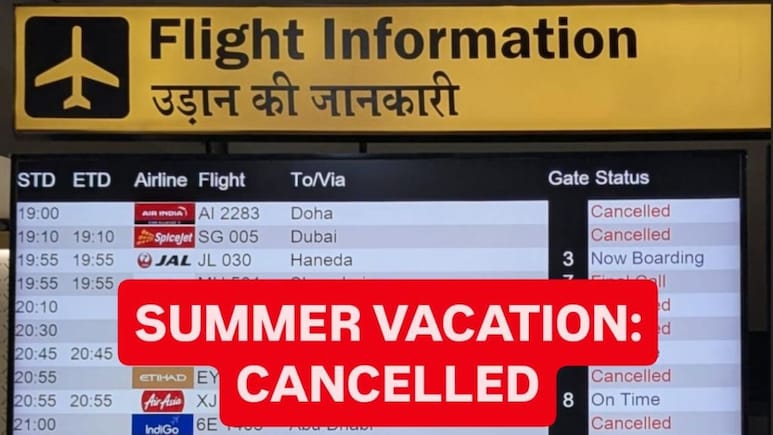
The escalating conflict between Iran and Israel has moved from periodic tensions to open military confrontation, with missile strikes, air raids and geopolitical involvement widening the crisis.
While the war is unfolding thousands of kilometres away, its ripple effects are already reaching travellers across the world, including Indians planning their summer holidays.
From longer flight routes and higher airfares to uncertainty around transit hubs in the Middle East, the conflict is quietly reshaping travel plans for thousands of Indian families.
Families Reconsider Summer Travel Plans
For many Indians who typically plan international holidays during the school summer break, the conflict has introduced a new layer of unpredictability.
Harkishan Singh, Founder and CEO of Focus Overseas, says his family usually travels to Europe every summer, often combining visits to multiple countries. But this year, planning the trip has become more complicated.
"We go to Europe every year, my wife is from Sweden, that's why we try to visit Sweden once a year. When we go, we try to cover three or four countries in the Middle Europe," Singh says.
However, with the ongoing conflict affecting flight routes, ticket prices have already increased and uncertainty around travel has forced families like his to rethink their plans.
He explains that while flights are still available, travellers are paying more not just for tickets but also for flexible options that allow cancellations or date changes. "We have to pay extra, apart from the surge charges," he says, adding that many travellers are choosing refundable tickets because of the fluid situation.
Singh also notes that people in his network are waiting before confirming travel plans. Some are even considering completely different destinations, such as Thailand or Vietnam, if the situation worsens.
His experience reflects what many Indian travellers are facing this year: higher costs, longer routes, and a sense of uncertainty around international travel.
Why The Middle East Conflict Affects Indian Travel
Experts say the reason a conflict in the Middle East affects Indian travel so directly is that the region sits along some of the world's busiest aviation corridors.
Dr Vandana Singh, Chairperson of the Aviation Cargo Federation of the Aviation Industry in India, explains that geopolitical tensions in parts of the Middle East can disrupt key international aviation corridors that connect India with Europe and other long-haul destinations. If airlines are forced to reroute flights to avoid certain airspaces, it increases flight duration and operational costs, particularly fuel, which may translate into higher airfares during the peak summer travel season.
"Geopolitical tensions in parts of the Middle East can impact key international aviation corridors that connect India with Europe and other long-haul destinations. If airlines need to reroute flights to avoid certain airspaces, it can increase flight duration and operational costs, particularly fuel," she says.

Experts say the reason a conflict in the Middle East affects Indian travel so directly. Representational Photo: Unsplash
During peak travel periods such as summer holidays, she notes that this could also lead to limited seat availability on certain routes.
Krishi Vora, COO of Banana Leaf Destinationz, a travel agency, says many international routes from India pass through Middle Eastern airspace, which makes rerouting expensive for airlines.
"If tensions continue, airlines may have to reroute flights to avoid certain airspaces. This means longer flying times and higher fuel consumption, which naturally pushes ticket prices up," she says.
She adds that on some international routes, particularly to Europe and parts of Asia, ticket prices could rise significantly.
"On some international routes, especially to Europe and parts of Asia, fares could increase by around 15-30%," Vora says.
Indian airlines anyway haven't flown over Pakistan since the May 2025 tensions between the two countries.
Rising Fuel Costs And Longer Routes
The war could also influence travel costs through rising fuel prices.
Himanshu Singh, Founder and CEO of ProXpense, an AI-powered Travel and Expense management platform, says geopolitical tensions often push up global crude oil prices, which have a direct impact on aviation fuel.
"One of the immediate concerns is the potential rise in global crude oil prices, which directly affects aviation turbine fuel costs," he says. "Since fuel constitutes a significant portion of airline operating expenses, any increase in jet fuel prices is likely to translate into higher airfares for passengers."

The war could also influence travel costs through rising fuel prices. Photo: Unsplash
Airspace restrictions could also make flights longer and more expensive to operate.
"Airspace restrictions in conflict-affected regions may force airlines to reroute flights, leading to longer travel times and higher operational costs," he adds.
Transit Hubs Under Scrutiny
Another major concern for travellers is the role of Middle Eastern transit hubs.
Cities such as Dubai, Doha and Abu Dhabi connect a large number of flights between India, Europe and North America.
Mehardeep Singh, General Manager, Corporate Affairs at Rubystone Hospitality, says the region plays a crucial role in global airline connectivity.
"The Middle East is included as a major transit point for flights travelling to Europe and other long-distance destinations from India," he says. "If airlines must limit their airspace or reroute flights, flight duration may become significantly longer and fuel prices are likely to rise," he adds.
These operational changes, he explains, inevitably lead to higher ticket prices for travellers.
For instance, many flights travelling from India to Europe, North America or even parts of Africa do not fly directly to their final destinations. Instead, passengers typically take a connecting flight through major hub airports such as Dubai, Doha or Abu Dhabi.
For example, a traveller flying from Delhi to Stockholm or Amsterdam may first fly to Dubai or Doha, change aircraft there, and then continue onwards to Europe. Airlines use these hubs because they allow carriers to combine passengers from multiple cities onto long-haul flights, making routes more efficient and profitable.
Travellers Adjusting Rather Than Calling Off Travel
Despite the uncertainty, experts say most travellers are adapting rather than cancelling their holidays.
Karan Bhangay, who runs the luxury concierge platform Indulge Global, says Indian travellers are already adjusting their travel strategies.
"Global tensions may lead to slightly longer flight routes and some airfare volatility, particularly on routes that traditionally pass through parts of the Middle East," he says. "However, Indian travellers tend to adapt quickly. Instead of cancelling holidays, they usually book earlier, choose alternate transit hubs, or slightly modify their destinations."
The desire to travel remains strong, he adds, particularly among affluent travellers who prioritise experiences over rigid itineraries.
Where Indians May Travel Instead
With uncertainty surrounding parts of the Middle East, some travellers are also reconsidering their destinations.
Alankar Chandra, Founder and CEO of Wild Voyager and Ilora Retreats, believes rising fuel costs could influence travel decisions this summer.
"The ongoing conflict in the Middle East has driven up fuel prices and disrupted airspace," he says. "Hence, I foresee travel becoming expensive, with several airlines announcing surcharges on fuel costs and passing on the increased costs to customers."
Even so, he believes global travel demand will remain resilient.
"Despite the conflict, destinations such as Iceland, Finland, Kenya and Tanzania will remain popular this year," Chandra says, adding that most European airspace remains open for travellers.
A Look Closer Home
Some data and experts indicate that some Indians might also travel domestically instead.
Himanshu Singh says that as travellers reassess overseas trips, many may turn to domestic destinations that offer diverse experiences at comparatively lower costs.
However, broader economic factors may also influence travel behaviour. Disruptions such as the closure of commercial gas supply in certain cities could impact restaurant and dining operations, potentially affecting hospitality businesses and travel-related spending, he says.

Some data and experts indicate that some Indians might also travel domestically instead. Photo: Unsplash
"Despite these challenges, destinations offering spiritual, cultural, and nature-based experiences such as Ayodhya, Varanasi, Rishikesh, Lakshadweep, Ladakh, Himachal Pradesh, Kerala, and the Andaman & Nicobar Islands are expected to witness strong interest among travellers,' Himanshu adds.
Dr Vandana Singh explains that the reason behind this stronger push this year is that travellers look for more predictable and flexible travel options.
"India offers a diverse range of summer destinations from hill stations in Himachal Pradesh and Uttarakhand to cultural circuits in Rajasthan and coastal retreats such as Goa and Kerala. With improved aviation connectivity and growing tourism infrastructure, domestic travel continues to become an attractive option for Indian families," she adds.
The Bottomline
The Iran-Israel conflict may feel geographically distant from India, but its effects are already rippling through global travel networks. Longer flight routes, higher fuel costs and uncertainty around key transit hubs are likely to make international holidays more expensive and slightly more complicated this summer.
For many Indian travellers, however, the solution may simply lie in adapting their plans, whether by booking earlier, choosing alternate routes or exploring destinations closer to home.
READ MORE: Is It Safe To Travel or Study In Iran Right Now? Key Things To Know
Track Latest News Live on NDTV.com and get news updates from India and around the world
