
Weight-loss drugs such as Ozempic and Mounjaro have transformed obesity treatment across the world. Originally designed to help people manage diabetes and shed excess weight, these medications belong to a class known as GLP-1 receptor agonists.
But as millions begin using them, a new question has surfaced online and in medical discussions: could these drugs also influence romantic desire or intimacy?
The debate was recently sparked by a viral post from a scientist on X, suggesting that the same brain circuits involved in appetite may also play a role in love and attraction. While the idea has captured attention, doctors say the science is far from settled.
The Viral Claim
Dr Shin Geon-yeong, PhD, posted on X that medications like Ozempic and Tirzepatide do far more than simply reduce appetite.
According to him, early understanding suggested that GLP-1 drugs only reduced food cravings. However, newer research indicates that these medications may also reduce other forms of compulsive behaviour, including alcohol use, drug cravings and gambling.
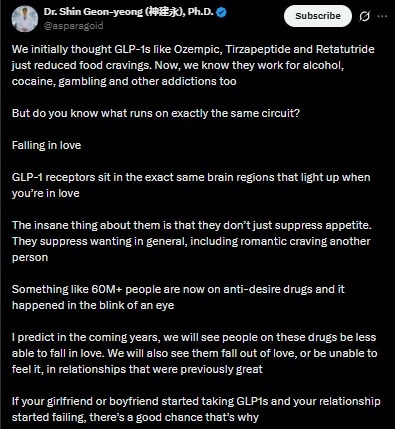
In the post, he argued that the brain regions affected by GLP-1 receptors overlap with the areas activated when people fall in love. Because these medications suppress what scientists call "wanting" or reward-driven motivation, he suggested they could theoretically dampen romantic craving as well.
He also wrote that tens of millions of people are already taking such medications and predicted that in the coming years, some users might find it harder to fall in love, maintain attraction, or feel the same intensity in relationships.
The claim quickly went viral, fuelling speculation that weight-loss drugs might influence not just metabolism but also emotional bonds.
We initially thought GLP-1s like Ozempic, Tirzapeptide and Retatutride just reduced food cravings. Now, we know they work for alcohol, cocaine, gambling and other addictions too
— Dr. Shin Geon-yeong (神建永), Ph.D. (@asparagoid) March 3, 2026
But do you know what runs on exactly the same circuit?
Falling in love
GLP-1 receptors sit in the…
What Science Says
The tweet also linked scientific studies that show that GLP-1 receptor agonists influence parts of the brain linked to reward and motivation. We had a look at them:
- A study published in JAMA Psychiatry examined how GLP-1 signalling interacts with neural pathways associated with addiction and behavioural reinforcement. Researchers found that the medications can reduce reward-seeking behaviour by affecting dopamine-related circuits in the brain. This partly explains why people on these drugs often report reduced cravings for food and sometimes other substances.
- Similarly, research published in The Lancet eClinicalMedicine explored the broader neurological effects of GLP-1 drugs. The findings suggested that these medications can influence brain areas involved in impulse control and motivation, which may help explain their growing role in treating addictions and compulsive behaviours.
- Scientists have increasingly observed that GLP-1 therapies may reduce cravings not only for food but also for alcohol and other addictive substances. This has opened up new areas of research into how metabolic drugs might influence reward processing in the brain.
However, none of these studies directly conclude that the drugs interfere with romantic attraction or emotional bonding. The connection between reward circuits and love remains far more complex. So we asked the experts.
Why Love Cannot Be Reduced To One Brain Pathway
Doctors emphasise that falling in love or feeling attraction is not governed by a single chemical pathway.
Dr Shashank Shah, Bariatric surgeon at Apollo Spectra Hospital in Pune, says the current claim linking GLP-1 drugs directly to romantic desire is not supported by strong scientific evidence.
Dr Shah explained that while GLP-1 drugs do act on various parts of the brain and may influence addiction-related pathways, romantic bonding involves multiple biological systems.
"If you look at only the romantic bonding, it's a complex entity which involves multiple systems including dopamine, oxytocin, serotonin, vasopressin, mood centre, surroundings, environment, situation, personality, past history, background, so it's a complex phenomenon," he said.

Weight-loss drugs might influence not just metabolism but also emotional bonds. Photo: Unsplash
Because of this complexity, he added that it is "very difficult to point out direct relationship of GLP-1 with romantic relationship or proposal at this moment with the present evidence available."
At the same time, he notes that indirect effects cannot be completely ruled out.
"However, a complex indirect interaction in some individuals cannot be ruled out, but it is too early to conclude that there is a direct relationship impact," he said.
Physical And Emotional Side Effects
Dr Shah also pointed out that some emotional changes seen in patients may not come directly from the medication's effect on love or attraction.
GLP-1 drugs can sometimes cause severe nausea, dehydration or significant appetite suppression, which can affect a person's overall well-being.
"It is also noticed sometimes that person on GLP-1, because of severe nausea, eats very less, sometimes is dehydrated, and we can make out that impact on a person's well-being," he said.
Food and social eating often play a central role in relationships, gatherings and shared experiences. If someone loses interest in eating or feels unwell during meals, it may influence social dynamics.
"Some people love to eat, and if that is removed, there is an emotional impact of being unable to eat or being unable to enjoy; it's seen sometimes," Dr Shah said.
He also warned that nutritional deficiencies may contribute to emotional changes.
"With GLP-1, patients eat much less, and the deficiencies are far more severe, and the impact of severe vitamin and micronutrient deficiencies on emotions and emotional well-being is seen," he added.
Such changes could indirectly affect interpersonal relationships, especially in social settings where food and shared experiences play a role.
The Reward System Connection
Dr Monika Sharma, senior consultant in endocrinology at Aakash Healthcare, says GLP-1 medications work by influencing brain areas associated with reward and motivation.
"GLP 1 receptor agonists can be categorically defined as being in the same class of medication as Ozempic and Tirzepatide. Both of these medications are wonderful drug choices that help control hunger by impacting brain areas associated with reward and motivation," she explained.
Research has shown that these reward pathways influence cravings beyond food.
"New research has demonstrated that the very same circuits that affect hunger also impact cravings for substances besides food," she said.
However, she stressed that romantic attraction is not identical to these reward signals.
"It's important to also keep in mind that these reward pathways are only somewhat different from those that are related to romance and intimacy."
In theory, she says, medications that reduce reward signalling might subtly influence how individuals experience attraction.
But she emphasised that there is currently no solid evidence linking GLP-1 drugs to loss of romantic feelings.
"At this time, we do not have enough solid clinical evidence to indicate that GLP 1 medications would cause someone not to fall in love or lose their desire and/or to negatively impact relationships."
Subtle Changes In Motivation
Both the expers however, acknowledge that a few patients taking GLP-1 drugs have reported changes in motivation or reward sensitivity.
According to Dr Sharma, these shifts may indirectly influence intimacy in certain situations.
However, she stressed that such effects are not universal and depend on multiple factors.
"The degree and type of effect will differ for every patient due to psychological/hormonal/relationship factors."
Because of this variability, doctors recommend monitoring emotional well-being during treatment.
"Patients who are taking GLP-1 medications should monitor for changes in mood, desire and/or relationships and discuss any concerns with their physician," she said.
The Final Verdict
GLP-1 drugs such as Ozempic and Tirzepatides like Mounjaro are powerful medications that alter appetite, metabolism and certain reward circuits in the brain. Research shows they may reduce cravings not only for food but also for addictive behaviours.
However, experts say there is currently no scientific evidence proving that these medications directly prevent people from falling in love or maintaining romantic relationships.
Love and attraction involve a complex interplay of hormones, brain chemistry, personality and life circumstances. While subtle changes in motivation or emotional state may occur in some individuals taking these drugs, the idea that weight-loss medications can "kill romance" remains, at this stage, more speculation than science.
Track Latest News Live on NDTV.com and get news updates from India and around the world
