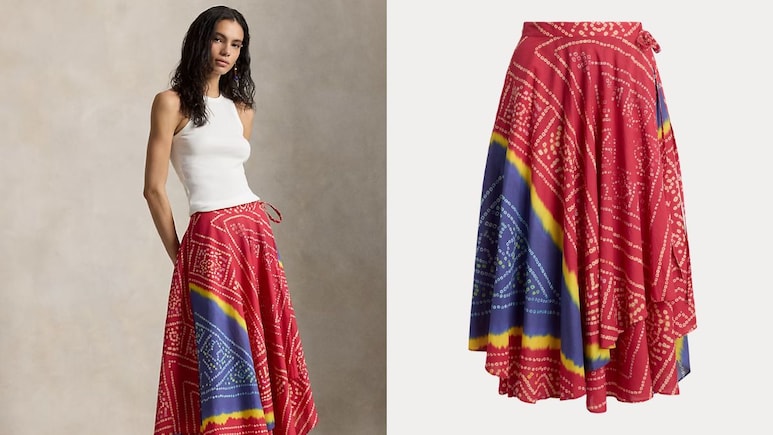
- Ralph Lauren sold a Bandhani-style skirt priced at Rs 44,800 without crediting Indian artisans
- The skirt's fabric was a printed design, not genuine Bandhani tie-dye
- Bandhani fabric traditionally costs Rs 200 to Rs 500 per metre in India
The script of the West stealing and selling Indian-inspired outfits and accessories without due credit is getting redundant. Fashion brands like Prada, Louis Vuitton, and Ralph Lauren continue to come up with new collections featuring garments or accessories inspired by South Asian heritage, but they almost always miss mentioning the artisans.
Do you remember when Ralph Lauren took Indian jhumkas to the Paris runway, sparking a debate around credit? In March 2026, the American fashion brand, synonymous with luxury, had models flaunting jhumkas—one of the most common accessories Indian women wear. They labelled them “vintage accessories” on their website without crediting Indian craftsmanship.
Well, you would think the brand might have learned something from the scrutiny on social media. But no. It is under fire again - this time for selling a Bandhani-style skirt at an exorbitant price of Rs 44,800.
Ralph Lauren's Rs 44,800 Bandhani Skirt
The official website is selling a wrap skirt featuring bandhani print. The description reads, "This beautifully draped cotton skirt is printed with a vibrant design inspired by traditional Bandhani tie-dye techniques and motifs. Its true wrap silhouette features a tied waist and a cascading angled hem for effortless movement with every step."
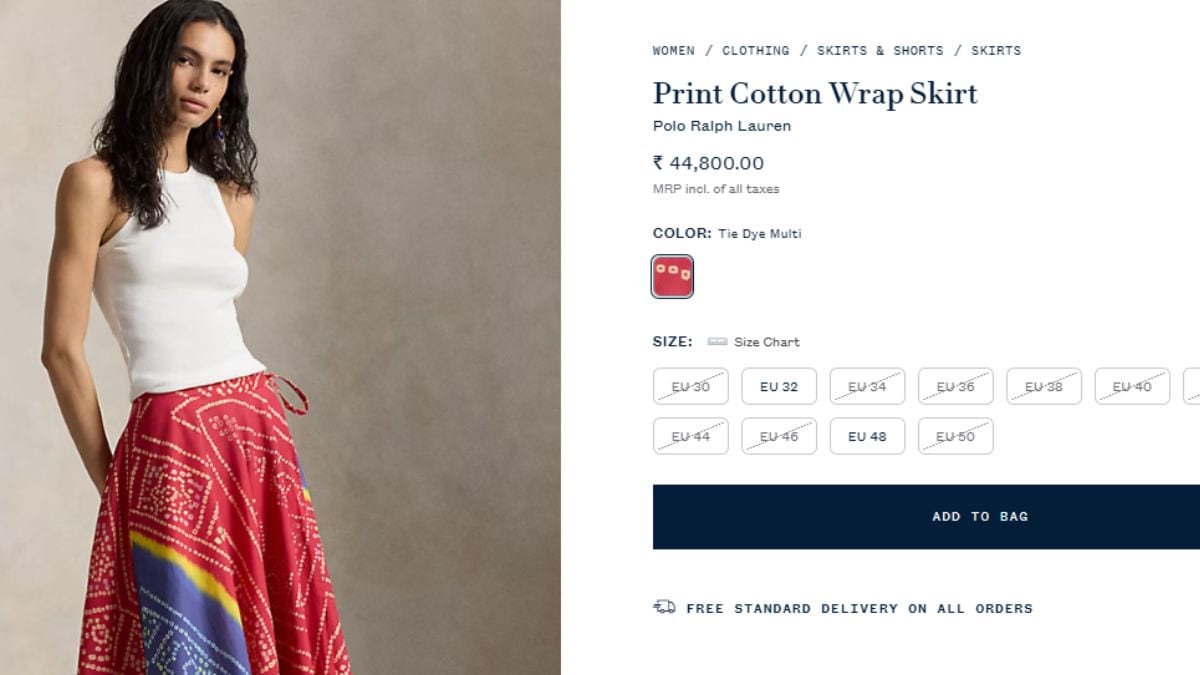
Ralph Lauren's Bandhani skirt is priced at Rs 44,800. Photo: Ralph Lauren
It comes with an interior buttoned closure on the right waist and side-on-seam pockets. The A-line design hits at the calf. The printed cotton wrap skirt is priced at Rs 44,800.
Social Media Reactions To Ralph Lauren's Rs 44,800 Bandhani Skirt
Radha Patel, a digital creator, took to Instagram to call out the luxury label. “Why, Ralph Lauren, why?” she asked, claiming that the skirt was not even made of real Bandhani tie-dyed fabric, but was merely printed. She further added that the brand should have mentioned “Indian” somewhere in the description to credit the inspiration behind the creation.
Having visited multiple stores in India, she said that a metre of originally tie-dyed Bandhani costs between Rs 200 and Rs 500. The creator also added that the skirt likely used no more than four metres of fabric, and by that logic, the cost should not exceed Rs 2,000–Rs 3,000.
"Now I understand the cost isn't just for the fabric, but even the design is super basic. You can find these skirts/silhouette in the markets of Jaipur and Goa! So what exactly are we paying for here besides the brand name itself?" she wrote in the caption.
Much like with any other subject, people in the comment section debated this, too. A person wrote, "Why are we so hungry for recognition? Why can't we just see what Ralph Lauren did, call them unethical, and move on?"
However, a few users supported her. One user wrote, "We're so tired man. Zara, Ralph, and the Prada champals. Like LEAVE US ALONE."
A third supported her and commented, "Honestly relieved to see someone influencing & de-influencing the right way!"
Bandhani Art
The art of tying and dyeing fabric dates back to the Indus Valley Civilisation. It is believed to have existed as early as 4000 BCE. In fact, the earliest examples of Bandhani-style dots can be seen in 6th-century paintings of Buddha depicting his life on the walls of the Ajanta Caves in Maharashtra.
Beautiful patterns are created by tying tiny knots and dyeing them in different colours. The fabric used for Bandhani is usually georgette or cotton, as well as handloom silk, chiffon, and crepe, among others.
Today, Bandhani sarees, suits, and dupattas are widely found in Gujarat and Rajasthan. Fine varieties are manufactured in Anjar, Mandvi, Pethapur, Udaipur, Porbandar, Rajkot, Jaipur, Bikaner, Jetpur, and Ajmer, among other places.
The problem is not the West drawing inspiration from Indian fashion and textiles, but brands failing to give credit where it is due. This is claiming ownership over something that was never yours, with its heritage rooted in another culture.
Also Read | Kareena Kapoor Channels Royalty In A Rs 98,000 Kurta Set
Track Latest News Live on NDTV.com and get news updates from India and around the world
