





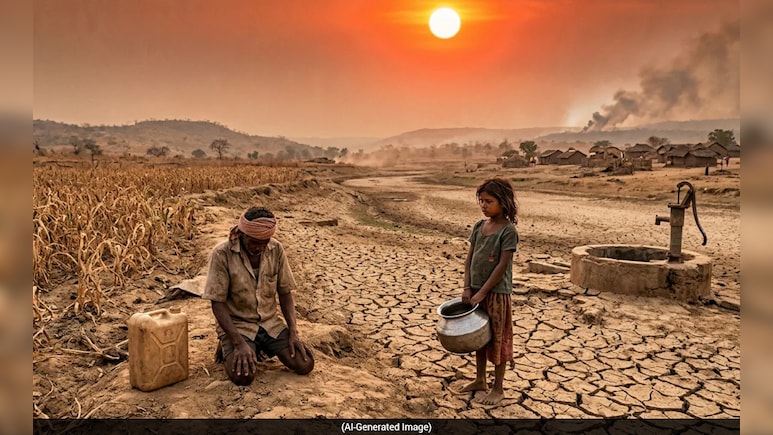
With temperatures soaring and heatwaves gripping large swathes of the country, attention is shifting to a developing climate pattern thousands of kilometres away in the Pacific Ocean. As India braces for the annual southwest monsoon - the lifeline that brings nearly 70% of the nation's rainfall between June and September - forecasters warn of an evolving El Nino that could test the resilience of farmers, reservoirs, and the rural economy.
By the time the monsoon arrives, El Nino is projected to be in its developing phase while overall El Nino-Southern Oscillation (ENSO) conditions shift from neutral. Experts caution that any departure from stable states injects turbulence into global weather systems. Yet this "notorious" phenomenon rarely follows a script, keeping meteorologists on edge and offering glimmers of hope amid the concern.
Understanding the Unruly Pacific Giant
El Nino forms part of the El Nino-Southern Oscillation (ENSO), a complex ocean-atmosphere interaction spanning months. It involves abnormal warming of sea surface temperatures in the central and eastern equatorial Pacific, which weakens trade winds and disrupts the Walker Circulation.
Read | India Bakes At 47.6 Degrees: Heatwave Explained, From Urban Heat To El Nino
"For sub-tropical regions like India, this often translates to subdued monsoon winds and below-normal rainfall. Its journey is anything but smooth: it can intensify, stall, or collapse unexpectedly. Consecutive El Nino years are rare, and the second year is usually less punishing," said GP Sharma, president (Meteorology & Climate Change), Skymet Weather.
An evolving El Nino frequently brings drier conditions and risks mild drought, whereas a decaying phase may avoid outright drought but still deliver deficient rains.
Different Flavours of El Nino
Normal/Canonical El Nino: Broad, relatively uniform warming across the Pacific.
Modoki El Nino: Warming concentrated in the central Pacific with cooler eastern and western flanks - often more damaging to the Indian monsoon.
Current projections by the US-based National Oceanic and Atmospheric Administration favour El Nino development in the coming weeks to months, with high likelihood of persistence through the Northern Hemisphere winter 2026-27. For the peak period of November 2026-January 2027, there is about a 1-in-3 chance of strong to very strong conditions (combined roughly 2-in-3 for at least strong), though uncertainty remains on exact intensity via the Relative Oceanic Nino Index (RONI).
The IOD Factor: Potential Saviour or Limited Relief?
The Indian Ocean Dipole (IOD) often interacts with El Nino. A positive IOD - warmer western Indian Ocean and cooler eastern part - can bolster moisture transport to India, sometimes offsetting El Nino's drying effect. Positive IOD has rescued the monsoon in notable past years.
As of the week ending May 10, 2026, the IOD index stood at -0.04 degree C, remaining near neutral after several weeks of near-zero values - a typical precursor pattern. Models suggest it could turn positive in June and cross the +0.4 degree C threshold by late July or August. However, even a positive IOD struggles to fully neutralise a strong El Nino.
History's Lessons: El Nino Doesn't Always Win
El Nino has earned its reputation as a monsoon spoiler. Between 1951 and 2022, roughly 60% of El Nino years saw below-average rainfall in India, and major droughts have consistently been linked to it. The IMD's April forecast already points to below-normal monsoon rainfall at around 92% of the long-period average (LPA) of 87 cm.
Yet the phenomenon has failed spectacularly before. Of 17 major events in recent decades, at least five delivered normal or above-normal rains. The powerful 1997-98 El Nino prompted fears of catastrophe, but a strong positive IOD helped India receive above-average rainfall. Similar surprises occurred in 1983, 1994, and the weak 2006 event passed with minimal disruption.
Location matters: Central Pacific warming (Modoki) tends to be harsher for India than eastern-focused warming. Climate change adds another layer - warming over Eurasia strengthens land-sea temperature contrasts, potentially bolstering monsoon winds and partially countering El Nino.
A landmark 2006 study by climate scientist KK Kumar and colleagues highlighted that while all severe droughts link to El Nino, not every El Nino causes drought. Even weak events have triggered sharp deficits (e.g., 2002 and 2009 at 78% of normal), underscoring the limits of relying on El Nino intensity alone.
Broader Global Ripples
El Nino influences weather far beyond India: drier conditions in parts of Southeast Asia, southern Africa, and northern Brazil; wetter weather in parts of South America and equatorial East Africa. It often contributes to higher global temperatures, as seen in recent record-hot years.
Earth System Scientist Raghu Murtugudde, speaking to NDTV, said climate models are pointing toward similar broad outcomes this year, though he cautioned against rushing to label the evolving event a "Super El Nino."
"It is still early to determine the strength of the upcoming El Nino, though it is warming the eastern Pacific. Calling it a 'Super El Nino' may be premature."
He explained that El Nino's influence is becoming more intense in a warming world.
"The ocean absorbs heat like a sponge during normal and La Nina years and releases it during El Nino. Global warming is amplifying this effect, as seen in the record-breaking 2023 temperatures. Heatwaves are becoming more frequent and intense."
Murtugudde also warned that climate change is making weather systems increasingly erratic, with uneven rainfall posing a greater threat than headline monsoon deficits.
"Seasonal forecasts predict 6-8% below-normal monsoon rainfall this year. Agriculture will suffer more from uneven rain distribution than from the overall deficit."
Pre-monsoon instability has already taken a toll in some regions.
"Pre-monsoon rains have already damaged thousands of hectares. We should be cautious comparing this to the 1877-78 El Nino, as there was no anthropogenic global warming then," Murtugudde explained.
He added that policymakers are already preparing for possible supply-side disruptions linked to weather and geopolitical stress.
"The government has already banned sugar exports and is preparing for possible shortages of edible oils and fertilizers in the wake of the West Asia crisis."
According to Murtugudde, disaster response and economic management during the season will rely heavily on improved forecasting systems.
"Disasters and disruptions during the seasons will be managed with IMD's short-, medium-, and extended-range forecasts from a day to a few weeks. Central and state governments, along with the private sector, will take decisions accordingly for cascading effects into transportation costs, vegetable prices, edible oils, etc."
For India, the implications are acute: potential impacts on kharif crops, water storage, rural incomes, food inflation, and heightened heatwaves or forest fires. A weak monsoon could compound other pressures, including energy and fertiliser challenges.
The Path Forward: Preparedness Over Panic
ENSO forecasting has advanced significantly, providing crucial lead time. The India Meteorological Department and global agencies now use multi-factor models incorporating IOD, ocean temperatures, Pacific patterns, and climate trends.
India cannot prevent El Nino, but proactive steps can blunt its effects:
* Promote drought-resistant crop varieties and adjust sowing schedules.
* Accelerate water conservation, groundwater recharge, and reservoir management.
* Strengthen state-level drought and heat action plans.
* Encourage contingency planning among farmers and policymakers.
As experts noted, El Nino signals risk, not inevitable doom. With monsoon forecasting remaining an imperfect science, vigilance and preparedness remain the wisest strategy.
The coming weeks will bring clearer signals as ocean conditions evolve. For millions dependent on the rains, the Pacific's mood swings will once again determine whether 2026 becomes a year of bounty or belt-tightening. India watches, prepares - and hopes for history to repeat one of its kinder surprises.
Track Latest News Live on NDTV.com and get news updates from India and around the world

