





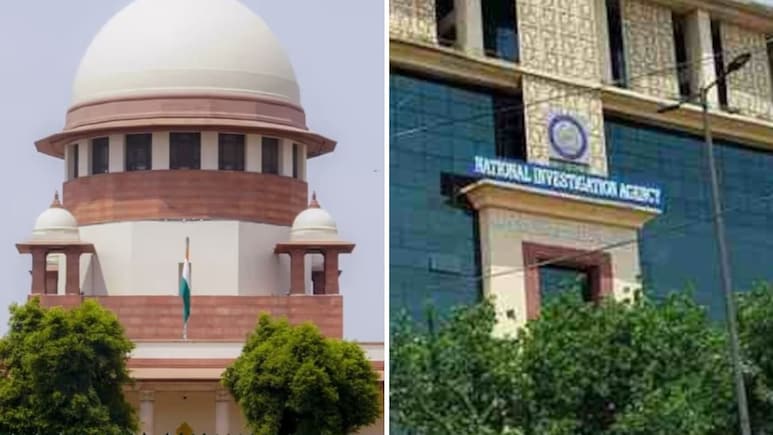
- The Supreme Court questioned the NIA's suo motu probe into violence in West Bengal's Beldanga
- “Every emotional outburst cannot be packaged as a threat to economic security,” the court remarked
- The Bengal government claimed the NIA initiated a probe without examining case records
The Supreme Court on Wednesday questioned the National Investigation Agency (NIA) over its decision to initiate a suo motu probe into the violence in West Bengal's Murshidabad district. "Every emotional outburst cannot be packaged as a threat to economic security," the court remarked.
A bench comprising Chief Justice of India Surya Kant and Justice Joymalya Bagchi was hearing a plea filed by the West Bengal government challenging a Calcutta High Court order that left it open for the Centre to deploy Central Armed Police Forces (CAPFs) in the district's Beldanga town following violent clashes in mid-January, which involved arson and damage to public property.
Questioning the NIA's conduct, Justice Bagchi noted, "Every emotional outburst cannot be packaged as a threat to economic security... In April 2025, we saw violence and the State government also agreed. The high court division bench asked the NIA to see if an investigation could be conducted. But the NIA slept on it."
The court asked the agency what the necessity was for initiating a suo motu investigation (of its own accord) without examining the material in the case, noting that the agency appeared to have ordered the probe without going through the relevant documents.
Arguments
Senior Advocate Kalyan Banerjee, appearing for the West Bengal government, told the court that the NIA ordered the probe without examining any records.
The Centre refuted the allegation, arguing that the ingredients of the FIR attracted Section 15 of the Unlawful Activities (Prevention) Act (UAPA), which deals with terrorist acts.
Additional Solicitor General SV Raju, appearing for the NIA, argued that Beldanga is located near the Bangladesh border, which he described as a "porous border". He said deadly weapons were used in the violence and claimed that the state was not handing over investigation papers to the central agency.
"We are conducting an independent investigation. They are not handing over the probe papers to us. Please direct them to do so," he urged the court.
Justice Bagchi, however, said that the correctness of the NIA invoking its powers would have to be examined by the Calcutta High Court.
"You can say there was no use of explosives and that there was no intention to affect economic security. You can tell the high court that the NIA invoked its power incorrectly," Justice Bagchi told the state government.
Sealed Cover Report
The Supreme Court directed the NIA to submit a status report on the investigation so far before the Calcutta High Court division bench in a sealed cover, indicating whether a prima facie case was made out for further investigation under Section 15 of the UAPA.
The bench said the high court should consider the NIA report independently and pass consequential orders on whether a probe by the agency was needed.
The court also transferred the West Bengal government's petition against the NIA probe to the Calcutta High Court, clarifying that it had not expressed any view on the merits of the case.
"The plea challenging the NIA probe before this court is pending. We are of the view that the legality of that order is pending before the high court. Thus, we dispose of it by transferring it to the high court," the Bench said.
It also directed that the matter be heard by a division bench headed by the chief justice of the Calcutta High Court, before whom the earlier plea is pending.
Earlier Petitions
On January 20, the Calcutta High Court had allowed the deployment of central forces in Murshidabad district on two public interest litigations - one filed by Leader of Opposition Suvendu Adhikari and another by a Beldanga resident.
The high court had described the "repeated incidents and recurrence of violence" in Murshidabad as "certainly worrisome" and called for "immediate and effective measures" to protect residents.
The West Bengal government subsequently moved the Supreme Court against the High Court order, arguing that it left the door open for central intervention, including the possibility of an NIA probe, without adequate basis.
Track Latest News Live on NDTV.com and get news updates from India and around the world

