






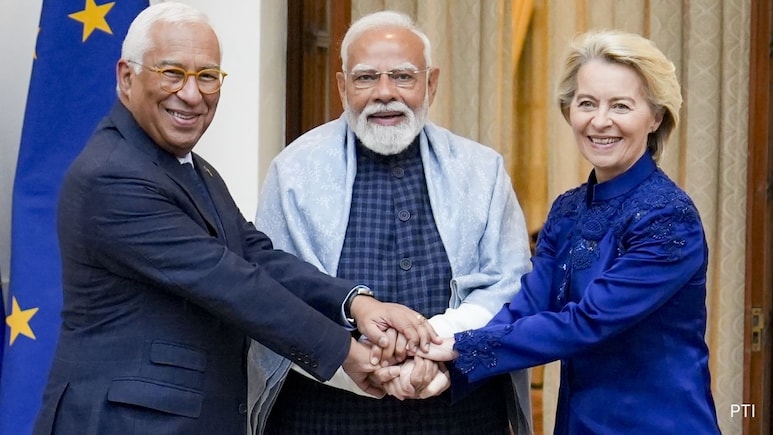
Trade deals with the United States and European Union in the last two weeks have underscored India's newfound confidence toward global trade. While the agreement with the United States was negotiated under duress, it is consistent with India's recent trade policy, which has shifted away from protectionism to focus on domestic support programs and trade deals. But more hard work lies ahead. For the United States and India to realise the potential of this burgeoning commercial relationship, domestic reforms must be prioritised at all levels of government in India.
Prime Minister Narendra Modi's government took office in 2014. Due to India's goods trade imbalances and the need to create low-skilled employment, the government kicked off the "Make in India" campaign with a goal of increasing manufacturing as a percentage of GDP from 15% to 25% by 2024. The toolkit to support the campaign consisted of a mix of protectionism, domestic reforms, and a global push to attract multinational manufacturers.
The target year came and went, and the manufacturing-to-GDP ratio actually declined slightly. The Union government had pushed ahead with key reforms such as creating the national Goods and Services Tax, relaxing foreign direct investment restrictions, pursuing labour deregulation, and implementing sectoral reforms in areas like hydrocarbon exploration. However, nascent attempts to push states to improve their local business environments - like the erstwhile "Business Reforms Action Plan," which ranked states' business environments - have faltered.
But about midway through the government's second term, there was a noticeable shift in its approach to trade. Successive Union budgets tended to have more tariff reductions than increases. The government began to promote domestic support programs for manufacturers called "Production Linked Incentives" programs. And India began to aggressively pursue trade agreements, finalising six agreements in a little over three years.
The free trade agreement with the European Union had been in the works for nearly 20 years, though a formal "restart" was announced in 2022 after a long pause in talks. Talks on a bilateral trade agreement with the United States were formally announced as part of the February 2025 United States-India Joint Leaders Statement after the White House summit.
India understandably will keep import restrictions on some products, notably the staple grains that are critical to hundreds of millions of small farmers. But in other sectors, India has shown a willingness to cut tariffs deeply. The government recognises that, despite aspirations (and some success) in attracting technology investments, the country's immediate potential strength is in labour-intensive sectors.
While concrete details on the tariff-and-timeline elements of the U.S.-India interim agreement are not yet available, India has staggered tariff cuts over different periods of time. This presents real urgency to Indian policymakers. Yielding the full benefits of these agreements will require recommitting to the difficult domestic policy reforms that investors require, such as transparent land acquisition, increased labour flexibility, improvements in electric power pricing and reliability, and faster resolution of disputes.
Most of this agenda lies not in Delhi, but instead with India's 28 state governments. State governments, for their part, have tended to focus investment policy on crafting sector-specific incentive programs such as an "electronics policy," "data centre policy," "green hydrogen policy," or "electric mobility policy." In recent years, most of these sectoral policies have focused on capital-intensive industries, the strength areas of India's partners in these new trade agreements. Relatively few states have been willing to do the hard work of improving the general business operations for land, labour, and capital.
Improved commercial ties between the United States and India will allow the two countries to continue to "grow together" well into the future. The interim agreement is a critical step toward reducing tensions and improving trade policy stability. The harder work now begins, at least in India. This burden of policy improvement must be shouldered from Bombay to Bhubaneswar, from Chennai to Kolkata, and from Patna to Panaji.
(Richard Rossow is a senior adviser and holds the Chair on India and Emerging Asia Economics at the Center for Strategic and International Studies in Washington, D.C.)
Disclaimer: These are the personal opinions of the author

