





The central government has taken a major step to promote foreign capital inflows into the country and mitigate the adverse effects of the Iran war on the economy, according to sources.
The Union Cabinet, led by Prime Minister Narendra Modi, has reportedly approved an ordinance amending the Income Tax Act. The ordinance, as per sources, will completely eliminate capital gains tax on investments made by foreign portfolio investors (FPIs) in Indian government securities (G-secs). It will be implemented after Presidential approval.
Currently, foreign investors pay a 12.5 per cent long-term capital gains (LTCG) tax on bonds and listed shares held for more than 12 months. In addition, they also pay a 20 per cent withholding tax on interest earned on government bonds. Follow Markets Live Updates
Significantly, the government eliminated the 5 per cent concessional rate on this in 2023. However, this year, foreign investors have pulled out a massive Rs 2.5 lakh crore from the Indian stock markets. Thus, to prevent further FII (foreign institutional investors) and FPI selling, there had been calls for tax cuts.
According to sources, more significant steps to shore up India's forex and attract global investments are likely to be taken in the future.
The decision comes days after Union Finance Minister Nirmala Sitharaman said that she is willing to listen to investors on what they have to say about reducing taxes on long-term and short-term capital gains.
In the Union Budget presented in July 2024, the finance minister raised the LTCG tax rate on most assets to 12.5 per cent from 10 per cent, while increasing the exemption limit for listed equity and equity-linked instruments to Rs 1.25 lakh. Meanwhile, STCG (short-term capital gains) on listed shares in India is taxed at 15 per cent, as per Section 111A of the Income Tax Act.
Is LTCG Driving Out Foreign Investors?
According to Harsha Vardhana VM, Group CEO, Atom Financial Services, the numbers are too large to dismiss. "FPIs were net sellers in India in eight of the 12 months in 2025, with total outflows of Rs 1,66,286 crore. January 2026 alone saw a Rs 33,598 crore exit, the highest monthly outflow since August 2025. The LTCG tax is contributing, but it is one factor in a five-variable equation."
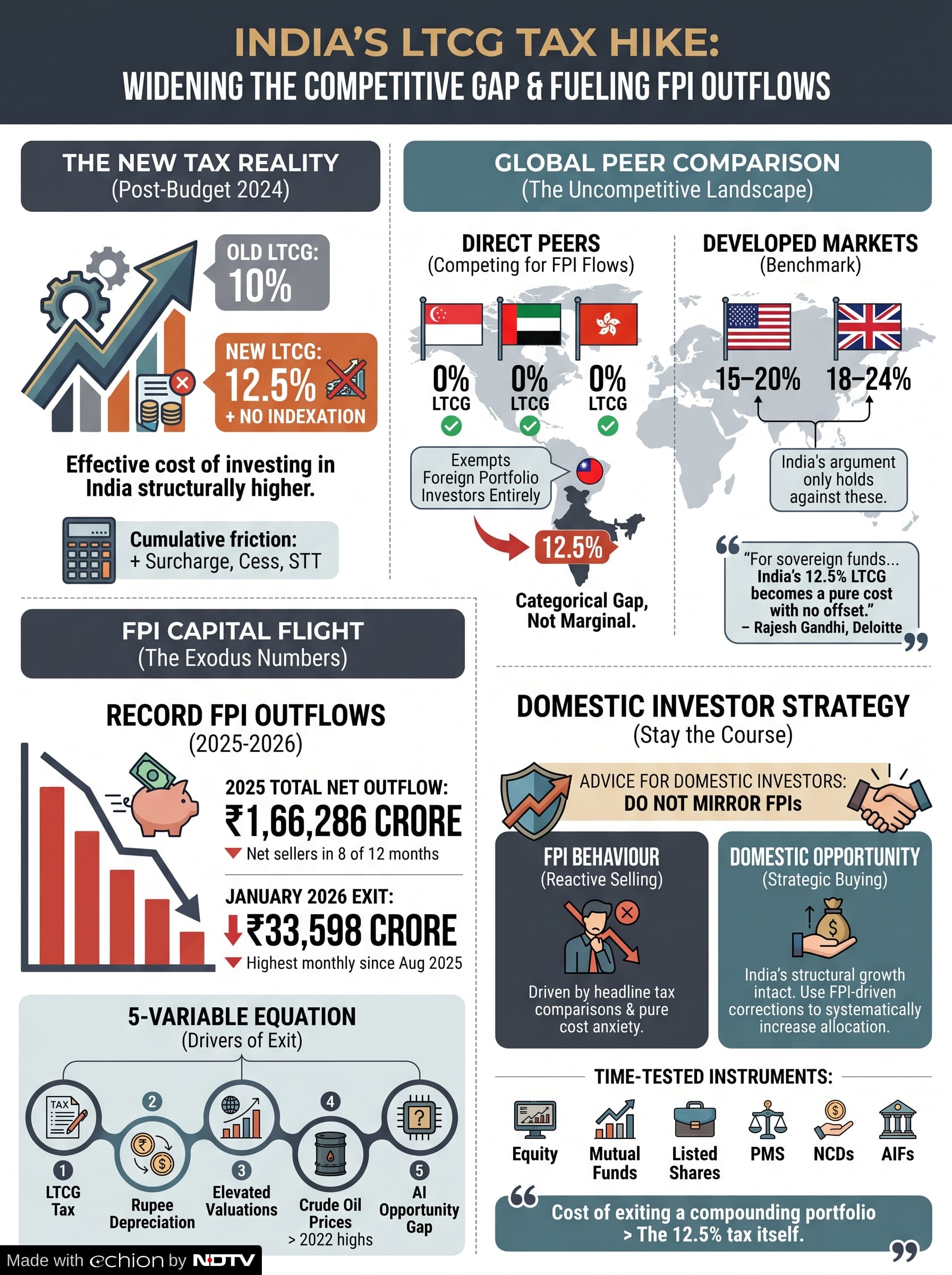
"The tax argument is most damaging not for equity funds, which can price in 12.5 per cent, but for tax-exempt institutions like sovereign wealth funds and pension funds that face India's LTCG as a pure incremental cost with no home-country offset. For these investors, India simply becomes more expensive than peer markets," added Vardhana.
In a similar vein, Gaurav Maheshwari, Chief Financial Officer, Alankit Limited, said India is considered an outlier because many major international financial centres, such as Singapore and Hong Kong, generally do not impose capital gains tax on foreign portfolio investors. "India, however, follows the principle that income generated from Indian assets should contribute to the country's tax revenues, regardless of whether the investor is domestic or foreign," added Maheshwari.
Track Latest News Live on NDTV.com and get news updates from India and around the world

