





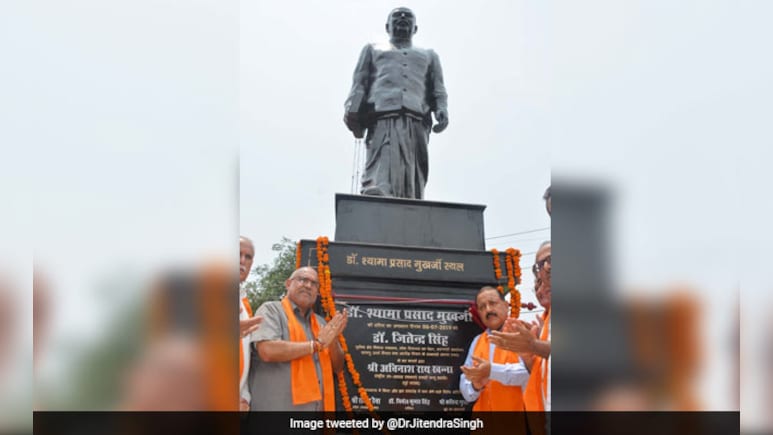
SP Mukherjee road is an arterial road in south Kolkata. That is how many of the city's residents are familiar with the name of Syama Prasad Mookerjee. The road joins key areas of the city -- ironically, including Kalighat and Bhabanipur, where Trinamool chief Mamata Banerjee's home and her constituency are located. Today, with Bengal's manadate apparently set to go to the BJP, it is perhaps time the city got reintroduced to the early 20th Century lawyer, educationist and minister in Jawaharlal Nehru government, who was also the founder of Bharatiya Jan Sangh -- the body precursor to the BJP.
Mookerjee is the reason the BJP says it fought so hard for Bengal. The party considers him a founding father.
Mookerjee was son of the illustrious Ashutosh Mukherjee, a man dubbed the "Tiger of Bengal" who got a chapter to himself in the state's school textbooks.
A mathematician, lawyer, jurist, judge of Calcutta High Court and a Vice Chancellor of Calcutta University, Ashutosh Mukherjee was truly the Renaissance man, who was behind the founding of a handful of institutions including the one known today as the Jadavpur University.
His son joined politics in 1929, joining the Indian National Congress and entering the Bengal legislative assembly. In 1939, he became a member of the Hindu Mahasabha in Bengal and within a year, its president.
His break with the Mahasabha came with the assassination of Mahatma Gandhi, which he condemned, despite being a stern critic of the Quit India movement.
Included in Independent India's first Cabinet headed by Jawaharlal Nehru, Mookerjee quit the government in 1950 and reached out to the Rashtriya Swayamsevak Sangh to launch a party dedicated to the cause of nationalism.
In 1951, he founded the Bharatiya Jan Sangh. The next year, the party won three seats in parliament. That was the moment BJP considers as the beginning of its journey to holding power in Delhi.
For this election, the BJP has frequently cited Mukherjee to underscore the party's Bengali credentials - a move meant to counter Mamata Banerjee's imposition of the "outsider" tag on it.
"If today Bengal is a part of India, it is because of Syama Prasad Mookerjee. Not only that, the fact that a large portion of United Punjab is today with India is also because of the voice raised by him," former BJP chief JP Nadda has said.
Today, the BJP victory in Bengal - a state with 42 Lok Sabha seats and the last frontier to the BJP's march in the eastern India -- is the fulfilment of a long-standing dream, a journey to which started in 2016.
That year, the party won 3 seats and 10 per cent vote share. In the next election five years on, it won 77 seats and 38 per cent vote share by 2021 -- a huge leap. This time, it has already crossed the majority mark of 148 in the 294-member Bengal assembly.
The final frame is yet to arrive.
Track Latest News Live on NDTV.com and get news updates from India and around the world

