





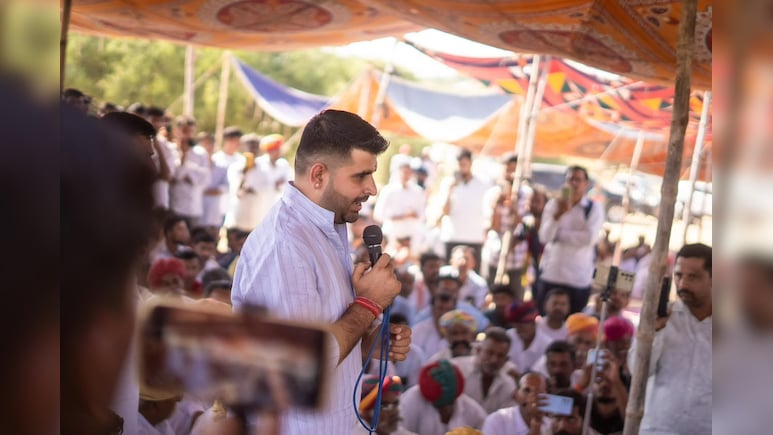
Ravindra Singh Bhati, Independent MLA from Sheo in Barmer, is all set to launch a yatra demanding political representation for upper castes through the quota for the Economically Weaker Sections. Raising the bogey of political reservation - ahead of the coming the panchayat polls - it could rewrite the political maths for a state that has been deeply divided along caste lines.
To mobilise opinion on the issue, Bhati will launch a 5-day yatra from home ground Barmer 's Alok Ashram on September 25, a day in Hindu calendar marked for victory and auspicious as "Anant Chaturdashi".
For the 29-year old politician who has chartered an independent course since he fought his first assembly election at the age of 25, this could just be the issue that would pivot him onto a larger stage. His assembly constituency Sheo is in the western deserts of Barmer, Rajasthan's last district on the western front.
Bhati has been something of a social media phenomenon. He has 3.1 million followers on Instagram, over 1.6 million on Facebook and his twitter handle has 3.49 lakh followers.
So is he just a social media phenomenon? Bhati dismisses the possibility. He won the assembly elections in a closely fought contest with 9 other candidates in Sheo. Bhati polled 79,495 votes and won with a margin of 3,950 votes and a vote share of 31.44 per cent.
His second runner-up was also an Independent - Fateh Khan - and the BJP and the Congress trailed them. The Congress by 24,231 votes and the BJP fared even worse. The BJP candidate was 56,675 votes behind Bhati.
In the Lok Sabha election 2024, Bhati again stood as an Independent with over 5.86 lakh votes.
He was behind the Congress candidate by 1 lakh-plus votes and way ahead of the BJP candidate and sitting minister Kailash Chaudhary by 2.99 lakh votes
"These facts speak for themselves," Bhati said. "Om ignoriya namah. I just ignore those kind of comments. I started my career in politics as the university president at Jodhpur University from 2019 to 2022. I have fought the assembly elections as the youngest candidate and the Lok Sabha elections where I polled more than 5 lakh votes and I have been closely connected with and built my network of youth supporters from my university days," he said.
"At the Jodhpur university, the most prestigious for students from all over Marwar, I developed a close connect with youth of that region, especially during the Covid years... Those years gave me a close and lifelong connection that has helped me politically," he said.
"In today's politics, only those with wealth and strength can enter," Bhati added. "It is about time we gave political representation to the Economically Weaker Sections of society... to fight a panchayat election candidates spend so much money... Even where seats are reserved for general candidates, do you see the economically weaker sections fighting elections? They cannot, because they don't have the funds for it," he added.
Of Rajasthan's total voting population, 24 per cent are upper castes who have often felt left out of a political narrative that panders to the larger arithmetic of the Scheduled Castes and OBC vote banks.
The Social Justice Front launched in 1999 that demanded upper caste economic reservation, was a response to the widening of the OBC quota by the BJP that gave the Jats reservation ahead of assembly elections 1999.
Historically, forward-caste communities like Rajputs, Brahmins, and Vaishyas in Rajasthan were solid supporters of the BJP.
By adopting the central law in February 2019 and actively stripping away complex property and land constraints in October 2019, Chief Minister Ashok Gehlot effectively tried to target this voter segment, but subsequently the BJP also made it an election plank in Rajasthan, asserting that it was the 103rd amendment by the Narendra Modi government that helped it secure reservation for upper castes and pitched before the Lok Sabha elections of 2019. It helped the BJP win 24 out of 25 Lok Sabha seats in the state.
Bhati has picked an issue that can resonate with the electorate in Rajasthan, and for a young leader who has always charted an independent course, it is a way to bring himself to political centrestage.
Bhati's "Saralikaran yatra" as it is called, will begin from Barmer's Alok Ashram - the headquarters of the Yuva Kshatriya Sangh or the organisation for the Rajput youth. The five-day yatra will focus on western Rajasthan, Bhati's stronghold, and will culminate in Jodhpur.
"Political representation is just one aspect of the yatra," said Bhati.
"We also want the government to have the same rules at the state and the Centre for the EWS. The criteria at the Centre does not take into account different conditions in the state," he said.
As an example, he cited the criteria of 5 acres of land for EWS status at the Centre. A 5-acre family plot pushes one out of the EWS category.
But 5 acres of land in the desert is not the same as 5 acres in Delhi-NCR or Haryana in terms of multiple items including agricultural productivity, irrigation facilities, local land value and economic utility.
A candidate should not have to obtain separate certificates for EWS for the state and for the centre. "So many genuinely backward EWS youth cannot give the UPSC exams and get benefits under this quota due to these riders," he added.
Track Latest News Live on NDTV.com and get news updates from India and around the world

