





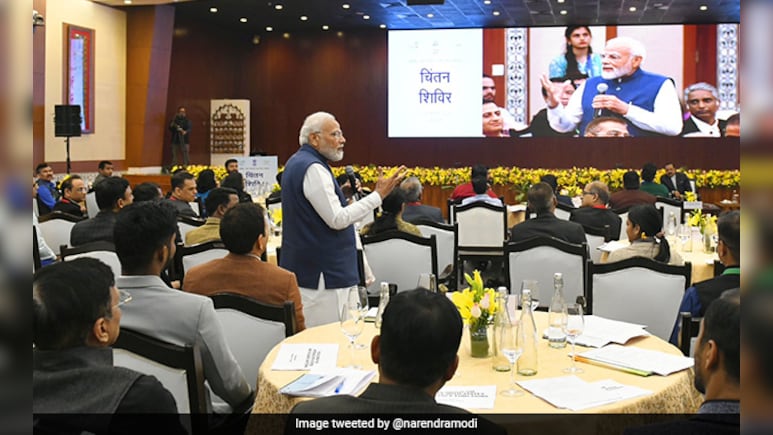
At the two-day brainstorming session of the Prime Minister Narendra Modi's Council of Ministers, all ministers were urged to remain active on ground. Several presentations regarding government schemes and operations were made during these deliberations, sources said. The process of reflection will continue - another two-day meeting involving all ministers is scheduled for next week.
Sources indicated that the objective of this brainstorming camp is to review the progress made during the first half of the 'Modi 3.0' term and gear up for the road ahead. Held with the resolve of achieving a 'Viksit Bharat' (Developed India), the session is also being viewed in the context of ministerial performance and a potential cabinet reshuffle.
Ministers were instructed to remain active at the grassroots level and ensure that the benefits of the government's welfare schemes reach everyone. They were also asked to share what they had learned from their colleagues, with these insights being documented.
The ministers, sources said, were asked to familiarise themselves with 40 to 45 major government schemes and programmes operating in their respective sectors and ensure their benefits reach all intended beneficiaries.
They were also advised to gather information on current issues and challenges before speaking to the media. Discussions centered on two themes - self-development and transforming public trust into public participation.
Sources said 12 ministers were organised into six groups to deliver presentations. Among them were Rajnath Singh, Nirmala Sitharaman, Gajendra Singh Shekhawat and Piyush Goyal.
Discussions covered topics such as personal efficiency, effective communication, improved implementation of schemes and decisions, ministry operations, and consultations with stakeholders.
Government sources said the aim of this exercise is to review the progress on the 'Viksit Bharat' mission. The session differs from previous brainstorming camps of this nature, as it focuses on reviewing policies and discussing ministers' own experiences.
The "Chintan Shivir" (brainstorming session) held at "Seva Tirath" was structured to allow small groups of ministers to engage in open discussions. All 68 ministers participated in the exercise, divided into four groups of seventeen ministers each.
Each group was subdivided into three smaller units, with two ministers in each sub-group assigned the responsibility for coordination and presentations. The first topic focused on 'Good Governance,' incorporating both political and personal aspects relevant to the ministers.
Each group's meeting lasted over three hours, and the ministers were encouraged to bring forward new suggestions.
Discussions covered the progress of government schemes and their impact on the ground, 'Ease of Living,' time management, timely completion of projects, progress on major infrastructure projects, and initiatives like "Gati Shakti".
Personal topics included ministers sharing experiences with one another and discussing health-related matters to ensure that the workload did not adversely affect their well-being.
To facilitate in-depth brainstorming, ministers were seated in separate rooms. Approximately one-and-a-half hours were dedicated to each theme.
The second topic focused on the journey from 'Public Trust' to 'Public Support' (Jan-Vishwas se Jan-Aadhar). Discussions centered beneficiaries and inclusion of individuals who had previously been left out of development schemes. Expanding the reach of these schemes to more beneficiaries was also a key topic of discussion.
Significantly, PM Modi was present through all the presentations and took extensive notes.
The brainstorming exercise is set to continue. Sources said more sessions may be held on September 30 and October 1. Ministers have been asked to prepare presentations on new themes, which may focus on youth and women.
The ministers made extensive preparations for this session. Those assigned coordination duties held a series of meetings over several days leading up to the event.
Government sources said inputs for presentations were gathered not only from ministries and departments but also from groups of secretaries, the Cabinet Secretariat, and NITI Aayog. The primary objectives are to discuss reforms, ease of living, reduction of compliance burdens, and government priorities.
Deliberations on transforming India into a developed nation by 2047 have been on since 2021. At the time, 10 groups of secretaries were drawn up to formulate long-term plans. Prior to this, eight presentations have already been made before the Council of Ministers.
Track Latest News Live on NDTV.com and get news updates from India and around the world

