





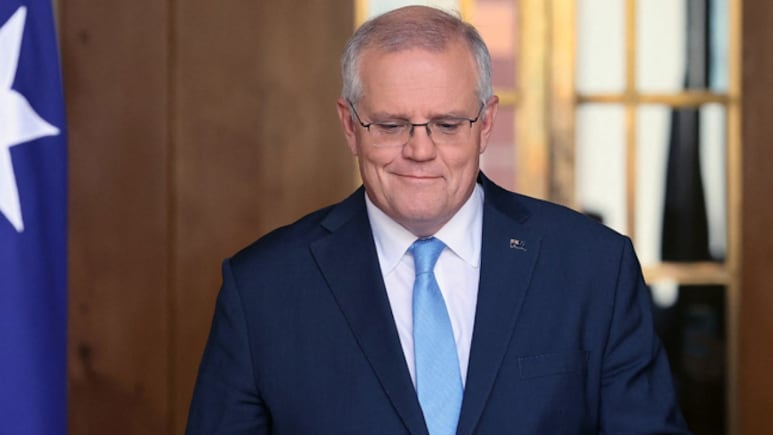
Former Australian Prime Minister Scott Morrison used an exclusive interview with NDTV to weigh in on some of the world's most pressing flashpoints while celebrating the deepening India-Australia partnership during Prime Minister Narendra Modi's ongoing visit to Australia.
Speaking to NDTV's Senior Executive Editor Aditya Raj Kaul, Morrison, who signed the Comprehensive Strategic Partnership and the Economic Cooperation Trade Agreement with PM Modi during his own tenure, said he met the Indian Prime Minister in Melbourne, where he first hosted him over a decade ago.
He noted that PM Modi addressed roughly 30,000 members of the Indian diaspora in Melbourne, calling it a celebration of Indian culture, and welcomed the fact that support for the relationship, including uranium sales to India that began under the Howard government, has become a bipartisan position in Australian politics.
On Iran and the Middle East
Asked about the renewed conflict near the Strait of Hormuz, where commercial ships have come under attack and the US has carried out strikes, Morrison offered a blunt assessment.
He argued that removing Iran's capability for a nuclear attack was justified, and said he was not surprised the conflict had entered another active phase, warning it could ease and flare up again.
Morrison described Iran's regime as not a rational actor open to practical engagement, driven instead by an apocalyptic vision for the region that makes a workable settlement difficult, though he believes some arrangement will eventually emerge - likely after a messy process.
He said the episode should serve as a wake-up call for governments and investors to build more resilient supply chains, diversify suppliers, and invest in alternatives such as pipelines and storage, since chokepoints like Hormuz will keep being exploited.
Quad Under Pressure
Regarding the Quad, Morrison rejected the idea that the grouping has lost strategic relevance, even as a leaders' summit remains overdue and Washington's priorities appear elsewhere. He credited Secretary of State Marco Rubio with driving momentum, pointing to the recent foreign ministers' meeting in New Delhi, and argued that India's primacy in the Indian Ocean must remain central to the Quad's work on infrastructure, critical minerals, energy and maritime security. He also flagged space as an area needing more attention.
Morrison cautioned against the Quad trying to be a sprawling multilateral body with a view on everything, arguing instead that its strength lies in being a focused, trust-based grouping - similar to Five Eyes - that gets practical things done, from the Malabar naval exercises to coordinated humanitarian response during COVID-19.
Trade, Tariffs and Terrorism
On trade, Morrison pointed to the Economic Cooperation Trade Agreement as the breakthrough that opened the door to a broader economic partnership now being negotiated further, even as global trade has been upended by what he called Washington's reset of tariff arrangements.
He praised Modi's handling of that disruption as patient and mature, and said India, Australia and partners like the US, Japan, Korea and Singapore need to build networks of trust to reduce friction and secure supply chains for goods, data and energy.
Turning to counter-terrorism, Morrison acknowledged frustration that global bodies like the United Nations have failed for decades to even agree on a definition of terrorism, saying such institutions struggle to agree on basics. He argued that bilateral and "minilateral" partnerships like the one between India and Australia, built on intelligence-sharing and trust, are far more effective at disrupting terrorist networks than large multilateral forums. He referenced both India's experience with cross-border terrorism, including the Pahalgam attack, and the Bondi Beach attack in Australia, and praised Modi's outreach to the Jewish community as a stand taken out of principle.
Diaspora as the "Soft Power" Glue
Morrison closed by crediting Australia's Indian diaspora, its largest migrant community, as the human bridge sustaining the relationship, describing it as skilled, entrepreneurial and culturally rich. He said the ease of the India-Australia relationship stems from shared democratic values and institutions, contrasting India's political freedoms with China's growth-focused model, and said he'd rather live somewhere citizens can freely criticise their leaders.
The interview came as Modi and Australian Prime Minister Anthony Albanese announced fresh cooperation on civil nuclear energy, trade and security during the Indian leader's third visit to Australia.
Track Latest News Live on NDTV.com and get news updates from India and around the world

