

)
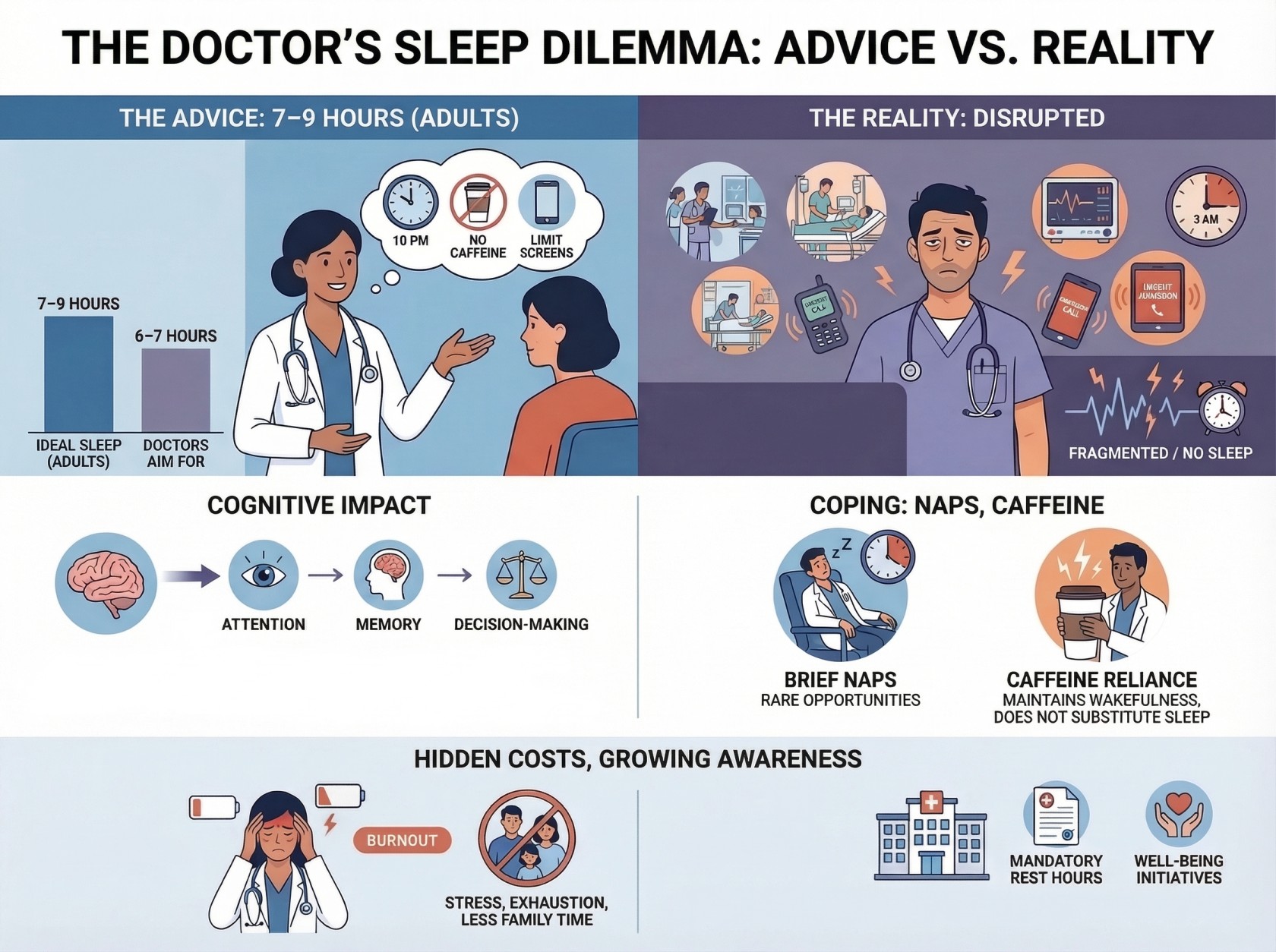
Every now and then you are reminded of the fact, through doctors' advice online or in-person, that improving sleep hygiene is the secret to good long-term health. You are asked to limit screen time, avoid caffeine late at night, and maintain consistent bedtimes. Doctors routinely offer this advice to patients. Yet behind hospital doors, the reality is often very different. To balance unpredictable schedules, emergency calls and critical patients, many physicians themselves struggle to get adequate sleep.
Ideally, they do try to aim for six to seven hours of sleep, which aligns with the general medical recommendation that adults should get 7-9 hours of sleep per night, according to sleep research published by the American Academy of Sleep Medicine. But in reality, clinical practice often interferes with that goal.
When On-Call Duties Disrupt Sleep
On-call duties can make sleep fragmented and sometimes even disappear entirely. Emergency admissions, deteriorating patients, or urgent procedures can interrupt their resting time adversely during the night. Some nights pass without sleep at all, particularly when critically ill patients arrive in the hospital during odd hours.
Despite all these hurdles, physicians continue working the next day. The consequences are not always immediately obvious. The doctors are not affected immediately; the adrenaline of a busy shift, the pace of hospital work, and the constant decision-making, patient consultations, and rounds keep them alert. It is only later on at the end of the day, that the accumulated fatigue becomes noticeable.
Also Read: Sleep Divorce Rising In India: Here's Why Couples Are Sleeping Apart By Choice
Why Sleep Matters For Clinical Decision-Making
Sleep is not just for comfort, but it is a fundamental aspect that determines cognitive function. A large volume of research from various clinical disciplines proves that sleep deprivation hampers attention, memory, and decision-making skills, all of which are of primary importance for medical professionals. Clinicians accept the fact that sleep deprivation may affect clinical decision-making, response times, and complex problem-solving skills.
Coping Mechanisms Doctors Use During Long Shifts
Yet over time most doctors have found ways to cope up with it. Short periods of rest whenever possible. A brief nap during a quiet moment between cases or during long hospital shifts can help restore alertness. Sadly, these opportunities are rare, especially in busy departments where patient flow remains constant.
Thus, making the doctors revert to another survival tool, which is caffeine. Coffee and tea often accompany physicians on their extended work shifts and thus play an important role in maintaining their wakefulness during overnight work. Though caffeine intake may temporarily increase wakefulness, according to experts who study sleep deprivation, it does not completely substitute for the benefits of actual sleep.
The Hidden Personal Cost Of Sleep Deprivation
Sleep deprivation also impacts physicians outside the hospital environment. Prolonged deprivation of sleep has been linked to stress, emotional exhaustion, and burnout. This is well documented in the medical literature. Occupational health research has also revealed that physicians who have irregular sleeping patterns tend to have higher levels of mental exhaustion and poor work-life balance.
However, most physicians believe that the pattern of irregular sleeping and wakefulness is due to the responsibilities that they have chosen for themselves. Patient care is their main priority. Though fatigue contributes to work stress, most physicians believe that it does not significantly impact their ability to function.
Still, sleep deprivation can also come at the cost of time with family, social engagement, or personal relaxation. To compensate, a few doctors make concerted efforts to guard tiny slivers of personal time. Working out, for example, is an especially popular tactic for staying physically and mentally strong. Family time is important for emotional recharge after long hours of duty.
Growing Awareness Around Doctors' Sleep And Well-Being
The importance of physician sleep and well-being has only recently begun to be recognized in healthcare systems around the globe. A number of hospitals have implemented structured rest and work hours that are mandatory for their residents and fellows. These changes are driven by growing evidence that the health of doctors and the safety of patients are improved when clinicians are well rested.
However, medical emergencies are unpredictable especially in high-stress functional areas, meaning that perfect sleep regimens are not realistic.
Also Read: 7 Hours 18 Minutes Of Sleep May Be The Ideal Sweet Spot For Blood Sugar Levels: Study
The Paradox Of World Sleep Day
It may be that the biggest paradox of World Sleep Day is the fact that the people who inform society of the need to get adequate sleep face the biggest challenge in getting adequate sleep themselves.
However, in spite of sleepless nights, disrupted sleep, and long hours of work, the doctor ensures proper attention to patients whenever the need arises, with consistency and commitment in spite of lack of sleep or no sleep at all.
This illustrates the point that sleep is not merely a matter of lifestyle; it is a biological imperative that applies across the board, including those in a position of protecting public health.
(By Dr. Basavaraj S Kumbar, Consultant- Internal medicine, Aster Whitefield Hospital, Bengaluru)
Disclaimer: The opinions expressed within this article are the personal opinions of the author. NDTV is not responsible for the accuracy, completeness, suitability, or validity of any information on this article. All information is provided on an as-is basis. The information, facts or opinions appearing in the article do not reflect the views of NDTV and NDTV does not assume any responsibility or liability for the same.