

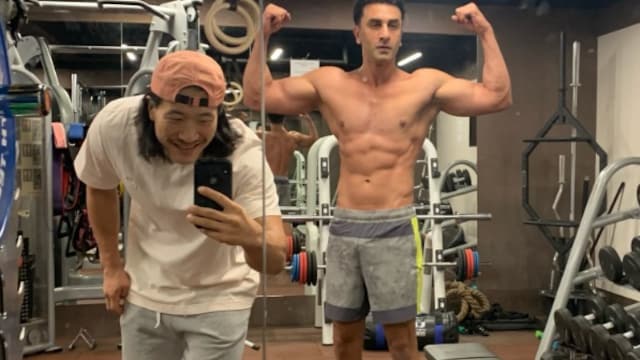
Ranbir Kapoor's latest fitness photograph shared by his trainer has put the spotlight on his transformation and the hard work behind building stronger arms. Ranbir Kapoor's trainer Korean fitness coach Nam, who goes by Training With Nam on Instagram recently shared a mirror selfie with Ranbir Kapoor offering a glimpse of Ranbir Kapoor's physique after months of rigorous training for his role as Lord Ram in Nitesh Tiwari's Ramayana. The photograph showcases Ranbir Kapoor flexing Ranbir Kapoor's biceps highlighting the muscle definition and upper-body development that Ranbir Kapoor has worked towards. "Saw the film last night and excited for everyone to witness this cinematic spectacle", Trainer Nam wrote in the caption. While achieving a physique like Ranbir's requires a structured fitness programme, adequate nutrition and time, building bigger and stronger arms does not necessarily mean spending hours lifting heavy weights. A well-planned workout targeting both the biceps and triceps, combined with progressive resistance training, can help improve arm size and strength. If you are looking to develop stronger, more defined arms, here are seven exercises worth incorporating into your workout routine.
7 Exercises To Build Bigger And Stronger Arms
Building bigger arms requires training two major muscle groups: the biceps, located at the front of the upper arm, and the triceps, which occupy the back of the upper arm. While biceps exercises help develop the familiar flexed-arm appearance, the triceps contribute significantly to overall arm size. Therefore, focusing exclusively on biceps curls may not deliver balanced arm development.
1. Dumbbell Biceps Curls
Dumbbell curls are among the most effective exercises for targeting the biceps. They allow each arm to work independently and can help address strength differences between the two sides. The most basic tip for the right form is to stand upright with a dumbbell in each hand and your palms facing forward. You don't need to open your elbows, rather keep them close to your torso. Then slowly curl the weights towards your shoulders. Lower the dumbbells in a controlled movement without swinging your body. 3 sets of 10-12 repetitions.
2. Hammer Curls
Hammer curls involve holding the dumbbells with your palms facing each other. This variation works the brachialis, a muscle underneath the biceps, along with the brachioradialis in the forearm.
Strengthening these muscles can contribute to fuller-looking upper arms and improved grip strength.Hold a dumbbell in each hand with a neutral grip, then keep your elbows close to your body. Curl the weights towards your shoulders without rotating your wrists and then slowly return to the starting position. You can try 3 sets of 10-12 repetitions.
3. Preacher Curls
Preacher curls isolate the biceps by supporting the upper arms against an angled bench. This reduces the tendency to use momentum and makes it easier to concentrate on the movement. Sit at a preacher curl bench and position your upper arms against the pad. Hold an EZ bar or dumbbells with a comfortable grip. Curl the weight towards your shoulders. Lower it slowly, maintaining control throughout the movement.
4. Triceps Pushdowns
The triceps are an important part of overall upper-arm development. Cable pushdowns target these muscles and allow you to work against consistent resistance throughout much of the movement. Stand facing a cable machine with a rope attachment. Keep your elbows close to your sides. Push the rope down until your arms are extended, and slowly return to the starting position without allowing your elbows to move excessively. Perform 3 sets of 10-15 repetitions.
5. Overhead Triceps Extensions
Overhead triceps extensions are great for working the triceps the long head. This part of the triceps crosses the shoulder joint. When you do this exercise with your arms raised overhead the muscle is stretched out. That means it gets a push during the movement.
To do it right, jus hold one dumbbell with both hands. Lift it straight up over your head. Keep your arms close to your head, don't let them move back or forward. Then bend your elbows slowly to lower the dumbbell behind your head. Pause just before your elbows are fully bent then push the weight up by straightening your elbows. Keep your core tight. Avoid swinging.
It's best to do this exercise with control. Don't rush the movement. Focus, on feeling the triceps work.
For results try 3 sets of 10 to 12 repetitions. If it's too easy you can increase the weight. If it's hard reduce the weight or do fewer reps. Always keep your form clean.
6. Close-Grip Push-Ups
Close-grip push-ups are a bodyweight exercise that place greater emphasis on the triceps than conventional push-ups. They also engage the chest and shoulders, making them an effective movement for building upper-body strength. To perform the exercise, start in a high plank position with your hands placed slightly narrower than shoulder width. Keep your body in a straight line from head to heels, bend your elbows, and lower your chest towards the floor in a controlled manner. Push yourself back up to the starting position while keeping your torso stable throughout the movement. Aim for 3 sets of 8 to 12 repetitions, depending on your fitness level.
7. Pull-Ups
Pull-ups are a compound exercise that primarily target the back muscles while also working the biceps and forearms. They are highly effective for improving pulling strength, grip strength, and overall upper-body development. To perform a pull-up, hold a pull-up bar with an overhand grip slightly wider than shoulder width and begin from a controlled hanging position. Pull your body upwards until your chin reaches the bar, then slowly lower yourself back to the starting position. Perform 3 sets of as many controlled repetitions as you can comfortably manage. If you are unable to complete a full pull-up, start with assisted pull-ups or resistance-band variations and gradually build strength.
How Did Ranbir Kapoor Train For Ramayana?
Ranbir's preparation for Ramayana involved more than conventional bodybuilding. In a July 2024 conversation with entrepreneur Nikhil Kamath, the actor spoke about how working with Nam had changed his approach to fitness. He revealed that he trained for approximately three hours a day, dividing his sessions between cardiovascular exercise, mobility work and strength conditioning. His morning routine included stretching, mobility exercises and cardio, while his evening sessions focused on strength training. The actor also discussed incorporating bodyweight movements such as pull-ups, squats and handstands into his routine. This approach highlights an important aspect of fitness: building a muscular physique is not just about lifting heavier weights. Mobility, cardiovascular fitness, functional strength and consistency also contribute to overall physical conditioning.
What Should You Keep In Mind While Training Your Arms?
Simply performing more biceps curls does not guarantee bigger arms. The quality of your training, the resistance you use and the time you allow your muscles to recover all matter.
1. Focus On Progressive Overload
Progressive overload involves gradually increasing the demands placed on your muscles as you become stronger. You can achieve this by increasing the weight, repetitions or number of sets over time. For instance, if you can comfortably perform 12 repetitions with a particular dumbbell, you may gradually increase the resistance while maintaining proper technique.
However, avoid increasing weights at the expense of form. Swinging your body or using momentum can reduce the effectiveness of an exercise and increase the risk of injury.
2. Give Your Muscles Enough Recovery Time
Muscles need time to recover after resistance training. Working your biceps and triceps intensely every day may not give them sufficient time to adapt. A practical approach is to train your arms twice a week, with adequate recovery between sessions. You can also incorporate arm exercises into your regular upper-body workouts.
Avoid strength training the same muscle groups on consecutive days.
3. Do Not Ignore Nutrition
Building muscle requires more than an effective workout. Your body needs adequate nutrition to support muscle repair, recovery and growth. Protein is particularly important because it provides amino acids required for muscle tissue maintenance and repair. Include protein-rich foods such as eggs, chicken, fish, dairy products, lentils and beans in your diet. Carbohydrates also have a role in supporting exercise performance, while healthy fats contribute to overall nutritional requirements.
Avoid extreme calorie restrictions if your primary goal is to build muscle. Maintaining a balanced diet and consuming sufficient calories can help support your training programme.
4. Prioritise Proper Technique Over Heavy Weights
Lifting heavier weights is not always better. Controlled movements, a comfortable range of motion and correct positioning are important for effective resistance training. Start with manageable resistance and gradually increase it as your strength improves. If an exercise causes pain, stop rather than attempting to push through it. Beginners can consider working with a qualified fitness trainer to learn the correct technique. Ranbir Kapoor's transformation for Ramayana offers a reminder that building a stronger physique requires discipline, consistency and a well-rounded approach to fitness. You do not need to follow a celebrity's three-hour workout routine to develop stronger arms. A structured resistance-training programme, exercises targeting both the biceps and triceps, adequate protein intake and sufficient recovery can help you make progress.
Start with manageable weights, focus on technique and increase the intensity gradually. Remember, building bigger arms is a long-term process, not an overnight transformation.
Disclaimer: This content including advice provides generic information only. It is in no way a substitute for a qualified medical opinion. Always consult a specialist or your own doctor for more information. NDTV does not claim responsibility for this information.