

)
Rajkummar Rao turns 42 and ihe is known for going to great lengths to transform himself for his film roles. From gaining weight for a character to shedding it within a short period, the actor has repeatedly undergone dramatic physical transformations for his work. In 2017, Rao gained around 13 kg for the web series Bose: Dead/Alive, in which he portrayed freedom fighter Subhas Chandra Bose. But soon after completing the project, he reportedly lost 10 kg in just one month for Fanney Khan, which released in 2018. Speaking to media in 2017, Rao opened up about how he approached the weight-loss process. "I always knew I would have to lose the excess weight after the show," he said. The actor also revealed that he had "stopped having breakfast and lunch". Describing his diet and exercise routine, he said, "I directly have dinner, which is essentially a meal high in protein. Since I am constantly working, the hunger pangs don't hit me as hard. As far as my workout is concerned, I am doing cardio and strength training for at least three hours every day." While such transformations may be necessary for an actor preparing for a role, they also raise an important question: Can losing 10 kg in a month be healthy, or is such rapid weight loss too extreme for most people?
Is Losing 10 Kg In A Month Safe?
According to Dr Aparna Govil Bhasker, Bariatric, Laparoscopic and Hernia, Weight Loss Surgeon, MetaHeal Clinic, Mumbai, the number on the weighing scale alone cannot determine whether rapid weight loss is healthy. "Celebrity weight-loss transformations often attract attention, especially when a significant amount of weight is lost within a short period. Losing around 10 kg in a month is certainly rapid, but whether it is healthy cannot be judged by the number on the weighing scale alone. The safety of any weight-loss programme depends on several factors the person's starting weight and BMI, body composition, medical conditions, nutritional intake, physical activity, and whether the process is being undertaken under professional supervision. Someone with severe obesity, for example, may lose weight much faster during the initial phase of a structured medical weight-loss programme than someone who is only mildly overweight," Dr Bhaskar adds.
This distinction is important because the same amount of weight loss can have very different implications depending on a person's starting weight, health status and method of weight loss.
Rapid Weight Loss Is Not Always Fat Loss
A sudden drop on the weighing scale does not necessarily mean that the body has lost an equivalent amount of fat. Dr Bhasker explains, "It is also important to understand that rapid changes on the weighing scale do not necessarily represent loss of body fat alone. Particularly during the first few weeks of dietary restriction, some of the reduction may come from loss of glycogen and the water associated with it. If protein intake and resistance exercise are inadequate, there may also be undesirable loss of muscle mass."
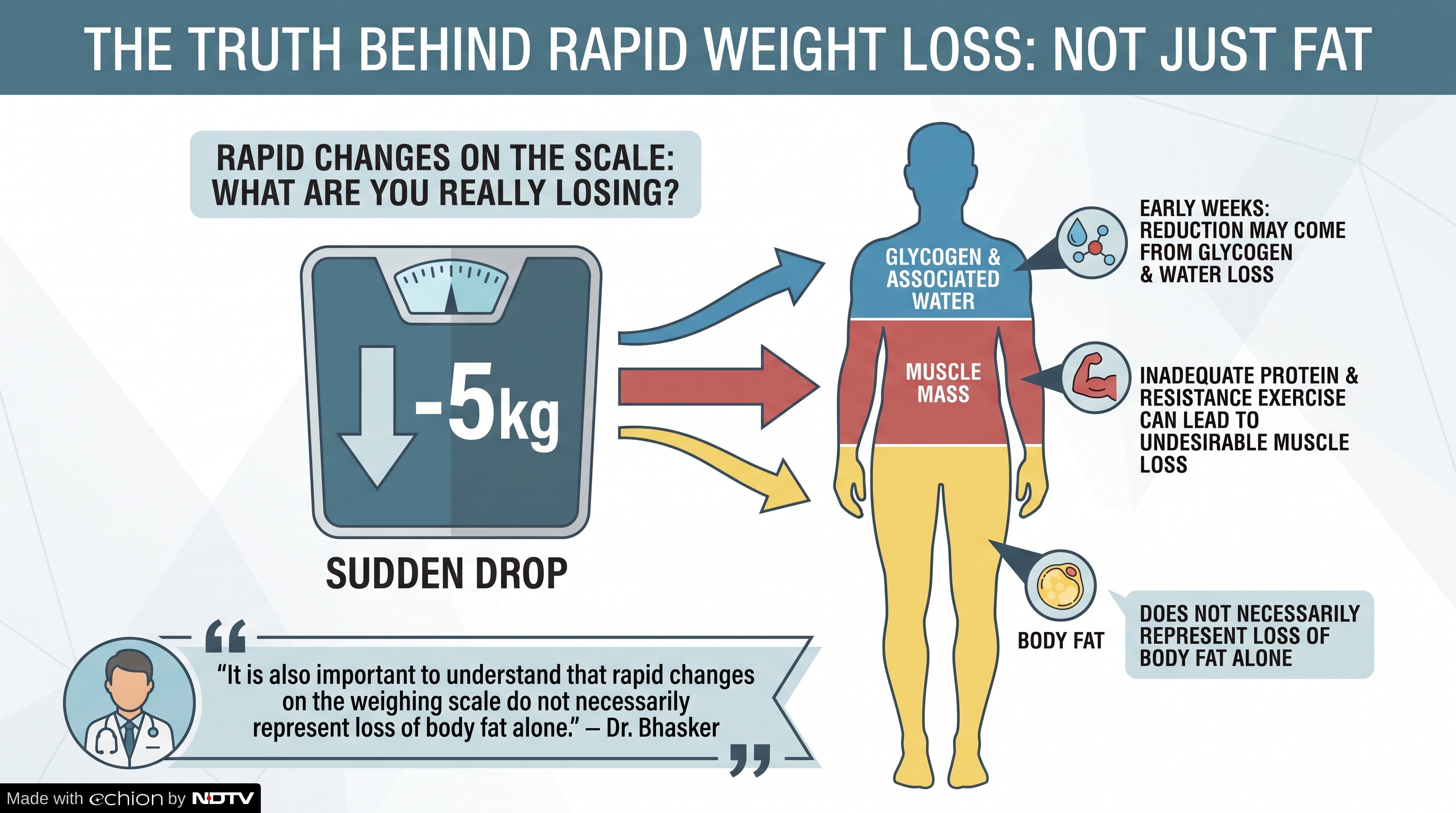
Glycogen is the stored form of carbohydrate in the body. When food intake, particularly carbohydrate intake, falls sharply, glycogen stores can decrease. Since glycogen is stored along with water, some of the initial weight reduction may therefore reflect changes in water and glycogen rather than body fat. This is one reason why a dramatic change in body weight over a few weeks should not automatically be interpreted as successful fat loss.
Can Extreme Dieting Cause Problems?
Rapid weight loss can be medically appropriate in certain situations, but the method used matters. "This does not mean that rapid weight loss is always harmful. In selected individuals, medically supervised low-calorie or very-low-calorie diets may be used for specific indications and can produce substantial short-term weight loss. Similarly, patients undergoing bariatric surgery often lose weight relatively rapidly in the early postoperative months," says Dr Bhasker.
"The important distinction is that these approaches are structured, nutritionally planned and monitored rather than being based on unsupervised crash diets."
Problems can become more likely when someone tries to replicate a celebrity transformation through extreme calorie restriction, prolonged fasting or an inadequately planned diet. Dr Bhasker adds, "Problems are more likely to arise when rapid weight loss is achieved through extreme calorie restriction, prolonged fasting or nutritionally inadequate diets. In such situations, inadequate intake of protein, vitamins, minerals and electrolytes can lead to fatigue, weakness, headaches, constipation, muscle cramps, poor concentration and loss of lean muscle mass. Hair fall can also occur, particularly when rapid weight loss is accompanied by inadequate protein or micronutrient intake."
Rapid Weight Loss May Increase Gallstone Risk
There is another potential complication that is often overlooked when people focus only on the number of kilograms lost. Dr Bhasker says, "Another recognised concern is gallstone formation. Rapid weight loss increases the risk of developing gallstones, particularly in susceptible individuals. Gallstones may remain asymptomatic, but in some people they can lead to biliary pain, acute cholecystitis or even pancreatitis." Gallstones are hardened deposits that can form inside the gallbladder. While they may cause no symptoms in some people, they can occasionally block the bile ducts and lead to significant pain or inflammation.
This is another reason why attempting to lose large amounts of weight in a very short period without medical supervision may not be advisable.
How Much Weight Should You Aim To Lose Per Week?
For most adults attempting weight loss through lifestyle changes, a gradual approach is generally more sustainable. "For many adults trying to lose weight through lifestyle measures, a gradual loss of approximately 0.5-1 kg per week is generally considered a reasonable and sustainable target," says Dr Bhasker. However, this should not be interpreted as a rigid rule for everyone. "There is no single ideal rate that applies to everyone. People with a higher starting body weight may lose considerably more during the initial weeks, while others may progress more slowly," she adds.
The appropriate pace depends on factors such as starting weight, body composition, dietary intake, physical activity, medical conditions and whether the person is receiving professional supervision.
What Matters More Than The Number On The Scale?
Weight loss should ideally be assessed beyond the weighing scale. Dr Bhasker says, "More important than simply asking 'How many kilograms did I lose?' is asking: Was the weight loss predominantly fat rather than muscle? Was my nutrition adequate? Can I sustain this approach? And is my overall health improving?"
This is particularly important when rapid weight loss is accompanied by intensive exercise. Combining severe calorie restriction with several hours of daily training can increase the risk of inadequate recovery and loss of lean tissue if nutrition is not properly managed. Preserving muscle through adequate protein intake and resistance training is an important part of healthy weight management.
Should You Try To Copy A Celebrity Weight-Loss Transformation?
Celebrity transformations can be impressive, but they should not automatically become fitness goals for the general public. Actors may have specific professional deadlines, access to trainers and nutritionists, and medical supervision that the average person does not. More importantly, the starting point and health needs of each individual are different.
Dr Bhasker says, "A celebrity transformation therefore should not become a template for individual weight loss. Losing 10 kg in a month may be appropriate in certain carefully selected and medically supervised circumstances, but trying to reproduce such results through extreme or unsupervised dieting can carry significant risks." Rajkummar Rao's reported 10-kg weight loss in a month highlights just how dramatically actors may transform their bodies for demanding roles. However, what works for a celebrity preparing for a specific project may not be appropriate for someone trying to lose weight for general health.
Rapid weight loss is not automatically dangerous, but losing a large amount of weight quickly requires careful consideration of nutrition, muscle preservation, medical health and the method being used. As Dr Bhasker puts it, "The goal should not be the fastest possible weight loss, but safe, nutritionally adequate and sustainable weight loss that preserves muscle and improves metabolic health."
Disclaimer: This content including advice provides generic information only. It is in no way a substitute for a qualified medical opinion. Always consult a specialist or your own doctor for more information. NDTV does not claim responsibility for this information.