

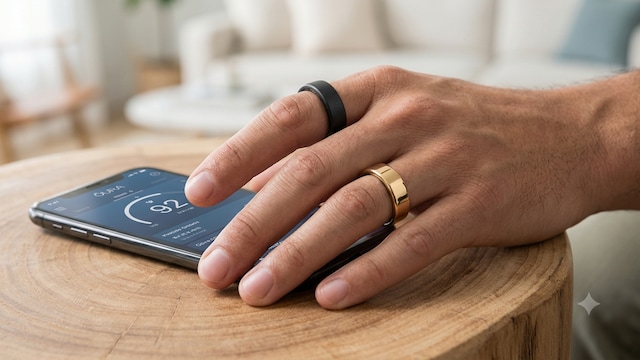
Smart ring maker Oura has introduced two new fitness metrics, Cardio Effort and VO2 max, to help users understand how their workouts affect cardiovascular health and long-term fitness. The new features expand the company's workout tracking capabilities beyond exercise duration and heart rate zones, offering users more insight into workout intensity, training progress and recovery needs. The update comes as competition in the smart ring market intensifies, with brands such as RingConn and Ultrahuman challenging Oura's position. By introducing more advanced fitness measurements, Oura aims to help users understand not just how much they exercise, but also how their bodies respond to physical activity. While Cardio Effort measures the cardiovascular demands of individual workouts and cumulative weekly activity, VO2 max provides an estimate of aerobic fitness. Together, the metrics are designed to help users assess whether their exercise routine is maintaining fitness, improving endurance or potentially placing too much strain on the body.
What Is Oura's New Cardio Effort Feature?
Oura's Cardio Effort feature measures how demanding a workout is on the cardiovascular system, taking into account both exercise intensity and duration. Rather than focusing solely on the number of minutes spent exercising, the feature helps users understand the overall cardiovascular effort involved. For instance, a shorter, high-intensity workout may produce a similar Cardio Effort score to a longer session performed at a lower intensity. According to the company, the metric is designed to answer a more useful fitness question: whether a person is maintaining their current fitness level, building it or potentially overdoing their training. Cardio Effort includes two components:
1. Workout Cardio Effort: This measures the cardiovascular demand of an individual workout, helping users understand how hard their bodies worked during a particular session.
2. Weekly Cardio Effort: This combines activity across the week to provide a broader picture of training load. Users are assigned categories ranging from Light and Fair to Maintaining, Building and Reaching.
Oura calculates elevated heart rate relative to each user's long-term resting heart rate rather than relying solely on estimates of maximum heart rate. Weekly effort categories are then determined using personalised ranges based on recent activity patterns. This approach is intended to make workout feedback more relevant to individual users, whose fitness levels and responses to exercise may differ.
What Is VO2 Max And Why Does It Matter?
VO2 max refers to the maximum amount of oxygen the body can use during intense exercise relative to body weight. It is commonly expressed in millilitres of oxygen per kilogram of body weight per minute (ml/kg/min). The measurement is an important indicator of cardiorespiratory fitness because it reflects how effectively the heart, lungs, blood and muscles work together to deliver and utilise oxygen during physical activity. A higher VO2 max generally indicates a greater capacity for sustained aerobic exercise, although the interpretation depends on factors such as age, sex, training status and the method used to measure it. VO2 max is relevant to activities such as running, cycling, swimming and other forms of endurance exercise. Tracking changes over time can help people understand whether their aerobic fitness is improving in response to training. However, VO2 max is only one measure of fitness. It does not independently establish overall health or diagnose a medical condition.
How Does Oura Estimate VO2 Max?
Traditionally, VO2 max has been measured in a laboratory using specialised equipment during progressively more demanding exercise. Some consumer fitness devices also estimate aerobic fitness using walking tests or exercise data. Oura's new feature estimates VO2 max passively using GPS-enabled workouts. According to the company, users receive an initial estimate after completing five qualifying activities. The feature is available through the My Health Heart Hub, where users can view:
- Their estimated VO2 max in ml/kg/min.
- Their fitness category, classified as Low, Fair, High or Peak.
- Changes in their estimated VO2 max over time.
- The date on which the estimate was last updated.
Insights highlighting meaningful changes or a relatively stable fitness trend. These insights can help users assess their longer-term progress rather than relying on individual workout scores. It is important to remember that a wearable's VO2 max reading is an estimate, not necessarily equivalent to a laboratory measurement. Its accuracy can depend on the underlying algorithm, the quality of the workout data and the activities used to generate the estimate.
Can Cardio Effort Help You Avoid Overtraining?
Monitoring exercise intensity and cumulative training load can help people make more informed decisions about their workouts. For example, someone who regularly performs demanding sessions may benefit from recognising when their weekly cardiovascular effort has increased substantially. This information can prompt them to consider whether they need additional recovery time or a more balanced training schedule. However, Cardio Effort should not be treated as a definitive measure of overtraining. Training needs depend on several factors, including exercise intensity, strength-training volume, sleep, nutrition, recovery and an individual's fitness level. Persistent fatigue, declining performance, disrupted sleep or recurring injuries may indicate that a training programme needs adjustment. A wearable can provide useful context, but it cannot replace an assessment of symptoms and recovery needs. Oura's addition of Cardio Effort and VO2 max gives users more ways to understand the relationship between exercise intensity, weekly training load and aerobic fitness. Cardio Effort focuses on the cardiovascular demands of workouts, while VO2 max offers an estimate of long-term cardiorespiratory fitness. Used together, these measurements may help users monitor training trends and make more informed decisions about physical activity. However, wearable metrics should be interpreted as guidance rather than definitive measures of health. Consistent exercise, adequate recovery, balanced nutrition and attention to how the body feels remain essential components of a sustainable fitness routine.
Disclaimer: This content including advice provides generic information only. It is in no way a substitute for a qualified medical opinion. Always consult a specialist or your own doctor for more information. NDTV does not claim responsibility for this information.