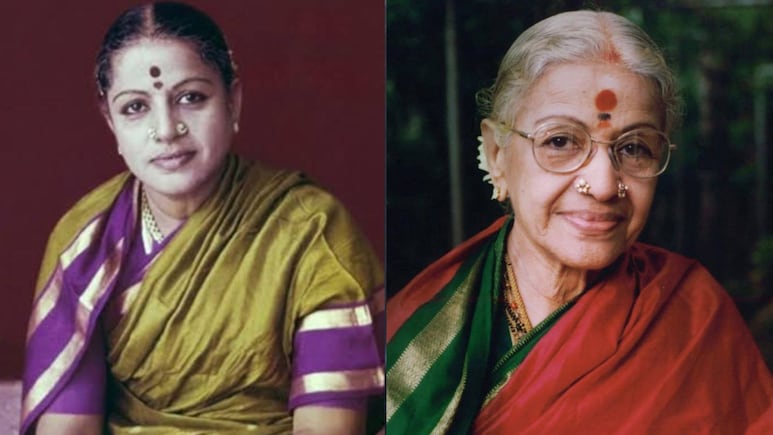
It was legendary Carnatic singer MS Subbulakshmi's 110th birth anniversary yesterday, September 16. In the evening, an emotional Rashmika Mandanna, dressed in a blue saree, attended an event at Chennai's Music Academy, where she expressed her happiness at getting the opportunity to portray the iconic singer's life on screen. A biopic on MS Subbulakshmi, titled MS - A Legacy On Screen, was officially announced.
A legacy indeed. Subbulakshmi was born on September 16, 1916, in Madurai. She grew up in a family deeply connected to classical music. Her mother, Madurai Shanmukhavadivu, was a veena player, while her grandmother, Akkammal, played the violin. Subbulakshmi started learning music from her mother when she was very young. She grew up surrounded by Carnatic music.
Britannica reported that Subbulakshmi belonged to the Isai Vellalar community, which had a long tradition of musicians and dancers, including women from the Devadasi tradition. Following a custom associated with the Devadasi tradition, Subbulakshmi used her mother's name, Madurai Shanmukhavadivu, giving her the initials MS.
A Musical Journey That Began At Home
It was not just about learning, as Subbulakshmi's musical talent became evident very early in her life. As reported by Britannica, Subbulakshmi recorded her first song when she was just 10 years old. On the other hand, The Hindu mentioned that she gave her first stage performance when she was 13.
By the time she moved to Madras, now Chennai, in 1936, Subbulakshmi had successfully established herself as a promising Carnatic vocalist.
Her career reached another important milestone when she performed at the Madras Music Academy in 1933. Reportedly, she became the first woman to sing at the Academy's annual conference.
Life After Moving To Madras, Now Chennai
Subbulakshmi moved to Madras in 1936, when she was around 20 years old. The Caravan reported that she sought the help of T Sadasivam, whom she had met earlier during a visit to Madras. Sadasivam was associated with the Tamil magazine Ananda Vikatan and was also involved in the Indian independence movement.
According to the same portal, Sadasivam was married when Subbulakshmi came to stay with him. The two eventually got married in July 1940, after the death of Sadasivam's wife. Their relationship went on to have a major influence on Subbulakshmi's professional life.
It was Sadasivam who played an important role in managing her career, with devotional compositions becoming an increasingly significant part of her work.
Work In Films
Subbulakshmi did not confine herself to singing and also ventured into acting. She entered films with Sevasadanam in 1938 and went on to appear in movies including Sakuntalai, Savitri, and Meera. However, she did not spend a lot of time in films. With time, she stepped away from the cinema to devote herself fully to music again.
Among her film appearances, Meera became especially important to Subbulakshmi's career. She played the 16th-century saint-poet Mirabai in the 1945 Tamil film, which was later remade in Hindi and released in 1947.
Her portrayal also earned admiration from prominent figures of the time. According to The Caravan, Sarojini Naidu bestowed upon Subbulakshmi the title of 'Nightingale of India' after her performance as Meera. After Meera, Subbulakshmi left the cinema behind and concentrated on her musical career.
Subbulakshmi's Musical Evolution Over The Years
Subbulakshmi's music evolved over the years. Her early performances showed her technical command of Carnatic music, including fast-paced musical phrases known as brigas. As her career progressed, devotional music became an integral part of her repertoire.
She performed compositions associated with some of India's most celebrated poets, saints, and composers, including Tyagaraja, Tulsidas, Kabir, Rabindranath Tagore, and Annamacharya. Her devotional recordings also helped her reach listeners beyond traditional Carnatic music audiences.
Taking Carnatic Music To The World
Subbulakshmi played an important role in introducing Carnatic music to international audiences, taking it beyond India. As reported by Britannica, she performed at the Edinburgh International Festival in 1963 and at the United Nations in New York in 1966. She later performed at Carnegie Hall in 1977 and London's Royal Albert Hall in 1982.
Her United Nations performance remains one of the major milestones of her career. She performed Maitreem Bhajata, a Sanskrit benediction composed by Chandrasekharendra Saraswati, the Kanchi Paramacharya.
When Jawaharlal Nehru Called Her The 'Queen Of Music'
Subbulakshmi's admirers included some of India's most prominent political figures. According to Britannica, after hearing her perform at an event in New Delhi in the late 1950s, then Prime Minister Jawaharlal Nehru reportedly described himself as merely a prime minister in the presence of a 'queen of music'. He said, "Who am I, a mere prime minister before a queen, a queen of music."
The Hindu also noted that Mahatma Gandhi, Jawaharlal Nehru and C Rajagopalachari were among the prominent leaders who admired her as a vocalist.
A Career Filled With Historic Honours
Subbulakshmi received several prestigious honours during her decades-long career. In 1968, she became the first woman musician to receive the Sangita Kalanidhi title from the Music Academy, Chennai, according to The Hindu.
Her honours also included the Padma Bhushan, Padma Vibhushan, Ramon Magsaysay Award, and several honorary degrees. One of the greatest recognitions came in 1998, when she was awarded the Bharat Ratna, India's highest civilian honour.
Music That Went Beyond The Stage
For Subbulakshmi, music was also a means to support social causes. According to Britannica, she performed more than 200 benefit concerts during her lifetime and helped raise money for a number of charitable and social institutions.
The Hindu reported that her first charity concert was held for the Kasturba Memorial Fund in 1944. Over the years, crores of rupees raised through her concerts and recordings benefited organisations and institutions, including Sankara Nethralaya, the Cancer Institute, Tirumala Tirupati Devasthanams, and several other causes. Her philanthropic work became an important part of the legacy she built alongside her music.
A Legacy That Went Far Beyond Carnatic Music
MS Subbulakshmi's journey took her from a musically rich childhood in Madurai to some of the world's most prestigious stages. She broke barriers for women in classical music, found nationwide fame through cinema, took Carnatic music to international audiences, and used her success to support charitable causes. She died at the age of 88 in 2004.
Now, A Biopic
Rashmika Mandanna is set to essay the role of MS Subbulakshmi in the biopic, which was announced on September 16 in Chennai. Rashmika and the film's team also met Subbulakshmi's family. Gowtam Tinnanuri will direct the biopic, while Anirudh Ravichander will compose the music.
Also Read: Viral Video: Rashmika Mandanna Meets MS Subbulakshmi's Family After Biopic Announcement
