





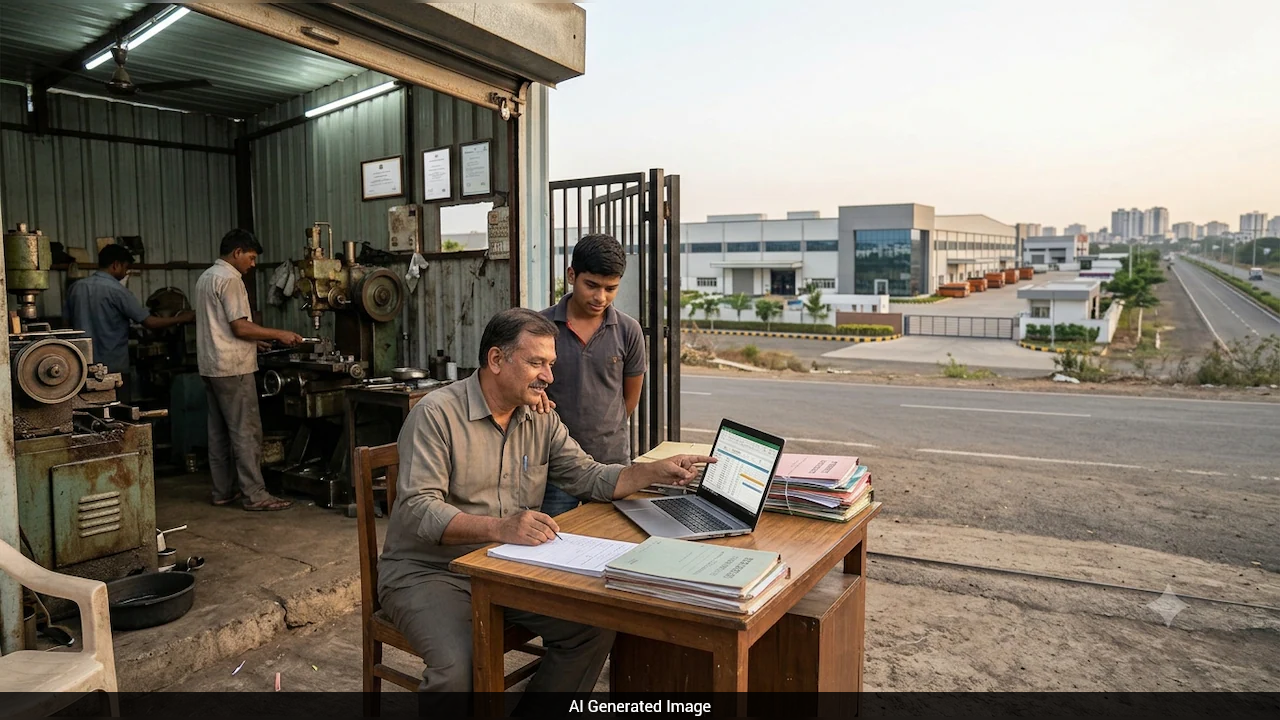
India wants millions of small businesses to become global exporters. But before they can think about selling overseas, many entrepreneurs are spending too much time and money simply getting their businesses off the ground.
That, in essence, is one of the strongest messages emerging from a recent NITI Aayog report, 'Boosting Exports from MSMEs', prepared in collaboration with the Foundation for Economic Development (FED). The report argues that India's export ambitions are being undermined by something far more basic than global competition -- the high cost and complexity of starting and running a business.
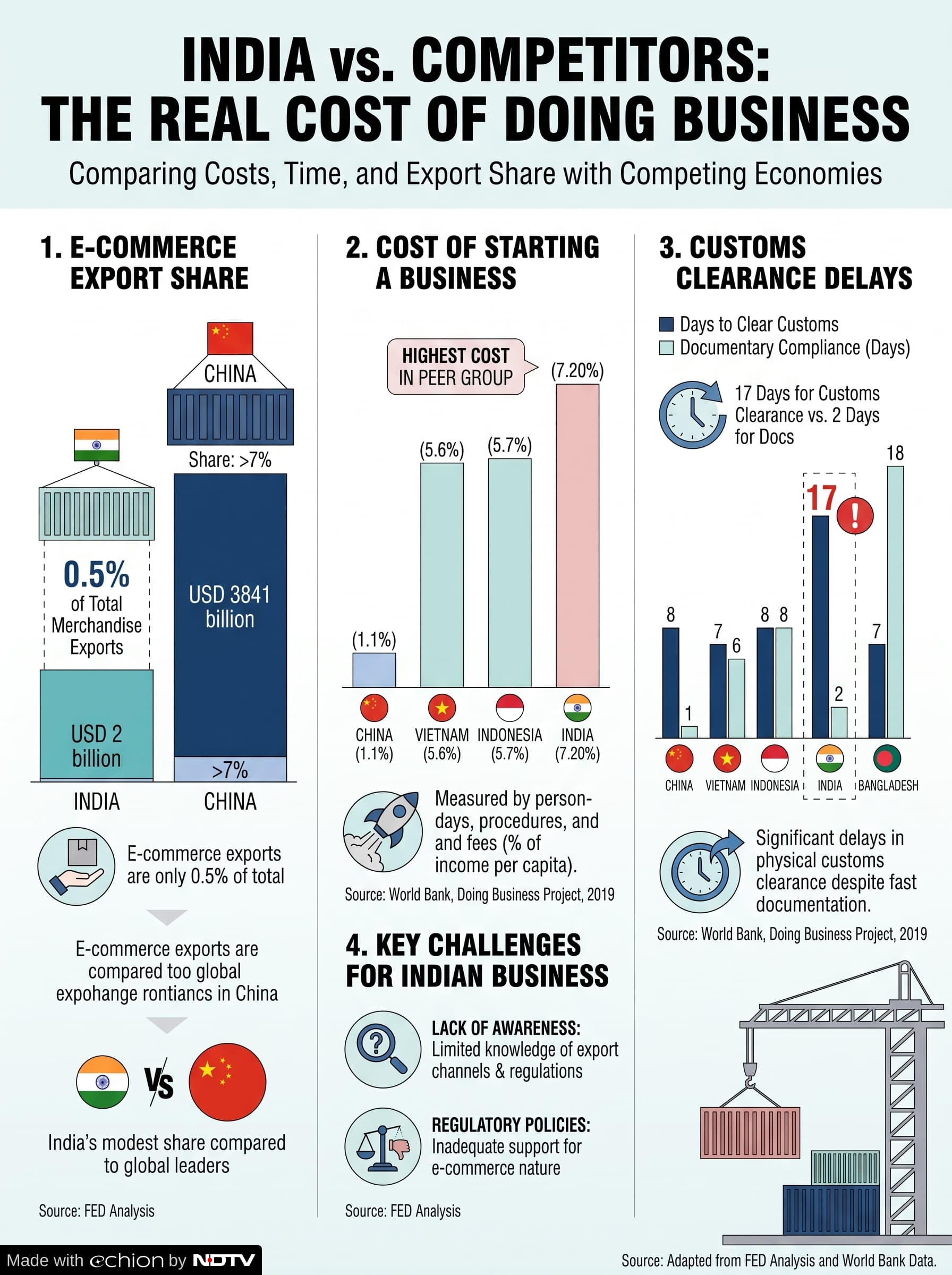
The report compares India with several competing manufacturing destinations, including China, Vietnam, Bangladesh and Indonesia. The findings are uncomfortable.
Also Read | Layoffs Are Rising In Tech, But These Skills Are Helping People Unlock Better Pay
According to data cited in the report, the cost of starting a business in India, measured as a percentage of income per capita, is significantly higher than in most competing economies. While countries like Vietnam and China have steadily reduced entry barriers for entrepreneurs, India's compliance burden remains relatively expensive, making it harder for small manufacturers to formalise and scale.
The problem goes beyond registration fees.
Manufacturers must navigate multiple registrations, licences, tax requirements, environmental approvals, labour compliances and factory regulations. Each step often involves different government agencies, documentation and procedural delays. For a large company, these are operational costs. For a small enterprise, they can become growth barriers.
Rahul Ahluwalia, Founder-Director of the Foundation for Economic Development, says the issue is reflected in global enterprise surveys as well.
"The World Bank Enterprise Survey, which speaks to firms, shows that in India businesses spend substantially more time dealing with licences, permits and other regulatory compliances than in other competing nations. For example, 14 percent of businesses in India cite permits as a constraint compared to 1.8 percent in Vietnam and 1.4 percent in China. Until we make the Indian ecosystem as smooth for businesses as it is in competing countries, MSMEs in particular will struggle, because they lack the resources to navigate the regulatory maze."
The NITI report echoes this concern. It notes that entrepreneurs must obtain multiple no-objection certificates, permissions and approvals before commencing operations. Compliance failures can also expose promoters to personal liability, increasing the risks associated with starting a business.
'India Can't Follow China's Model'
However, not everyone believes India should simply replicate the business models of China or Vietnam.
VP Singh, Professor of Economics at Great Lakes Institute of Management, Gurgaon, argues that comparisons should take into account India's democratic framework.
"While there is no denying that labour laws, property rights and bureaucratic processes in India need reforms, India's growth story, investment climate and regulatory frameworks can't be compared with countries like Vietnam and China. India is a flourishing democracy while the other two have strong autocratic governance."
He points to episodes such as the rollback of the Land Acquisition Ordinance and the repeal of the three farm laws as examples of how public consultation shapes policymaking in India. According to Singh, India has also begun addressing procedural delays through initiatives such as the National Single Window System (NSWS), a digital platform designed to streamline approvals and clearances for investors. But he adds that India's regulatory framework inevitably reflects a balance between protecting citizens' rights and promoting industrial growth.
This balance, he says, may sometimes make India's investment climate appear slower than authoritarian economies, but it is also a defining feature of the country's democratic institutions.
India's Ease of Doing Business
The report argues that reducing regulatory friction is not merely about improving India's Ease of Doing Business rankings. It is about making Indian products more competitive globally.
MSMEs typically operate with limited capital and manpower. Every additional licence, delay or compliance requirement increases their costs before production even begins. Those costs eventually affect pricing, competitiveness and the ability to enter export markets.
India currently has roughly 6.4 crore MSMEs, but only a tiny fraction participate in exports, despite the sector contributing nearly 45 per cent of the country's exports. Unlocking more exporters, the report argues, requires making business creation easier rather than relying solely on subsidies.
Roadmap To Boost Exports
Beyond lowering compliance costs, the report proposes a broader roadmap to boost MSME exports. Among its key recommendations:
- Create a single AI-enabled information portal where exporters can find details on tariffs, paperwork, incentives, finance and overseas markets.
- Expand e-commerce exports by simplifying regulations for small sellers.
- Improve access to export finance and increase the adoption of Export Credit Guarantee Corporation (ECGC) schemes.
- Build a unified export credit marketplace to lower financing costs.
- Integrate government databases to accurately measure MSME exports and design better policies.
- Continue reducing the procedural burden associated with merchandise exports.
The report's central argument is straightforward. India does not necessarily need more subsidies to create export champions. It first needs to make entrepreneurship cheaper, simpler and faster. Because if starting a business remains more expensive than in competing economies, many MSMEs may never reach the point where exporting even becomes an option.
Track Latest News Live on NDTV.com and get news updates from India and around the world

