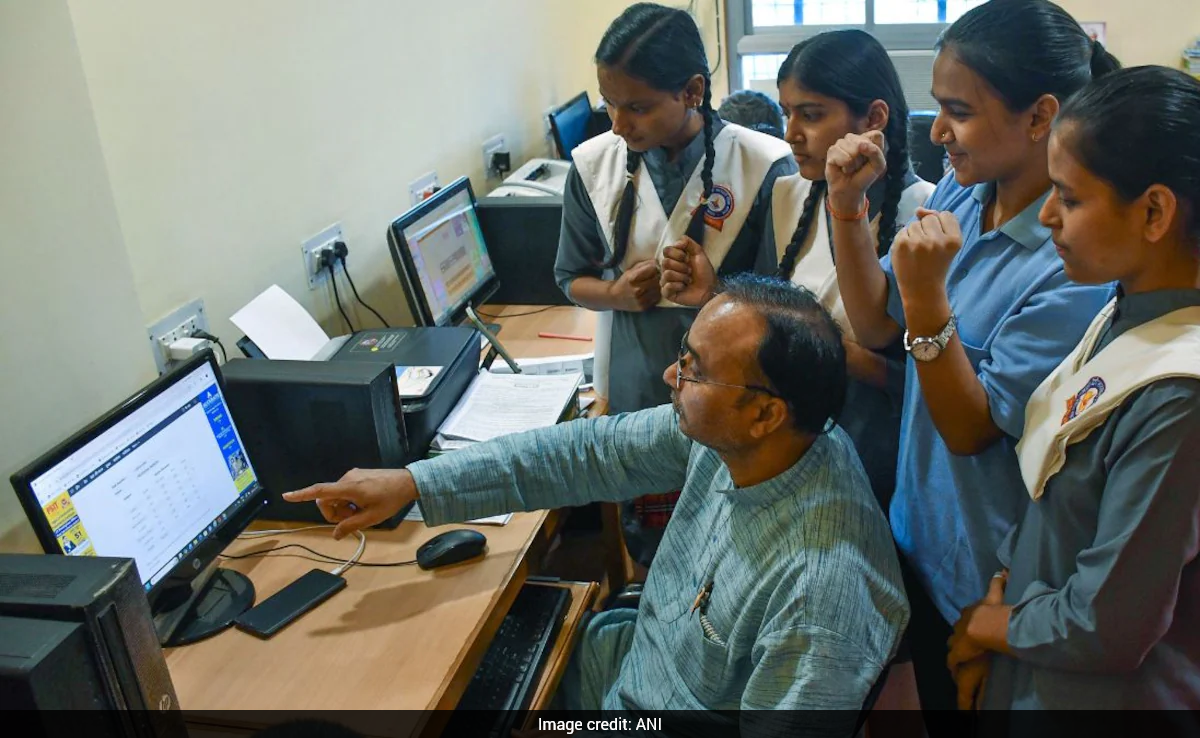

The NITI Aayog 2026 report, titled 'School Education System in India: Temporal Analysis and Policy Roadmap for Quality Enhancement', has highlighted that India has made substantial progress in school infrastructure, including electricity, rollout of computers, internet connectivity, and smart‑class facilities. However, regional disparities persist.
Improvements at the national level coexist with significant regional divergence: more than one-third of schools still lack computers, over one-third of schools still remain without internet connectivity, and nearly seven out of ten schools still lack smart classrooms.
Availability Of Functional Computers
Access to functional computers is a key enabler of technology-integrated learning and digital skill development. As per the official data, the availability of computers in schools has expanded steadily over the last decade. Nationally, the share of schools with functional computers increased from 26.42 per cent in 2014-15 to 64.7 per cent in 2024-25.
The study has shown that the availability of computers in schools has reached full coverage in Lakshadweep (100%), and is virtually universal in Delhi (99.9%), Puducherry (99.5%), Chandigarh (99.5%), Kerala (99.5%), and Punjab (99%).
At the other end, the lowest current levels are recorded in Meghalaya (19.7%), West Bengal (25.1%), Bihar (25.2%), Manipur (38.0%), Jammu and Kashmir (43.1%), and Arunachal Pradesh (47.7%).
The report has highlighted that overall, the decade marks a rapid expansion of computer facilities across most states. Yet, more than one-third of schools still lack computers, and wide interstate disparities persist.
Internet Connectivity In Schools
Internet access is an essential component of digital infrastructure, enabling access to online content, educational platforms, and ICT-based learning. The past decade has witnessed a sharp expansion in internet connectivity within schools, as per the report. Starting from a very low level of 8.05 per cent in initial years, nearly two-thirds (63.5%) of schools reported having access to internet facilities in 2024-25. Despite this, over one-third of schools still remain without connectivity.
Interestingly, Karnataka, the country's leading IT hub, has only about half of its schools (50.7%) connected to the internet, reflecting a stark contrast between the state's global digital profile and its basic educational infrastructure.
Functional Smart Classrooms
Smart classrooms are digitally enabled teaching spaces that integrate tools such as projectors, interactive whiteboards, audio-visual content, and access to e-resources. According to the document, the spread of smart classrooms in schools has accelerated in recent years. It has reached from 14.9 per cent in 2021-22 to 30.6 per cent in 2024-25.
However, nearly seven out of ten schools still lack smart classrooms. The highest levels are reported in Chandigarh (95.2%), Lakshadweep (86.1%), Punjab (80.1%), Delhi (75.7%), and Puducherry (72.5%).
On the other hand, the lowest levels are observed in Meghalaya (4.3%), West Bengal (5.7%), Mizoram (11.3%), Jharkhand (14.8%), Bihar (14.9%), Jammu and Kashmir (16.5%), Manipur (18.6%), Madhya Pradesh (19.6%), and Uttar Pradesh (19.8%).
The NITI Aayog's 2026 report has pointed out that improvements at the national level coexist with significant regional divergence across infrastructure and digital indicators. Addressing these will require geographically differentiated strategies rather than uniform provisioning approaches.
